

A lip balm sits on your lips and protects them. A lip oil sinks in, softens and adds a glassy finish. If your lips are sensitive or eczema-prone, you rarely have to pick one. You choose each for its job, read the label carefully, and layer them. Our Petal Perfect Lip Oil™ is made for the oil step of that ritual, with clean, plant-based ingredients designed for sensitive skin.
Key Takeaways
- A balm is built around wax and occlusives that seal in moisture and shield the lips. An oil is lighter, slicker and more cosmetic, with plant oils that soften.
- Oils on their own are not humectants, so for dry, dehydrated lips, many dermatologists suggest applying oil over a balm.
- For sensitive lips, the label matters more than the format: fragrance, flavoring, menthol and camphor are the usual troublemakers.
- Any lip product can protect from the sun if it is formulated with SPF 30 or higher. Check the label, because most oils have none.
- Stop using any lip product that burns, stings or tingles.
Table of Contents
- The real difference between lip oil and lip balm
- Hydration and protection: what each one really does
- Reading the label when your lips are sensitive
- Do lip oil and lip balm protect from the sun?
- When to use oil, when to use balm, and how to layer them
- Our perspective
- Bring the ritual home
- FAQ
The real difference between lip oil and lip balm
I like to think of lips as skin with no oil glands of its own and a very thin protective layer. That is why they dry out so quickly, and why what you put on them matters so much.
Texture and finish. A lip balm is typically a waxy or buttery stick, tin or tube. You swipe it on directly, and it feels thicker and more matte or satin. A lip oil is a lightweight liquid, usually with a wand applicator, that leaves a glossy, sheer sheen without the stickiness many people associate with gloss.
Ingredients. Balms are built on waxes and occlusives, which are ingredients that form a seal over the skin. Common ones include beeswax, petrolatum, shea butter and cocoa butter. Oils are built on plant oils such as rosehip, jojoba and argan. Those soften and add slip, and they carry a little color or shine.
Job. In the words of one dermatologist quoted in Bustle, lip oils create a barrier that seals in moisture but are not humectants, meaning they do not draw water into the skin. The same piece notes that balms contain wax that acts as an occlusive, plus proven moisturizing ingredients. Put simply: a balm protects and holds, an oil nourishes and polishes.
| Lip balm | Lip oil | |
|---|---|---|
| Feel | Thicker, waxy or buttery | Light, slippery, glossy |
| Main strength | Protection and sealing | Softening and shine |
| Typical base | Wax, butters, petrolatum | Plant oils |
| Application | Stick, tin or tube | Wand or doe-foot applicator |
| Best moment | Before bed, outdoors, in cold or wind | Daytime comfort, over balm, for glow |
Hydration and protection: what each one really does
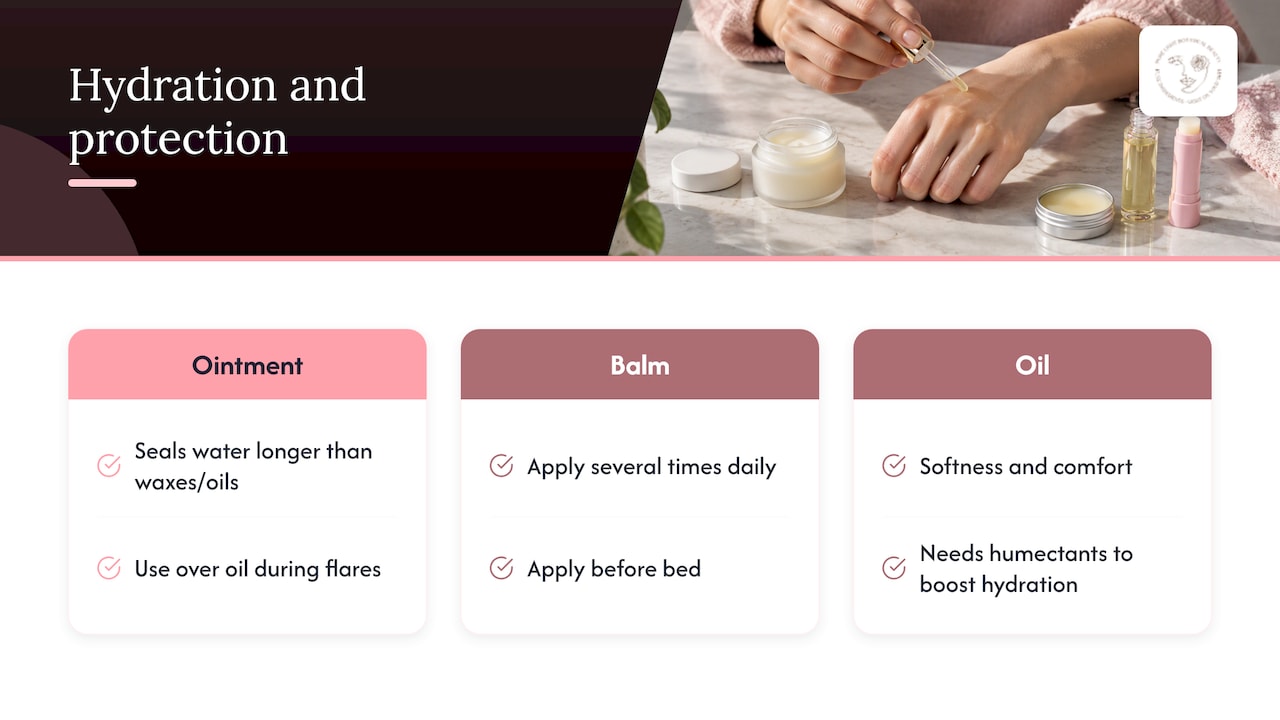
The American Academy of Dermatology says a thick ointment, such as white petroleum jelly, seals in water longer than waxes or oils for very dry, cracked lips. It also advises applying a non-irritating lip balm several times a day and before bed. That is the foundation of any lip routine, and it is why a balm earns a permanent place in it.
Oils shine in a different way. Dr. Marisa Garshick, quoted in InStyle, explains that oils such as rosehip, jojoba and argan seal in moisture, but unless a formula also contains humectants like hyaluronic acid and glycerin, it will not boost hydration. So an oil is wonderful for softness and comfort, and a balm is the more dependable layer when lips feel parched.
If you are in the middle of a flare, with cracked, burning or very irritated lips, simple is best. The same InStyle piece suggests a plain petrolatum-based ointment over an oil during those moments. Once the skin calms, oil comes back into the ritual.
Reading the label when your lips are sensitive
This is where the choice is actually made. Whether a product is an oil or a balm matters less than what is in it.
The American Academy of Dermatology tells you to stop using any lip product that causes burning, stinging or tingling. It lists camphor, cinnamon, citrus, mint and peppermint flavorings, and fragrance among the ingredients to avoid on chapped lips. It recommends ingredients such as castor seed oil, ceramides, dimethicone, hemp seed oil, mineral oil, petrolatum, shea butter, and titanium oxide or zinc oxide for sun protection, ideally in a fragrance-free, hypoallergenic product.
A review of lip-balm contact allergy in the medical literature adds more possible triggers: menthol, vanilla, geraniol, beeswax, lanolin, propylene glycol, propyl gallate and certain dyes. Not everyone reacts to every one of these, which is why a reaction on one product does not mean you must give up the whole category.
Two details are worth knowing:
- “Fragrance” and “flavor” are catch-all words. Dermatologist Dr. Rajani Katta explains that US labeling rules do not require every ingredient inside them to be listed, so one word can cover dozens of additives.
- Reactions can arrive late. She notes that allergic contact cheilitis, an allergic inflammation of the lips, typically shows up two to three days after exposure. If your lips flare midweek, think back to what you started using a few days earlier.
If your skin is eczema-prone, this matters even more. The same medical review points out that people with a history of atopic dermatitis are predisposed to dry lips, and that a bland, non-irritating balm applied several times a day, including before bed, is the daily foundation. A balm that causes discomfort should be discontinued.
So your label checklist is short: no fragrance, no flavoring, no menthol, camphor or peppermint, and a base of gentle plant oils and butters. Then patch test a new product on a small area before you commit to using it all over your lips.
Do lip oil and lip balm protect from the sun?
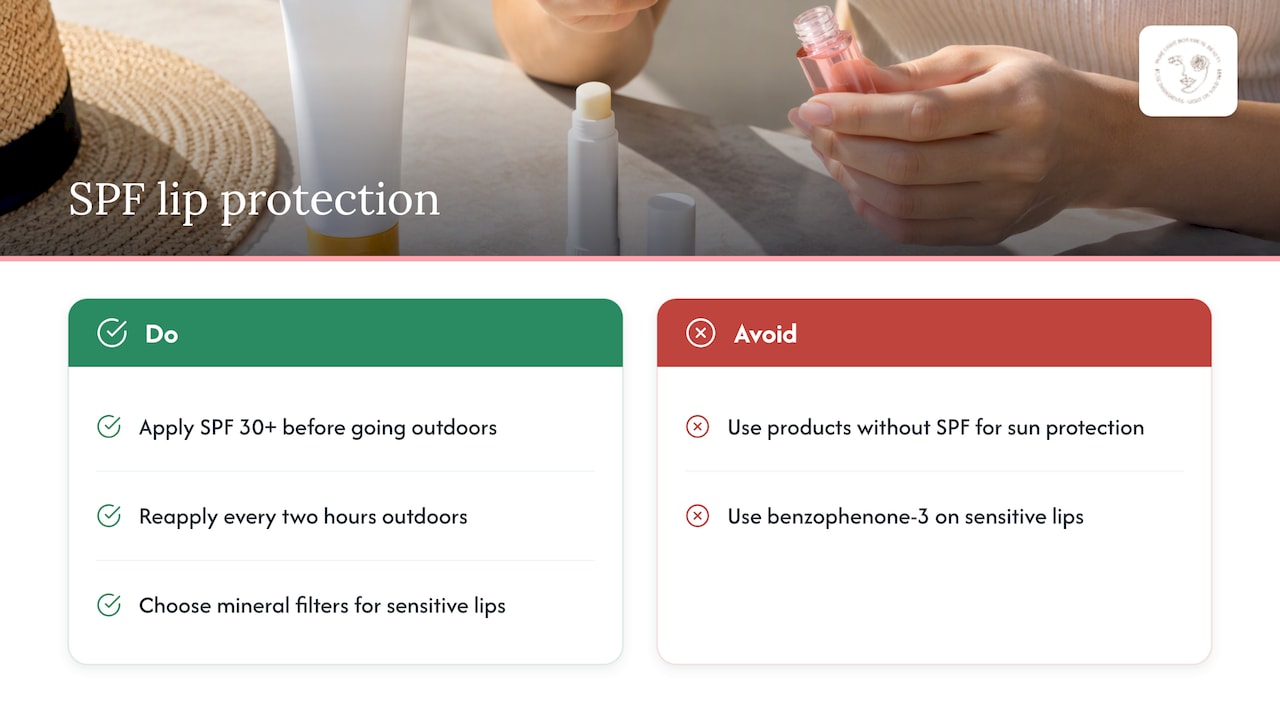
Only if they are made with SPF. The FDA lists lips among the frequently forgotten spots where an SPF lip balm should be used. The AAD recommends a non-irritating balm with SPF 30 or higher before heading outdoors, reapplied every two hours while you are outside.
According to Byrdie, a balm, oil, gloss or lipstick with SPF 30 or higher can protect equally well, and the declared SPF appears on the label. Mineral filters such as zinc oxide and titanium dioxide are the gentle choice for sensitive lips, while chemical filters such as benzophenone-3 can cause contact reactions, as the contact dermatitis review notes.
So the practical rule is simple. If it has no SPF on the label, treat it as comfort, not sun protection. For a long day in the sun, reach for an SPF 30 or higher balm first.
When to use oil, when to use balm, and how to layer them
Morning. Start with a balm if your lips feel dry. Then add oil for softness and shine. This is the order dermatologists quoted in Bustle and InStyle recommend: oil over balm, so the oil helps seal the moisture the balm provides.
Outdoors. Use an SPF 30 or higher balm and reapply every two hours. Oil can go on top if you want gloss.
Evening. Make this a slow ritual. Cleanse gently, then apply a bland balm before bed, since the AAD specifically mentions bedtime.
On a flare day. Skip fragrance, skip anything that tingles, and keep it plain. Return to your oil when the lips feel calm again.
Pretty days. A oil on its own is often all you need when your lips are healthy and you want a soft, luminous look, for a dinner out or a quiet Sunday.
Our perspective
We make lip oil for the women who were told that beauty and comfort are a trade. Our view is that a lip product should be gentle enough for the skin it touches and still feel like a small ritual.
That is why Petal Perfect Lip Oil™ is formulated with clean, plant-based ingredients for sensitive skin and skin conditions like eczema, and why we write about reading labels as much as we write about color. A balm gives lips their foundation. An oil gives them softness, radiance and a moment of care. Layered together, they let you feel looked after without a sting.
If you have eczema, you already know that a quiet routine is a kind of healing. Choose the formulas that ask nothing of your skin, and let the ritual do the rest.
Caitlin Grey
Bring the ritual home
If you want to start with the oil step, Petal Perfect Lip Oil™ is $44.44. For a tinted, nourishing balm texture, our Botanical Beauty Balm™ starts from $44.44. Our guide to lip oil for sensitive skin goes deeper on the oil, and our natural lip balm tips cover the balm side. If you want a personal plan for eczema, the Eczema Healing Consultation is $444.
FAQ
Is lip oil like Chapstick?
Not quite. A traditional balm like Chapstick is wax-based and made to protect and seal, while a lip oil is a lighter plant-oil formula that softens and adds shine. Many people use both, with the oil layered over the balm.
Can I use lip oil instead of lip balm?
For soft, healthy lips, yes, an oil can be all you need. For dry or chapped lips, dermatologists suggest a balm or ointment as the base, since oils alone are not humectants. If you are going outdoors, make sure whichever product you choose has SPF 30 or higher.
Which is better for eczema-prone lips?
The better product is the one without fragrance, flavoring, menthol or camphor, in either format. During a flare, a plain, bland balm or ointment is the gentlest base. When lips are calm, a clean plant-based oil adds softness on top.
Can lip oil and lip balm be layered?
Yes. Dermatologists quoted in Bustle and InStyle suggest applying lip oil over a balm so the oil helps seal in the balm’s moisture. Put the balm on first, wait a moment, then add the oil.
Does lip oil have SPF?
Only if the label says so. Any lip product can offer sun protection when it is formulated with SPF, and SPF 30 or higher is considered effective. If no SPF is listed, use a separate SPF balm outdoors.