

For sensitive skin, choose fragrance-free, minimal-ingredient tints or balm-based makeup, and always patch-test before wearing anything on your full face. That single decision, made before you ever open a compact, prevents more redness and breakouts than any serum you’ll apply afterward.
The safest starting point is a lightweight skin tint or balm color rather than a full-coverage liquid foundation, since fewer ingredients mean fewer chances for your skin to react. From there, layer in a cream blush and a nourishing lip color formulated with soothing plant oils instead of drying, alcohol-based stains.
- Start with a tinted balm or skin tint. Let it sit for a full day before adding more products.
- Add a cream blush and a nourishing lip balm once your skin tolerates the base product.
Formulas with heavy preservative loads and synthetic fragrance are the two most common triggers editors and dermatologic sources flag for reactive skin, which is why ingredient transparency matters more than marketing claims. Purelightbotanicalbeauty builds its lip and cheek color around plant-based, low-irritant formulas specifically for this reason, and its product pages list every ingredient for exactly this kind of scrutiny.
Key Takeaways
The most effective way to prevent makeup-related irritation is choosing fragrance-free, minimal-ingredient formulas and patch-testing every product for 24 to 48 hours before full use.
| Point | Details |
|---|---|
| Start with a tint or balm | Lightweight skin tints and balm-based colors carry fewer ingredients and lower irritation risk than full-coverage foundations. |
| Screen for the same red flags | Avoid fragrance, alcohol denat, parabens, certain essential oils, mineral oil, microplastics, and bismuth oxychloride. |
| Repair the barrier first | Gentle cleansing, a lightweight moisturizer, and skipping exfoliants on makeup days reduce reactions more than product choice alone. |
| Patch-test every new product | Apply a small amount to the jawline or inner arm and wait 24 to 48 hours before judging tolerance. |
| Watch shelf life closely | Lightly preserved natural formulas spoil faster; discard at signs of separation, odor change, or texture shift. |
| Purelightbotanicalbeauty fits the standard | Nourishing Lipstick™ (Rose Quartz, Amethyst) and Botanical Crème Blush™ use plant-based, fragrance-conscious formulas with full ingredient transparency for sensitive and eczema-prone skin. |
Sources for Ingredient and Clinical Claims
- Clean-beauty testing roundups for ingredient red flags and formulation trends.
- Clinical foundation pages for allergy-testing and dermatologist-tested claims.
- Editorial reviews for shelf-life and natural-preservative guidance.
Table of Contents
- What Is the Best Natural Makeup for Sensitive Skin?
- How Do You Know If a Makeup Ingredient Will Irritate Your Skin?
- How Should You Prep Your Skin Before Wearing Makeup?
- How Long Does Natural Makeup Last Before It Spoils?
- A Note on Testing Standards and What Guides This Guide
- Matching Products to Dry, Oily, and Combination Sensitive Skin
- Where the Usual Sensitive Skin Advice Falls Short
- Ready to Try Gentle Makeup Built for Reactive Skin?
What Is the Best Natural Makeup for Sensitive Skin?
The honest answer depends on what your skin is reacting to, but the pattern holds across nearly every credible review of clean formulas: the fewer synthetic additives in a product, the less likely it is to trigger a flare. Editors who’ve tested natural foundations extensively tend to steer sensitive-skin readers toward lighter, skin-tint or cream formats built around soothing botanicals, with ingredient lists you can actually read without a chemistry degree. That’s the throughline worth following as you shop.
Skin tints and cream foundations
Skin tints trade heavy pigment load for sheer, breathable coverage, usually with an emollient or humectant base instead of silicones and film-formers. They’re the gentlest entry point if your skin flares easily, because they sit closer to a tinted moisturizer than a true foundation. Cream foundations sit one step up in coverage. They still rely on oils and butters rather than alcohol or heavy synthetic emulsifiers, so they blend without dragging on irritated patches. Choose a skin tint if your main concern is evening tone without masking texture; choose a cream formula if you need a bit more coverage for redness or post-flare marks.
Cream blushes
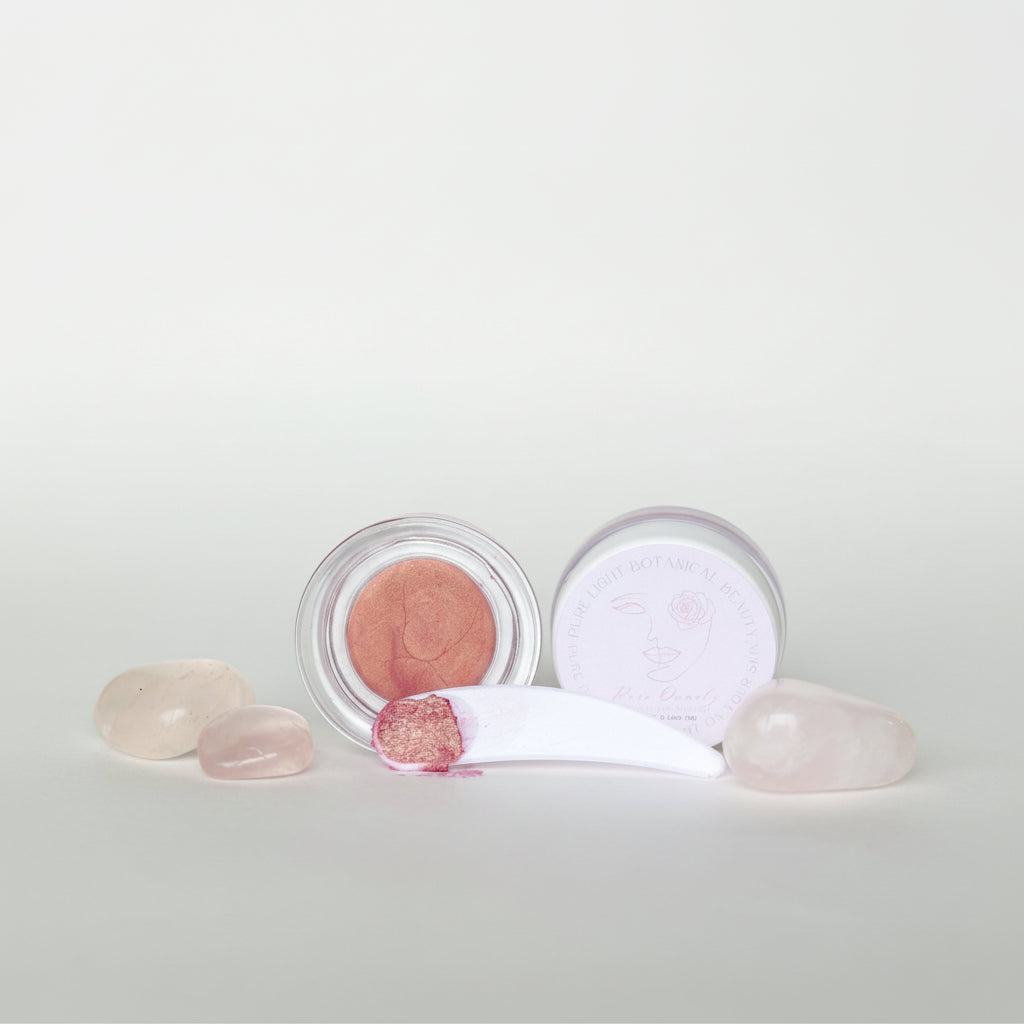
Cream blush formats deserve more credit than they get. Because they’re pigment suspended in a moisturizing base rather than a powder bound with talc or silica, they tend to move with your skin instead of settling into dry patches or clinging to eczema-prone areas. Purelightbotanicalbeauty’s Botanical Crème Blush™ ~ Rose Quartz is built on exactly this logic: a nourishing base carrying a soft, buildable rose tint, designed to melt into cheeks without the chalky pull some mineral powders leave behind on dry or reactive skin. If your skin runs dry or you have eczema on the cheeks, a cream blush is almost always the safer bet over a pressed powder.
Balm-based lip color
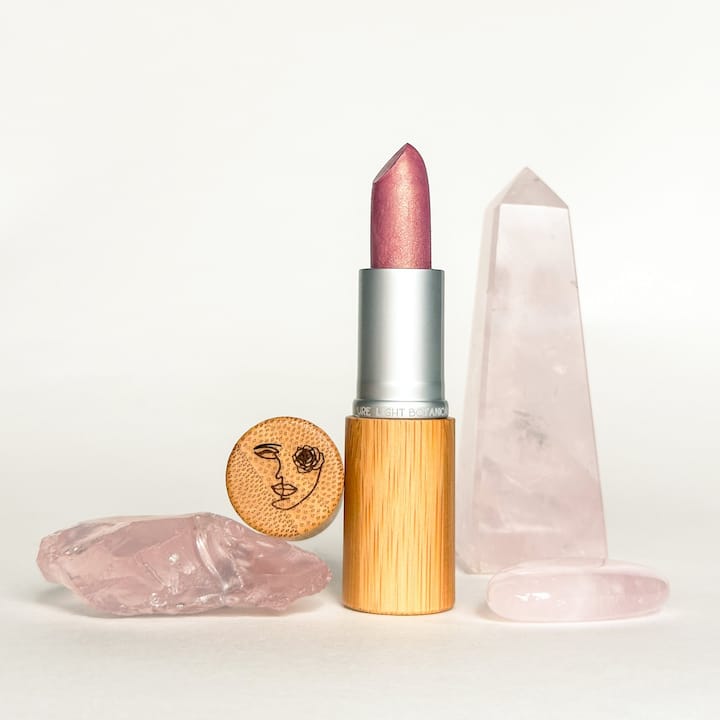
Lip skin is thinner and more reactive than most other facial skin, which is why so many “sensitive skin safe” lipsticks still cause stinging or peeling. Balm-based formulas solve this by keeping the color suspended in a conditioning oil or butter base instead of a drying wax-and-pigment stick. Nourishing Lipstick™ ~ Rose Quartz and Nourishing Lipstick™ ~ Amethyst both follow this approach, pairing color with nourishing plant oils so the product treats the lips while it tints them, rather than sitting on top like a coat of drying pigment.
Here’s how to think about matching product class to your situation:
- Daily minimal wear: a skin tint or tinted balm alone, patch-tested first.
- Redness or post-flare coverage: a cream foundation plus a cream blush for color that doesn’t settle into texture.
- Lip sensitivity or chronic dryness: a balm-based lipstick like the Rose Quartz or Amethyst shades, applied over a plain lip balm as a buffer layer.
- Combination needs (oily zones, dry patches): cream formulas on dry areas, a lighter tint on the T-zone, applied separately rather than blended as one product.
What ties all three product classes together is the absence of the usual troublemakers. None rely on fragrance for a “spa” scent, none use alcohol denat to speed drying, and none lean on bismuth oxychloride, the shimmer mineral that’s a known irritant for a subset of sensitive-skin users in clean-beauty testing. That’s a deliberate formulation choice, not a marketing footnote, and it’s worth checking for on any product you’re considering, ours or otherwise. For a broader look at how these formats compare side by side, our guide to natural makeup types breaks down coverage and finish for each.
How Do You Know If a Makeup Ingredient Will Irritate Your Skin?
Ingredient lists are the single best predictor of how a product will treat sensitive skin, better than price, brand reputation, or a “clean” label on the front of the box. Reviewers who’ve tested dozens of clean foundations consistently flag the same handful of culprits, and knowing them turns label-reading from a chore into a five-second scan.
Red flags to check for first:
- Fragrance (including “natural fragrance”) — the single most common trigger for contact irritation, even in botanical formulas.
- Alcohol denat — used to speed drying and mattify, but it strips the skin barrier on repeated use.
- Parabens — preservatives linked to sensitization in a meaningful share of reactive-skin users.
- Certain essential oils — citrus oils, peppermint, and eucalyptus are common offenders even in “natural” lines.
- Heavy mineral oils — can trap heat and worsen inflammation on already-compromised skin.
- Microplastics — often listed as polyethylene or acrylate copolymers; they can physically abrade sensitive skin during blending.
- Bismuth oxychloride and some synthetic dyes — flagged repeatedly in clean-beauty testing as irritants for shimmer-based products.
Positive signals worth seeking out:
- Allantoin and niacinamide for calming and barrier support.
- Aloe vera and hyaluronic acid for hydration without heaviness.
- Non-nano zinc oxide as a gentler mineral pigment and sun-protective option, often preferred over chemical filters for reactive skin.
- Fragrance-free labeling paired with a full ingredient disclosure, not just a “clean” or “natural” claim with no list to back it up.
Label language deserves a second look, too. “Hypoallergenic” has no regulated legal definition in most markets, so it’s a claim, not a guarantee. “Allergy-tested” usually means the formula was checked against a panel of common allergens, which carries more weight, and dermatologist-tested claims on clinically oriented products often reference reduced hypersensitivity in monitored trials, which is a stronger signal than either of the other two terms alone. “Fragrance-free” is the most reliable of the three, provided the ingredient list backs it up with no hidden aromatic compounds.
Pro Tip: Keep a running note on your phone of any ingredient that’s ever caused a reaction, then screenshot every new product’s ingredient list before buying. Comparing the two takes thirty seconds and saves you from repeating the same reaction under a different brand name.
If you want a deeper primer on reading these labels product by product, our decision checklist for choosing natural makeup walks through the same red flags with real label examples.
How Should You Prep Your Skin Before Wearing Makeup?
Makeup rarely causes irritation on its own. More often, it exposes a skin barrier that was already compromised, which is why practitioners increasingly treat barrier repair as a prerequisite to wearing makeup successfully, not an afterthought. A gentle cleanse, a lightweight barrier moisturizer, and sunscreen if you’re heading outdoors during the day form the baseline. Skip the exfoliating acids on any day you plan to wear makeup, since a freshly exfoliated barrier absorbs pigments and preservatives more aggressively.
Patch testing is the step most people skip, and it’s the one that actually prevents surprises. The protocol is simple:
- Pick your test site. The inner arm, behind the ear, or along the jawline all work well.
- Apply a small amount of the product, roughly a pea-sized dab, without rubbing it in aggressively.
- Wait 24 to 48 hours without washing the area, checking periodically for redness, itching, or bumps.
- Read the result honestly. Mild, fading redness within a few hours is usually nothing. Persistent redness, swelling, or itching past the 24 hour mark means the product isn’t for you.
If a product fails patch testing repeatedly across different brands, or if you’re seeing reactions to products that pass most people’s tolerance, that’s your signal to see a dermatologist for formal allergy testing rather than continuing to self-experiment.
How Long Does Natural Makeup Last Before It Spoils?
Natural formulas trade synthetic preservatives for lighter, plant-derived systems, and that tradeoff shows up directly in shelf life. Water-rich, small-batch formulations in particular can separate or spoil faster than conventional makeup, sometimes needing refrigeration or an earlier discard date than you’d expect from a drugstore product.
Watch for these signs that a product has turned:
- A sour, rancid, or otherwise “off” smell that wasn’t there when you bought it.
- Visible separation, with oil pooling or texture turning grainy.
- A shift in color or consistency, especially in cream blushes and balms.
- Any change in how the product feels on application, like new stinging or tackiness.
Hygiene habits matter just as much as storage. Never double-dip your fingers into a cream product, keep applicators clean between uses, and treat any sample size as its own patch test before committing to a full-size purchase. Store natural makeup in a cool, dry spot away from direct sunlight or bathroom humidity, and refrigerate anything the label specifically recommends keeping cold.
Pro Tip: Write the purchase date on the bottom of any natural cream product with a fine-tip marker. Most lightly preserved formulas are best used within six to twelve months, and that date fades from memory long before the product does.
A Note on Testing Standards and What Guides This Guide
This guide is written by Kaitlyn, whose approach centers on one repeated finding across clean-beauty testing: ingredient checks and real-world patch testing have to work together, because individual sensitivity varies too widely for either one alone to be reliable. That’s the philosophy behind every recommendation here, and it’s the same philosophy behind how Purelightbotanicalbeauty formulates.
Beauty shouldn’t ask your skin to suffer for the sake of color. Every formula we build starts with the question of what the skin needs first, and what looks good comes second, not the other way around.
Pure Light Botanical Beauty’s mission grew out of a simple frustration: most “clean” claims on packaging don’t survive contact with genuinely reactive or eczema-prone skin. The brand’s formulas are built plant-first, with full ingredient transparency, so a reader with a history of flare-ups can check a label and actually trust what it says. Readers managing eczema-prone skin have described a noticeable difference switching to lighter, botanically based formulas over conventional makeup, particularly around the cheeks and lips where friction and dryness compound irritation fastest.
Matching Products to Dry, Oily, and Combination Sensitive Skin
Sensitive skin isn’t one texture, and treating it as one ignores half the picture. Dry, sensitive skin does best with cream formulas across the board: cream blush, balm lipstick, and a hydrating skin tint rather than anything powder-based, since powder pulls moisture from skin that has little to spare. Look for hyaluronic acid and plant oils high on the ingredient list.
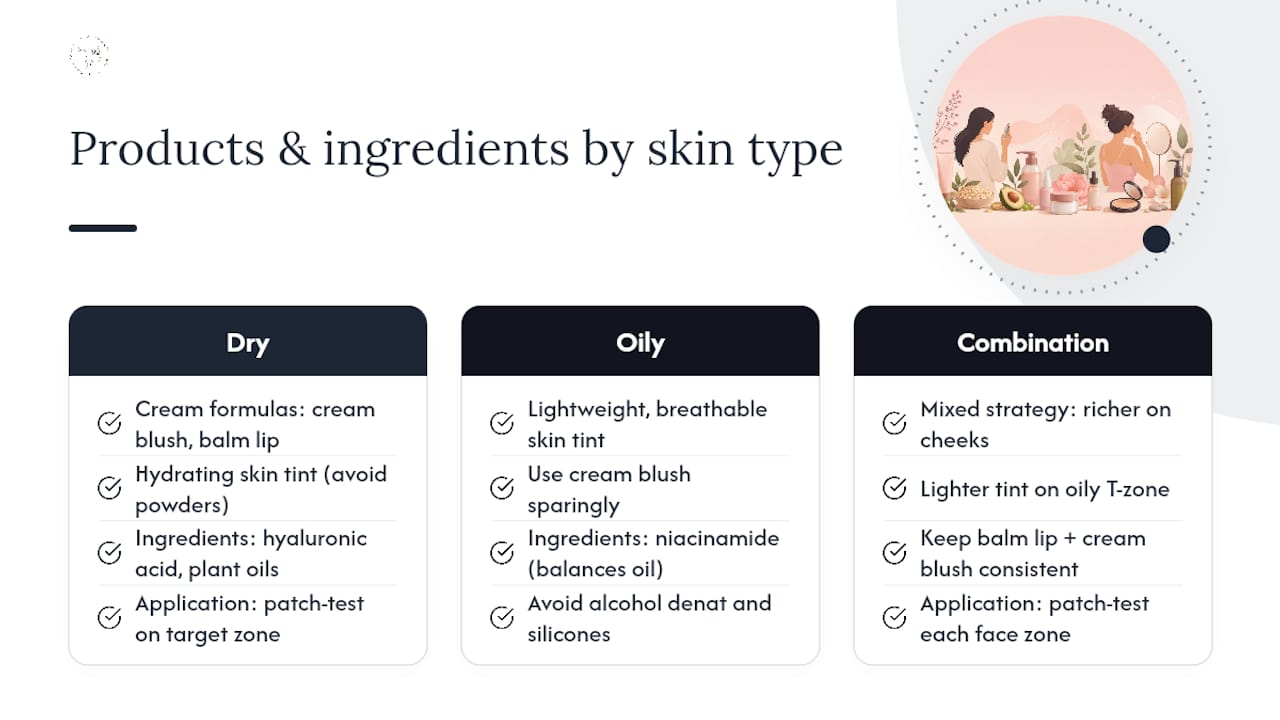
Oily, sensitive skin is trickier, because many “oil-free” formulas swap in alcohol denat or silicones to control shine, both of which are common irritants. A better approach is a lightweight, breathable skin tint with niacinamide, which helps balance oil production without the drying tradeoff, paired with a cream blush applied sparingly since it wears longer on oilier skin than expected.
Combination sensitive skin benefits from a mixed strategy rather than one product for the whole face. Use a slightly richer cream formula on dry cheeks and jawline, a lighter tint on an oilier T-zone, and keep the lip and cheek color consistent (a balm lipstick and cream blush) since those areas rarely shift between oily and dry the way the center of the face does. Whatever your type, the same rule holds: patch-test each new formula on the actual skin zone you plan to wear it on, not just your inner arm, since oil and dryness levels shift the way a product performs.
Where the Usual Sensitive Skin Advice Falls Short
Most sensitive-skin makeup advice stops at “look for fragrance-free products,” and that’s not wrong, it’s just incomplete. The bigger blind spot is treating makeup selection as separate from skin health, when the two are inseparable. A barrier that’s already compromised from over-exfoliation or harsh cleansers will react to almost anything you put on it, natural or not, which is why so many people blame a product when the real problem started days earlier in their routine.
The other gap is trusting front-of-package language over the ingredient list itself. “Hypoallergenic” and “natural” are marketing words with no consistent legal weight behind them in most places. A short, recognizable ingredient list with allantoin, aloe, or niacinamide near the top tells you more than either label ever will.
If you take one thing from this guide, prioritize barrier repair before you shop for makeup, then patch-test everything, even products marketed specifically for sensitive skin. That order of operations, skin first, product second, is what actually prevents reactions instead of just treating them after the fact.
— Kaitlyn
Ready to Try Gentle Makeup Built for Reactive Skin?
If you’ve read this far, you already know what to look for: short ingredient lists, no fragrance, and formulas that support your skin instead of just sitting on top of it. Purelightbotanicalbeauty’s lip and cheek line was built around exactly that standard, and each product page lists every ingredient so you can check it against your own patch-test history before buying.
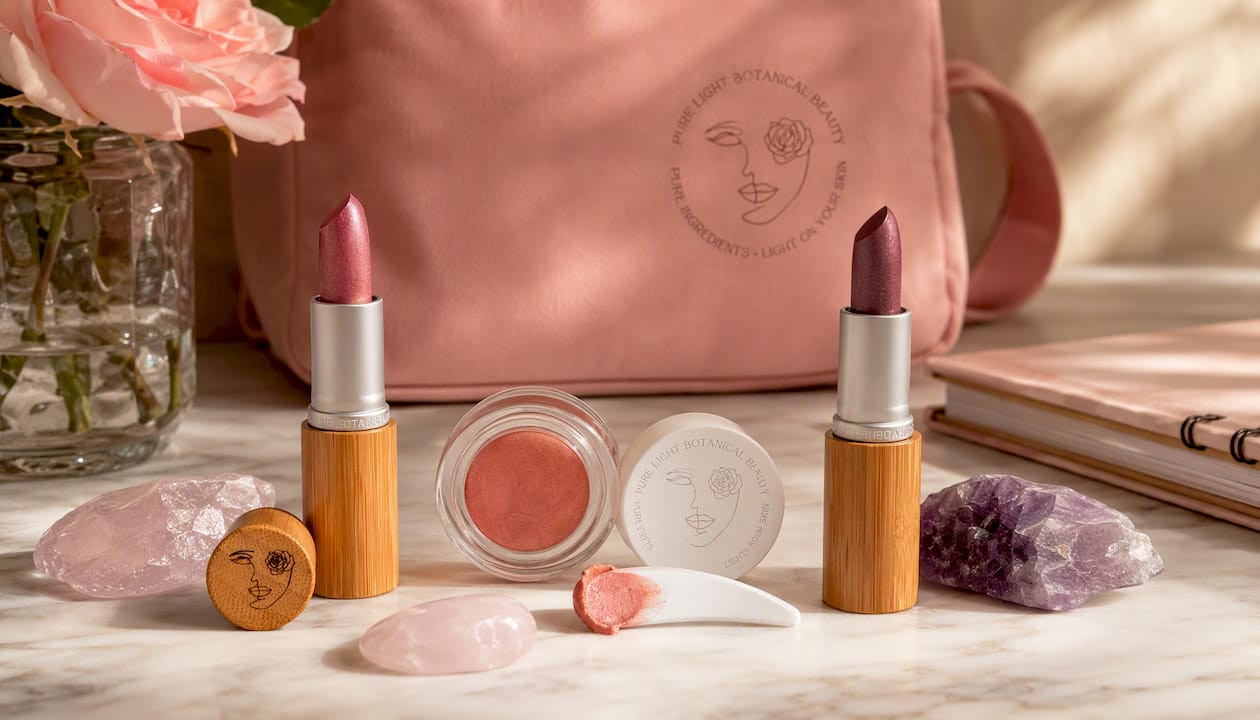
Nourishing Lipstick™ ~ Rose Quartz leans on nourishing plant oils in a balm base, giving lips a soft rose tint without the tightness or peeling that waxier lipsticks can cause on dry or sensitive lips. Botanical Crème Blush™ ~ Rose Quartz uses that same cream-forward approach for the cheeks, blending into skin without clinging to dry patches or eczema-prone areas the way pressed powders often do. And if Rose Quartz isn’t your shade, Nourishing Lipstick™ ~ Amethyst offers the same conditioning base in a deeper tone, so you’re not choosing between color and comfort.
Before committing to a full-size product, patch-test a small amount along your jawline for 24 to 48 hours, the same protocol covered earlier in this guide. Visit each product page to review the complete ingredient list, check current sample options, and see which shade fits your coloring, then order directly through Nourishing Lipstick™ in Rose Quartz, Botanical Crème Blush™ in Rose Quartz, or Nourishing Lipstick™ in Amethyst to see which one fits your skin’s needs first.
Recommended
- Skin-Friendly Makeup Tips: Complete Expert Guide – Pure Light Botanical Beauty
- 7 Types of Natural Makeup for Sensitive, Radiant Skin – Pure Light Botanical Beauty
- How to Choose Natural Makeup for Sensitive Skin Relief – Pure Light Botanical Beauty
- Blend Natural Makeup Flawlessly for Sensitive Skin Health – Pure Light Botanical Beauty