

Yes, an organic lipstick can be genuinely safer and more nourishing for sensitive lips, but only when it carries a real certification and a full ingredient list you can actually read. A product labeled “organic” without USDA Organic, COSMOS, or Ecocert backing is a marketing claim, not a promise. Even the cleanest formulas trade some staying power for that gentleness, so expect to reapply more often than you would with a conventional bullet.
TL;DR:
- Only certified organic lipsticks with transparent ingredient lists and full INCI disclosure guarantee genuine safety and sourcing from reputable standards like USDA, COSMOS, or Ecocert.
- Organic formulations typically prioritize plant-based ingredients such as shea butter, cocoa butter, and mineral pigments, but may offer less staying power and a softer sheen compared to conventional options.
- Common irritants like synthetic dyes, fragrances, parabens, and mineral oil remain a concern, especially for sensitive or eczema-prone lips, emphasizing the need for fragrance-free and low-reactivity ingredients.
- Organic lipsticks have a shorter shelf life, usually about one to one and a half years, and require careful storage, patch testing, and application with clean tools to prevent early spoilage.
- Reputable brands provide full ingredient transparency, including the source of colorants, and often include refillable cases to reduce packaging waste and facilitate safe, repeated use.
Table of Contents
- What Does “Organic Lipstick” Actually Mean?
- Which Ingredients Should You Avoid in a Lipstick?
- How Can You Tell If a Lipstick Is Truly Organic?
- How Do You Choose an Organic Lipstick for Eczema-Prone Lips?
- What Should Be on Your Organic Lipstick Shopping Checklist?
- What Allergic Reactions Can Organic Ingredients Cause?
- How Should You Store Organic Lipstick to Maximize Shelf Life?
- Why We Formulate Organic Lipstick the Way We Do
- Try Nourishing Lipstick™ Where It Actually Counts
- Where to Learn More About Ingredient Safety and Certification
- FAQ
What Does “Organic Lipstick” Actually Mean?
An organic lipstick is a lip color built primarily from plant-derived and mineral ingredients grown or processed without synthetic pesticides, and it typically skips the petroleum-based fillers and synthetic preservatives found in mass-market formulas. That’s different from “natural,” a word with no legal definition, and different from “clean,” a marketing term that varies from brand to brand. Certification is what separates the two.
Most organic lipsticks build their base from a small, recognizable set of plant ingredients:
- Shea butter and cocoa butter for slip and moisture retention
- Coconut oil or sunflower oil to soften texture and help pigment glide on
- Plant waxes like candelilla, or beeswax in formulas that aren’t strictly vegan, to give the bullet its structure and hold
- Iron oxides and mica for color, along with some plant-derived colorants in place of synthetic dyes
Pigment source matters as much as the base oils. Iron oxides are mineral compounds that have been used safely in cosmetics for decades, while synthetic dyes (often listed as FD&C or D&C colors) are linked to more irritation complaints among sensitive users. The trade-off with plant-based formulas is honest: you generally get less budge-proof wear and a softer sheen rather than a high-gloss, all-day matte finish, because the synthetic film-formers that create that “locked-on” effect are exactly what clean formulations leave out.
Which Ingredients Should You Avoid in a Lipstick?
Sensitive and eczema-prone lips react to a fairly predictable list of offenders, and once you know the names, they’re easy to spot on a label. A large part of what makes a lipstick “clean” in editorial testing comes down to the absence of one specific group of ingredients: parabens, synthetic fragrance, mineral oil, and certain synthetic dyes.
- Parabens (often listed as methylparaben, propylparaben) act as preservatives but have raised concern for hormone disruption with repeated exposure.
- Phthalates, sometimes hidden inside “fragrance” on a label, are plasticizers linked to similar hormonal concerns.
- Synthetic fragrance blends are one of the most common triggers for lip irritation and allergic contact reactions in people with sensitive skin.
- Mineral oil and petrolatum sit on top of the skin rather than absorbing, which can feel moisturizing short-term but does little for lips that are already compromised by eczema.
- Certain synthetic dyes and microplastic ingredients (look for polyethylene or acrylates) add shine and hold but bring higher irritation potential and environmental persistence.
Lead is a separate concern worth understanding correctly. Lead is not intentionally added to lipstick, but trace contamination can occur through mineral pigments sourced from certain regions, which is why reputable organic brands test and disclose pigment sourcing rather than leaving it to chance. If a brand won’t discuss where its colorants come from, treat that silence as the red flag it is.
Lips have thinner skin and no oil glands of their own, so anything irritating applied there has fewer natural defenses than it would on your cheek or forehead.
How Can You Tell If a Lipstick Is Truly Organic?
Certification, not marketing copy, is the only reliable filter here. Third-party organic seals mean an independent body has actually verified the ingredient sourcing and processing, rather than taking the brand’s word for it.
- USDA Organic requires a minimum percentage of certified organic agricultural ingredients and audits the supply chain behind them.
- COSMOS and Ecocert are European standards that certify both organic and “natural” tiers, with specific rules about which processing methods and preservatives are allowed.
- A full INCI list (the International Nomenclature of Cosmetic Ingredients) should be visible on the packaging or product page. If a brand only lists “active botanicals” without the complete INCI, that’s a gap worth questioning.
Reading an INCI list is a skill worth building. Ingredients are listed in descending order by concentration, so the first five names tell you what the product is mostly made of. Vague catch-all terms like “parfum” or “fragrance” can legally hide dozens of undisclosed compounds, including phthalates, which is exactly why fragrance-free formulas earn extra trust from ingredient-conscious shoppers.
Certain marketing words carry no regulatory weight at all. “Natural,” “clean,” and “non-toxic” are unregulated terms that brands can apply to almost anything.
Pro Tip: Search the product name plus “INCI list” before buying. If you can’t find the full ingredient list within two clicks of the product page, that’s usually a sign the brand isn’t prioritizing transparency the way a certified organic line would.
How Do You Choose an Organic Lipstick for Eczema-Prone Lips?
Selection criteria change once eczema or chronic sensitivity enters the picture, because the margin for irritation is smaller and the skin barrier is already compromised. Prioritize these factors in order:
- Full ingredient transparency, meaning the brand publishes its complete INCI list without you having to dig for it
- Fragrance-free formulation, since fragrance is the most common lip irritant across sensitive-skin populations
- Dermatologist-tested or patch-tested claims, which signal the brand has at least done baseline safety screening
- Moisturizing botanical actives like shea butter and cocoa butter, which provide measurable, repeated hydration benefits for compromised lip skin
- Low-risk pigments, meaning iron oxides and mineral colorants rather than synthetic dye blends
Format matters more than most shoppers realize. A balm-style tinted lipstick tends to be gentlest because it prioritizes emollients over hold, making it a strong starting point if you’re new to switching. A traditional bullet gives you more color payoff and precision but usually contains more wax and film-forming agents, which can feel drying on already-irritated skin. Liquid lip formulas vary widely: some use lightweight oils that sensitive lips tolerate well, while others use long-wear polymers that behave more like the synthetics you’re trying to avoid.
Before committing to a full-size lipstick, run a simple trial. Apply a small amount to the inner forearm and wait 24 hours to check for redness or bumps. If that’s clear, apply a thin layer to the lips themselves and wear it for a few hours, then watch for delayed reactions over the following 24 to 48 hours, since some sensitivities show up a full day later rather than immediately.
Pro Tip: Always patch test a new organic lipstick on the inner wrist even if you’ve never reacted to makeup before. Eczema-prone skin’s threshold for irritation can shift with hormones, weather, and stress, so a formula you tolerated last year isn’t guaranteed to sit well today.
What Should Be on Your Organic Lipstick Shopping Checklist?
A few practical trade-offs decide whether a lipstick earns a spot in your bag long-term, and most of them come down to weighing hydration against hold.
- Finish: Cream and satin finishes tend to carry more emollients and feel better on dry or flaky lips; matte finishes often need more wax and clay to grip, which can accentuate dryness.
- Longevity: Plant waxes and mineral pigments provide moderate wear. If a “clean” lipstick claims eight-hour wear, check the INCI for synthetic polymers doing that heavy lifting.
- Refillability: A refillable case cuts packaging waste substantially over a year of repurchases and often signals a brand that’s thought past the marketing checklist.
- Price versus ingredient quality: A higher price tag should track back to sourcing (organic certification, mineral pigment quality), not just packaging design.
| Checklist item | What to look for | Why it matters |
|---|---|---|
| Finish | Cream, satin, or sheer over full matte | Affects hydration and comfort on dry lips |
| Longevity | Plant wax/butter blends over synthetic film-formers | Determines wear without sacrificing safety |
| Refillability | Replaceable bullet or pan | Reduces packaging waste over repeat purchases |
| Price tier | Cost aligned with certified sourcing | Confirms you’re paying for ingredients, not marketing |
What Allergic Reactions Can Organic Ingredients Cause?
Organic doesn’t mean risk-free. Plant-based ingredients can trigger genuine allergic reactions, and in some cases the botanical origin of an ingredient is exactly what makes it a problem for a specific person. Beeswax, for instance, is a common lipstick ingredient that some people react to, particularly those with existing bee product or pollen sensitivities. Certain plant oils, including some nut-derived butters, can cross-react with food allergies, so anyone with a tree nut allergy should read the base ingredients closely rather than assuming “plant-based” is automatically safe for them.
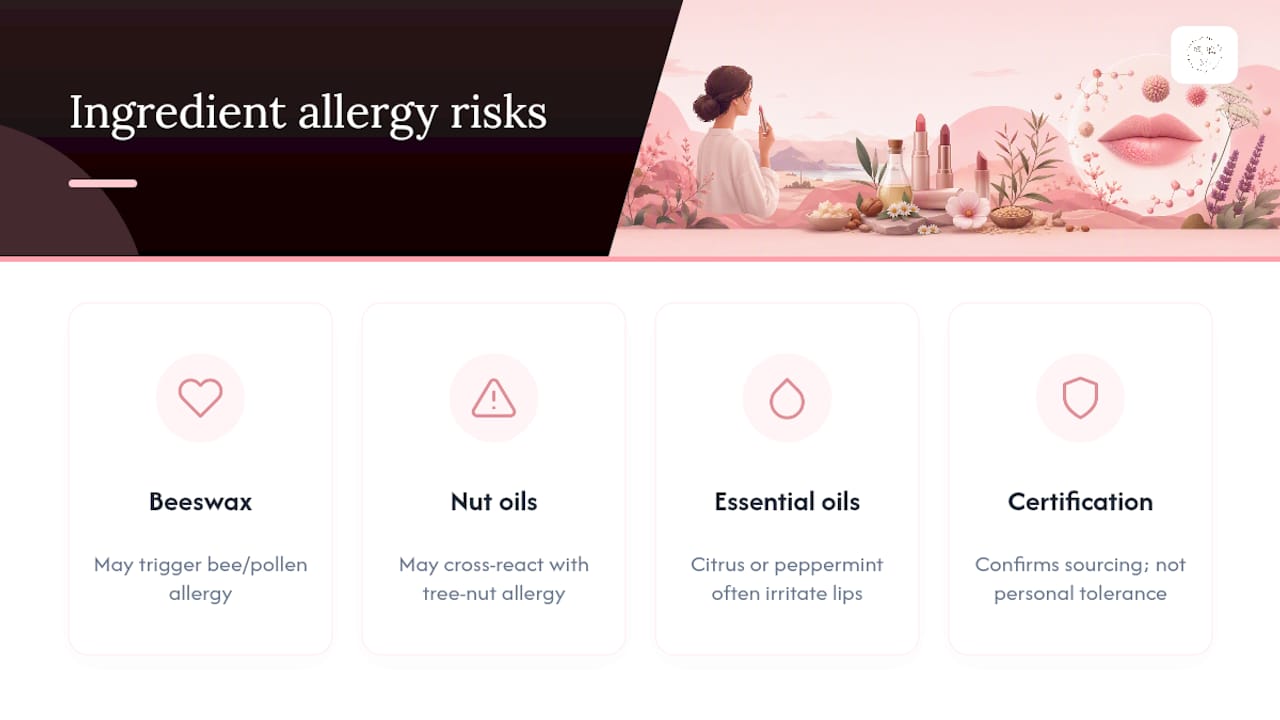
Essential oils deserve particular caution. Some organic lipsticks use citrus oils, peppermint, or other essential oils for scent or tingle, and these are among the more common natural irritants for lips specifically, since lip skin lacks the oil barrier that makes those same oils tolerable on other parts of the face. A product can be entirely certified organic and still contain an ingredient that triggers your particular sensitivity, which is why the certification badge and the individual patch test are not substitutes for each other. They answer two different questions: one confirms sourcing integrity, the other confirms your skin’s personal tolerance.
Symptoms to watch for go beyond obvious redness. Mild swelling, a persistent dry or peeling texture that develops days after starting a new product, small bumps along the lip line, or a burning sensation that shows up specifically after eating or drinking can all signal a delayed contact reaction. If any of these appear, stop use and give your lips a few days on a bare balm before reintroducing anything new.
How Should You Store Organic Lipstick to Maximize Shelf Life?
Organic lipsticks generally have a shorter shelf life than conventional ones, and that’s a direct trade-off for skipping synthetic preservatives. Most certified organic lipsticks generally last about a year to a year and a half once opened, shorter than the typical shelf life of conventional lipsticks containing parabens and other long-acting preservatives.
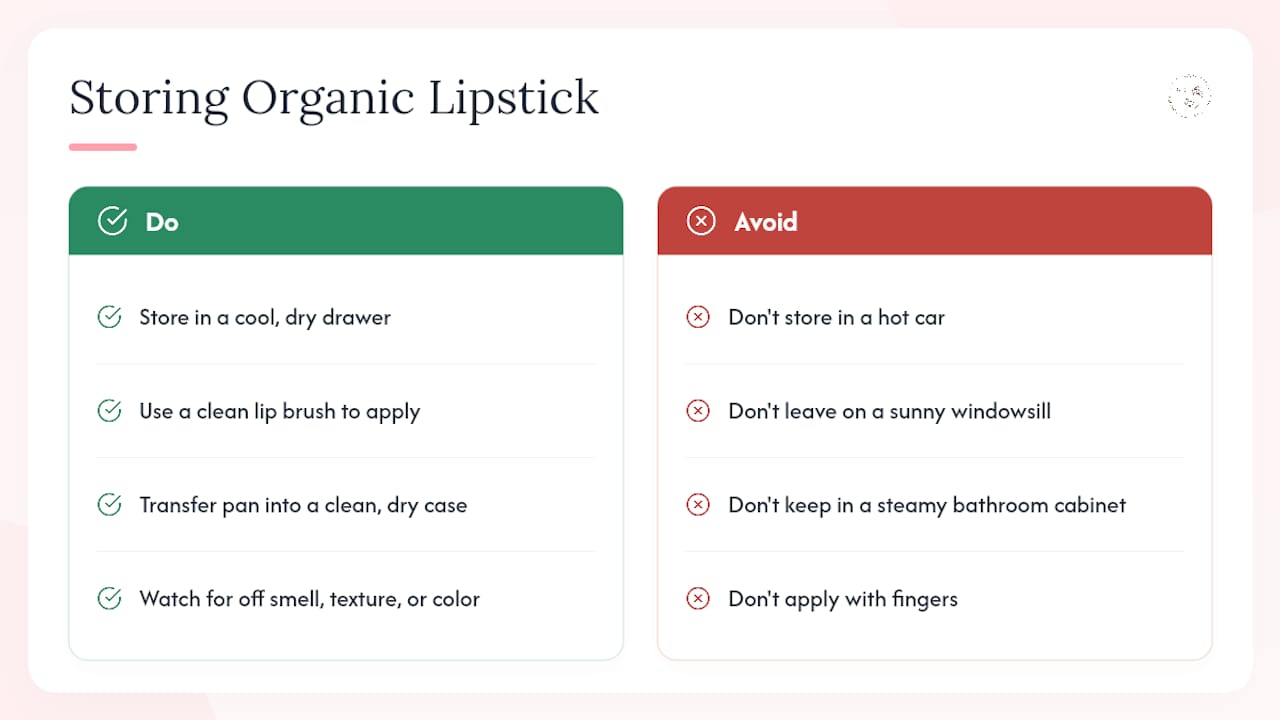
Heat and light are the two biggest threats to an organic bullet’s texture and safety. Storing lipstick in a hot car, a sunny windowsill, or a steamy bathroom cabinet accelerates oxidation of the plant oils and butters, which shows up as a change in smell, a grainy texture, or visible separation. A cool, dry drawer away from direct sunlight is the simplest way to extend a product’s usable life.
Watch for practical signs that a lipstick has turned rather than relying on the printed expiration date alone. A sour or “off” smell that wasn’t there originally, a change in color or texture (crumbly, greasy, or separated), and a noticeably duller pigment payoff are all cues to retire the product even if it’s technically within its stated window. Because organic formulas skip heavy synthetic preservatives, they’re also more sensitive to contamination from repeated finger contact, so applying with a clean lip brush rather than your fingertip can meaningfully extend how long a bullet stays good.
Refillable cases add one more consideration: transfer the pan into a clean, dry case, and avoid leaving the old pan exposed to air for extended periods between swaps.
Why We Formulate Organic Lipstick the Way We Do
Our Nourishing Lipstick line is developed with a focus on skin health first and color performance second, treating these goals as complementary rather than competing. The formula emphasizes shea butter and cocoa butter to provide real moisture rather than ingredients that only create a smooth feel. Fragrance is omitted entirely to avoid irritation often caused by scent components in sensitive-skin formulations.
Every Nourishing Lipstick shade provides a full ingredient list without vague catch-all terms. There is a refill program designed to reduce packaging waste and extend use of the lipstick cases.
— Caitlin Grey
Try Nourishing Lipstick™ Where It Actually Counts
If everything above sounds like a lot to verify on your own, that’s the gap Nourishing Lipstick™ was built to close. Every shade ships with a fully disclosed ingredient list, a shea and cocoa butter base for real moisture, and mineral pigments in place of synthetic dyes, so the checklist work is already done before the product reaches you.
- Ingredient transparency: full INCI list published on every product page, no hidden fragrance blends
- Moisturizing botanicals: shea and cocoa butter lead the formula, not fillers
- Refillable design: swap the pan instead of tossing the whole case
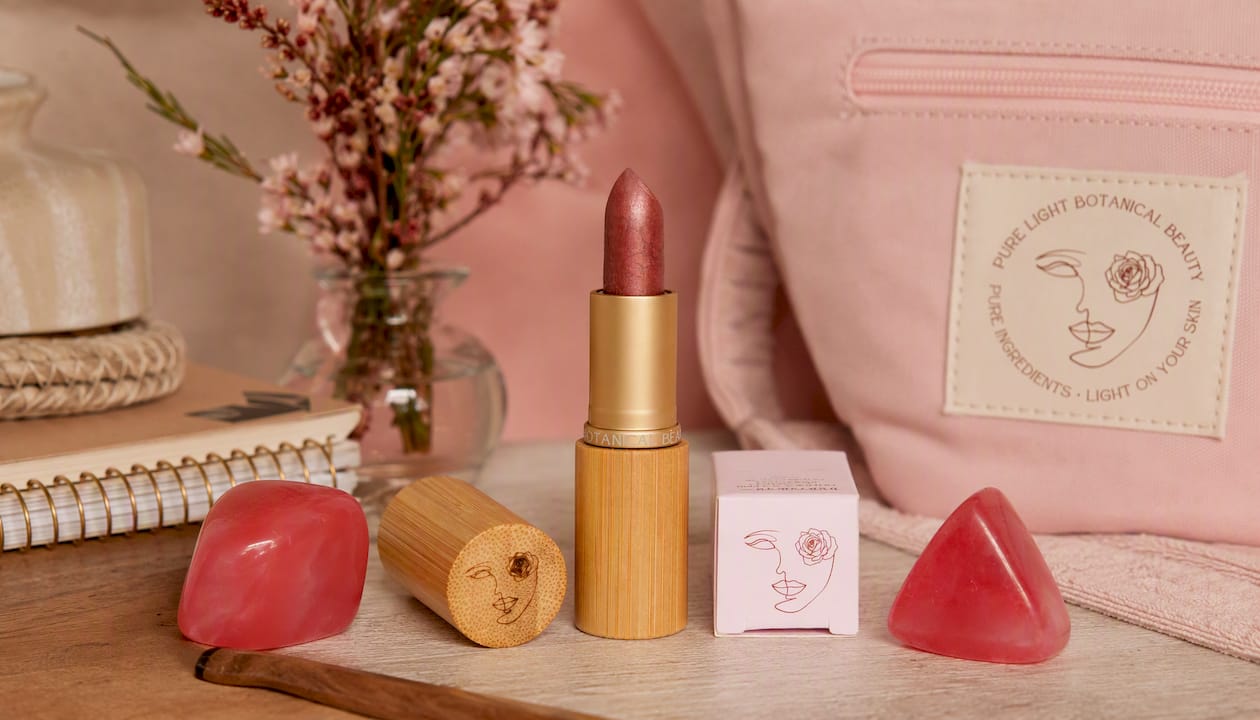
The Ruby shade is a warm, everyday red built on that same base, and Cherry Quartz offers a cooler, berry-toned option if you want to test the formula in a different family before committing to a full wardrobe of shades. Once you find your color, the refill keeps you from repurchasing the case every time. If you’re new to switching, patch test on your inner wrist for 24 hours before applying to your lips, the same rule that applies to any new organic formula, ours included.
Where to Learn More About Ingredient Safety and Certification
- USDA Organic program pages explain exactly what percentage of organic content a product needs to carry the seal.
- COSMOS and Ecocert standards detail how European organic and natural cosmetic certifications differ from the US system.
- Our own guide to clean cosmetics benefits and lead-free lipstick comparison go deeper into sourcing and trace-metal testing than this guide has room for.
FAQ
Is Organic Lipstick Safe to Use?
Organic lipstick is generally safe for most people, and often safer for sensitive or eczema-prone lips, but “organic” alone doesn’t guarantee zero irritation risk since individual ingredients like beeswax or essential oils can still trigger reactions in specific people.
How Can I Tell If a Lipstick Is Truly Organic?
Check for a third-party certification like USDA Organic or COSMOS/Ecocert, and confirm the brand publishes a full INCI ingredient list rather than relying on unregulated marketing words like “natural” or “clean.”
What Is an Organic Lipstick?
An organic lipstick is a lip color made primarily from certified organic and plant-derived ingredients, such as shea butter, cocoa butter, and mineral pigments, instead of petroleum-based fillers and synthetic dyes.
Does Organic Lipstick Last as Long as Conventional Lipstick?
Generally, no. Organic formulas typically wear for a shorter stretch than conventional lipsticks because they skip the synthetic film-formers that create long-lasting hold, though botanical waxes and butters still provide moderate, comfortable wear.
How Long Does Organic Lipstick Last Before It Expires?
Most certified organic lipsticks generally last about a year to a year and a half once opened, shorter than the typical shelf life of conventional lipsticks containing parabens and other long-acting preservatives.