

“Beyond beauty” is a healing-first philosophy: plant-based makeup and skincare rituals that repair your skin barrier while providing gentle, nourishing coverage. Tonight, cleanse with a fragrance-free wash, layer an emollient rich in ceramides or colloidal oatmeal, seal with petrolatum, and wake up to a calmer, more receptive canvas. Dermatologist Dr. Ramirez calls this the “night-before” foundation of any safe makeup routine for eczema-prone skin, and the NEA Seal of Acceptance offers a reliable trust marker when you’re choosing products to support that ritual.
Key Takeaways
Plant-based, barrier-first makeup is the most reliable approach for sensitive and eczema-prone skin: repair the barrier the night before, choose fragrance-free formulas with ceramides and colloidal oatmeal, and never apply makeup over broken skin.
| Point | Details |
|---|---|
| Barrier repair comes first | Cleanse, layer an emollient with ceramides, and seal with petrolatum the night before applying makeup. |
| Label signals that matter | “Fragrance-free,” “hypoallergenic,” and the NEA Seal of Acceptance are the most reliable filters for sensitive skin. |
| Patch-test every new product | Apply to the inner forearm for 48–72 hours before using on your face; stop at the first sign of reaction. |
| Skip makeup during flares | Never apply products to broken, weeping, or actively inflamed skin — wait until the skin has fully calmed. |
| Purelightbotanicalbeauty | Offers plant-based formulas and Beauty Within™ Online Coaching for a personalized healing-first beauty routine. |
Table of Contents
- Why your skin barrier comes first with eczema-prone skin
- The night-before ritual you can do tonight
- How to choose clean makeup that won’t irritate sensitive skin
- How to apply and remove makeup gently on sensitive skin
- What to look for by product category
- When to stop a product and when to see a dermatologist
- Beauty as healing: a perspective worth holding onto
- Purelightbotanicalbeauty’s healing-first approach, made personal
- Useful sources and further reading
Why your skin barrier comes first with eczema-prone skin
A compromised skin barrier is the root of the eczema cycle, not just a symptom. When the barrier is disrupted, moisture escapes and irritants enter more easily, triggering the itch-inflammation loop that makes eczema so persistent. Applying makeup over that disrupted surface without addressing the barrier first is like painting a wall with cracks: the finish suffers, and the damage underneath worsens.
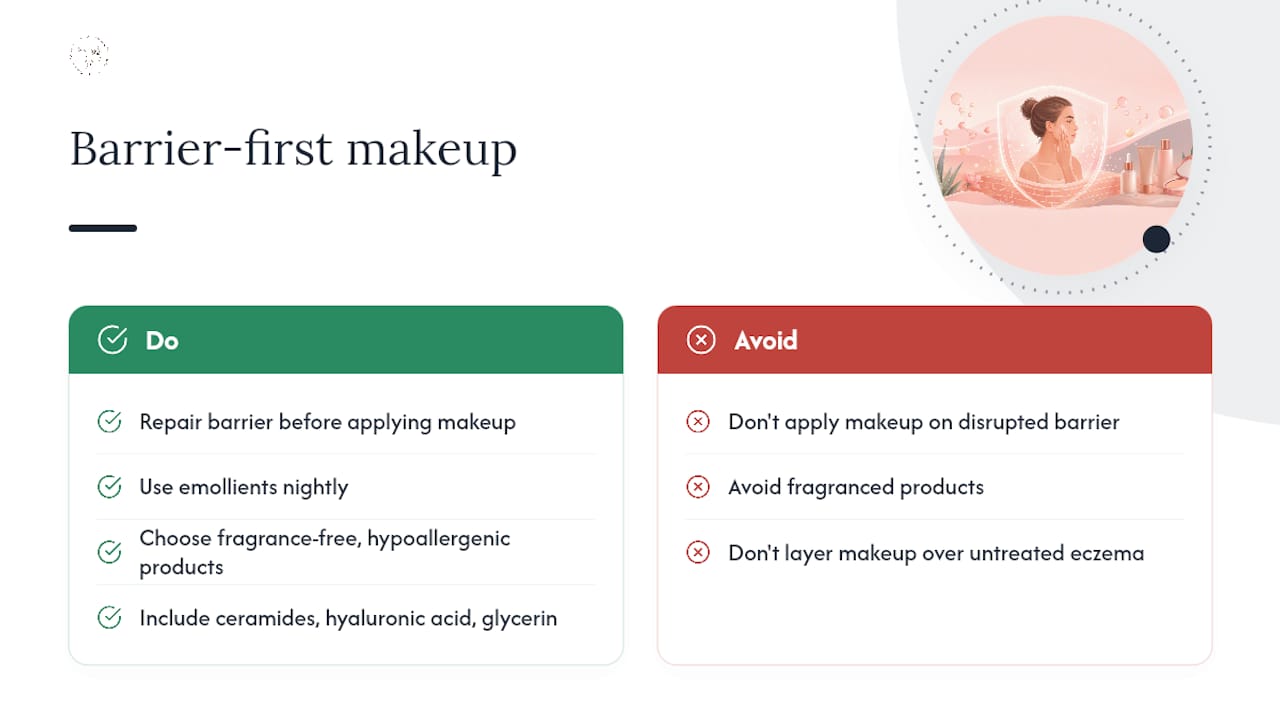
Clinical reviews of atopic dermatitis care consistently place barrier-repair strategies at the center of treatment. Ceramides, hyaluronic acid, glycerin, and petrolatum are among the most studied ingredients for restoring and maintaining that protective layer. A broad review of complementary therapies in atopic dermatitis found that OTC petroleum-based moisturizers were more cost-effective than some prescription barrier creams in one RCT, which speaks to how accessible effective barrier care can be.
Dr. Shari Marchbein, a board-certified dermatologist, emphasizes that “fragrance-free” and “hypoallergenic” labels are the most reliable quick filters for sensitive-skin shoppers because they reduce the likelihood of allergic contact reactions. Dr. Ramirez reinforces this by recommending that the ideal makeup routine begins the night before, with diligent barrier repair and consistent emollients so that makeup enhances rather than disrupts skin.
Clinical signal: Multiple RCTs and meta-analyses support barrier-focused interventions, including emollients and ceramide-containing formulations, as a meaningful strategy for reducing eczema severity and improving skin texture over time.
The night-before ritual you can do tonight
One night of meticulous barrier care genuinely changes how your skin receives makeup the next morning. Here is the sequence Dr. Ramirez recommends, adapted for practical home use:
- Gentle cleanse. Use a fragrance-free, soap-free cleanser. Avoid hot water; lukewarm is enough. Pat skin dry with a soft cloth rather than rubbing.
- Targeted actives (if tolerated). If your skin is calm and not in a flare, a niacinamide serum can support barrier function and reduce redness. Skip this step during active inflammation.
- Emollient layer. Apply a ceramide-rich or colloidal oatmeal cream while skin is still slightly damp. This is the most important step: it replenishes the lipids your barrier needs.
- Occlusive seal. Follow with a thin layer of petrolatum or a petrolatum-based balm to lock in the emollient. Wait 10–15 minutes before any additional layers.
- Wet-wrap option (for moderate dryness). After the emollient, dampen a soft cotton cloth and wrap the treated area loosely for 20–30 minutes before applying the occlusive. This technique can accelerate moisture absorption.
Pro Tip: Wet wraps are most effective on the body and limbs. For facial eczema, a damp cotton mask worn for 10 minutes over your emollient layer offers a gentler version of the same principle. Always use clean, unbleached cotton.
For a deeper look at barrier repair routines tailored to sensitive skin, Purelightbotanicalbeauty’s blog offers step-by-step guidance grounded in the same healing-first approach.
How to choose clean makeup that won’t irritate sensitive skin
The simplest rule: look for “fragrance-free” and “hypoallergenic” on the label, then check the ingredient list against the framework below.
| Seek These Ingredients | Avoid These Ingredients |
|---|---|
| Ceramides | Synthetic fragrance / parfum |
| Hyaluronic acid | Drying alcohols (denatured, SD alcohol) |
| Glycerin | Essential oils (lavender, eucalyptus, citrus) |
| Niacinamide | Certain preservatives (formaldehyde-releasers) |
| Colloidal oatmeal | Some chemical UV filters (oxybenzone, octinoxate) |
| Sunflower seed oil | Mica in heavy concentrations for broken skin |
| Virgin coconut oil | Sodium lauryl sulfate |
| Squalane | Artificial dyes (D&C colorants) |
| Petrolatum | Parabens (if sensitivity is confirmed) |
Small clinical trials suggest that virgin coconut oil and sunflower seed oil can improve barrier function and reduce eczema severity compared with some alternatives, though evidence varies in study size. Colloidal oatmeal is among the best-researched natural ingredients for eczema relief; both U.S. and Canadian regulators recognize its protective and soothing properties in topical products.
Label signals worth trusting: “Fragrance-free” is more meaningful than “unscented” (which may contain masking agents). “Dermatologist-tested” means a dermatologist reviewed the formula, but it does not guarantee it suits every skin type. The NEA Seal of Acceptance is the most specific trust marker for eczema-prone skin: products bearing it have been reviewed for ingredients that are unlikely to trigger flares.
Patch-testing is non-negotiable. Apply a small amount of any new product to your inner forearm, leave it uncovered, and observe for 48–72 hours. If redness, itching, or swelling appears, discontinue immediately. For facial products, test on the jawline rather than the cheek, where skin is slightly less reactive.
Pro Tip: When transitioning to clean makeup, introduce one new product at a time with a full week between introductions. This makes it easy to identify the culprit if a reaction occurs.
How to apply and remove makeup gently on sensitive skin
Gentle application and prompt, thorough removal protect the barrier just as much as the products themselves. Friction and residue are two of the most common triggers for post-makeup flares.
Application and removal protocol:
- Prep. Apply your morning moisturizer and allow it to absorb for at least 5 minutes. Follow with a fragrance-free, mineral-based primer to create a smooth buffer between your skin and pigment.
- Apply in thin layers. Use a damp silicone sponge or a clean, soft brush. Press product into skin rather than dragging it across the surface.
- Minimize friction. Avoid buffing motions. Stipple or pat for blush and concealer.
- Remove promptly. At the end of the day, dissolve makeup with a fragrance-free micellar water or cleansing balm, then follow with a gentle soap-free cleanser. Never sleep in makeup.
- Re-moisturize within 60 seconds. Apply your emollient immediately after cleansing, while skin is still slightly damp, to prevent transepidermal water loss.
Tool hygiene checklist:
- Wash sponges and brushes with fragrance-free soap every 7–10 days, or after each use if skin is actively reactive.
- Replace disposable sponges weekly.
- Store tools in a clean, dry container, never loose in a makeup bag where bacteria accumulate.
- Consider single-use applicators for concealer during sensitive periods.
Do not apply makeup to broken skin, actively weeping eczema, or open sores. Covering an active flare traps bacteria, delays healing, and risks secondary infection. Wait until the skin has fully closed and calmed before resuming coverage.
What to look for by product category
Cream, balm, and lipid-rich formulations are the preferred forms for eczema-prone skin because they deliver hydration alongside color. Dry powders, matte finishes, and alcohol-based setting sprays tend to pull moisture from an already-compromised barrier.
Foundation. Seek tinted moisturizers or skin-tint formulas with ceramides and hyaluronic acid. Avoid full-coverage matte foundations with high talc or alcohol content. A sheer, buildable formula gives you control without overloading the skin.
Concealer. A creamy, balm-based concealer with glycerin or squalane blends without tugging. Avoid waterproof formulas with film-forming polymers that require heavy removal.
Blush. Cream blush is gentler than pressed powder. Purelightbotanicalbeauty’s Botanical Crème Blush is formulated with plant-based pigments and skin-nourishing botanicals, making it a natural fit for this category. Look for products with no synthetic fragrance and minimal colorant load.
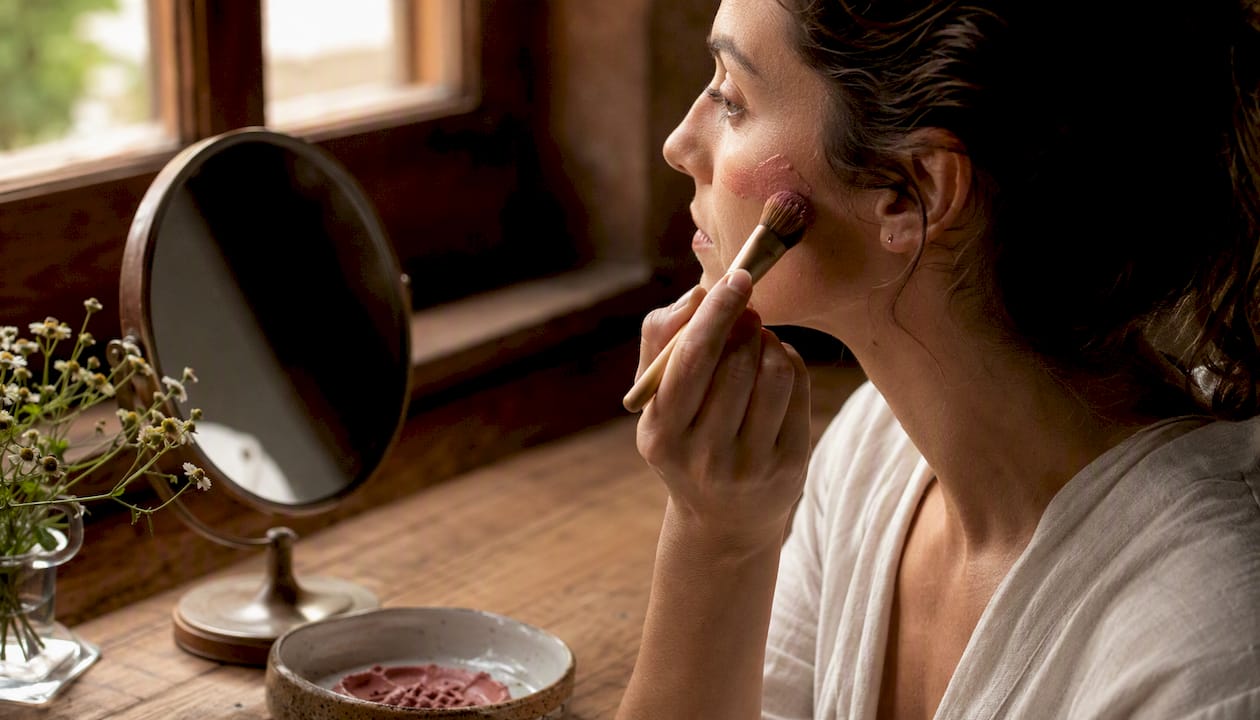
Lip care. A lip oil or balm-based lipstick delivers color and moisture simultaneously. The Petal Perfect Lip Oil and Nourishing Lipstick from Purelightbotanicalbeauty are designed with this dual purpose. Avoid matte liquid lipsticks with drying alcohols.
Sunscreen. Mineral (physical) sunscreens with zinc oxide or titanium dioxide are better tolerated by sensitive skin than most chemical UV filters. Look for the NEA Seal of Acceptance on sunscreen formulas when possible. A tinted mineral SPF can double as a light foundation on lower-symptom days.
For a full holistic beauty routine built around these categories, Purelightbotanicalbeauty’s blog offers practical, skin-first guidance.
When to stop a product and when to see a dermatologist
Stop any product immediately if you notice increased redness, spreading rash, blistering, oozing, or a burning sensation that persists beyond 30 minutes of application. These are not adjustment reactions. They are signals that the product is actively harming your barrier.
Red flags that require stopping a product:
- Redness or swelling that spreads beyond the application area
- New blistering or weeping after product use
- Intense itching that worsens rather than settles
- Systemic symptoms: hives, swelling of the lips or eyes, difficulty breathing (seek emergency care immediately)
- Any sign of infection: yellow or green discharge, warmth, crusting
Patch-test every new product for 48–72 hours on the inner forearm before applying it to your face. If a reaction appears at 24 hours, stop; do not wait the full period.
When you visit a dermatologist, bring a written list of every product you use (including makeup, sunscreen, and laundry detergent), a photo timeline of your skin over the past 4–6 weeks, and any products you suspect triggered a reaction. This information allows your clinician to identify patterns quickly and recommend targeted alternatives.
This article is general information, not a substitute for professional medical advice. Always confirm treatment decisions with a qualified dermatologist.
Beauty as healing: a perspective worth holding onto
There is a quiet resilience in choosing to care for your skin rather than simply cover it. The “beyond beauty” approach is not a trend; it is a return to something more honest. When I think about what it means to wear makeup with eczema-prone skin, I keep returning to the same truth: the ritual matters as much as the result. Slowing down to cleanse gently, to layer an emollient with intention, to choose a product because it nourishes rather than merely conceals — these are self-love practices that compound over time.
What most conventional beauty advice misses is that consistent skincare adherence is as much a mindset as a method. Readers who frame their nightly barrier routine as a ritual of care, rather than a chore, tend to maintain it far more reliably. The science of botanicals and the art of self-compassion are not separate disciplines. They reinforce each other. Wellness and beauty, approached this way, become a single, coherent practice.
Purelightbotanicalbeauty was built on exactly this belief: that your skin deserves ingredients that heal, and that you deserve to feel radiant without compromise.
Purelightbotanicalbeauty’s healing-first approach, made personal
Purelightbotanicalbeauty translates the “beyond beauty” philosophy into products and guided support that work together: clean, plant-based formulas designed for sensitive and eczema-prone skin, and a coaching program that helps you build a personalized healing-first routine from the ground up.

The Beauty Within™ Online Coaching program is the most direct path for readers who want more than a product list. It offers personalized guidance on barrier repair, ingredient selection, and mindful beauty techniques, grounded in the same healing-first principles this guide covers. Whether you are navigating your first clean-beauty swap or managing a persistent flare, the program meets you where you are. Visit Purelightbotanicalbeauty to learn more and take the first step toward beauty that genuinely heals.
Useful sources and further reading
- Dr. Ramirez, Vogue Singapore — Interview on building a makeup routine for eczema-prone skin; primary source for the night-before barrier-repair approach.
- Dr. Shari Marchbein, Allure — Dermatologist guidance on label signals (“fragrance-free,” “hypoallergenic”) as primary filters for sensitive-skin shoppers.
- PMC — Complementary therapies and barrier repair in atopic dermatitis — Clinical review covering ceramides, hyaluronic acid, petrolatum, and plant oils; source for ingredient evidence and RCT findings.
- Cleveland Clinic — Home remedies for eczema — Clinician-reviewed overview of colloidal oatmeal, coconut oil, and petrolatum as accessible, evidence-backed adjuncts.
- Healthline — Makeup for eczema-prone skin — Practical clinician-backed guidance on safe application, removal, and the NEA Seal of Acceptance as a product trust marker.
- WebMD — Best and worst cosmetic ingredients for eczema — Dermatology-sourced reference for humectants, ceramides, niacinamide, and petrolatum in barrier maintenance.
Recommended
- 7 Types of Mindful Makeup for Sensitive, Radiant Skin – Pure Light Botanical Beauty
- Natural Makeup: Healing Sensitive Skin Through Beauty – Pure Light Botanical Beauty
- Performance-Driven Makeup: Beauty That Heals Sensitive Skin – Pure Light Botanical Beauty
- Minimalism in Makeup: Healing Beauty for Sensitive Skin – Pure Light Botanical Beauty