

A clean perfume is a fragrance formulated with disclosed ingredients that avoids substances commonly flagged by clean-beauty standards, like phthalates, certain synthetic musks, and formaldehyde releasers. Before buying, check the ingredient list, look for dermatological testing claims, and sample the scent on skin for 24 to 48 hours. Several skin-friendly options appear later in this guide, including scent-adjacent picks from a brand specializing in botanical beauty products.
TL;DR:
- Many clean perfumes are priced between $60 and $180 due to smaller batch production, natural sourcing costs, and third-party safety testing.
- Full ingredient transparency varies widely, with brands that disclose specific fragrance components and respond to direct questions offering more reliable safety.
- “Clean” does not mean fragrance-free or all-natural, as well-vetted synthetics can reduce allergens and environmental impact compared to some natural extracts.
- Labels like “fragrance” can hide dozens of undisclosed, potentially allergenic compounds, making direct brand inquiry a crucial step.
- Scent profiles commonly associated with clean perfumes include soapy aldehydic notes, bright citrus, aquatic elements, and soft musks, but formulation method determines longevity and character.
Table of Contents
- What Does “Clean Perfume” Actually Mean?
- How Do You Choose a Clean Perfume?
- Which Ingredients Should You Avoid, and Why?
- What Does a “Clean” Scent Actually Smell Like?
- What Do Sensitive-Skin Experts Say About Wearing Fragrance?
- How Much More Does Clean Perfume Cost?
- Which Clean Perfume Brands Are Worth Knowing?
- Where Should You Buy Clean Perfume, and How Do You Spot Fakes?
- Do Clean Perfumes Last as Long as Conventional Ones?
- What This Guide Gets Right That Most Clean-Beauty Advice Misses
- A Gentler Way to Wear Scent: Purelightbotanicalbeauty’s Approach
- Sources Worth Bookmarking
- FAQ
What Does “Clean Perfume” Actually Mean?
There is no single legal definition of clean perfume. No government agency issues a “clean” seal, which means the word is doing marketing work as much as safety work. That matters because two bottles can both carry a “clean” label and contain meaningfully different ingredient philosophies.
Retailer-led programs fill the gap. The CLEAN at Sephora program, for instance, excludes categories like parabens, phthalates, and mineral oils from qualifying products, but the exact exclusion list varies from one retailer or certifier to the next. A fragrance that passes one brand’s clean threshold might not pass another’s, so the label alone tells you less than the ingredient panel does.
Here is the part that surprises a lot of shoppers: clean does not mean only natural. Industry voices in the clean-beauty space increasingly argue that a well-vetted synthetic can beat a natural extract on both allergen risk and environmental footprint. A lab-created musk replacement, for example, can spare an endangered species and reduce the allergic potential that comes with some natural absolutes. The cleanest formulas often blend a short list of natural botanicals with a few deliberately chosen synthetics, not a total absence of lab-made ingredients.
There is also a disclosure problem baked into the industry. Investigative reporting on the fragrance sector has found that many ingredients are protected as trade secrets, which limits how much a brand can legally reveal even when it wants to be transparent. A single word, “fragrance,” on an ingredient panel can legally stand in for dozens of individual compounds.
What a genuinely clean-leaning brand tends to offer instead:
- A published list of the ingredient categories it avoids and why
- Willingness to answer direct questions about fragrance components, even when full disclosure isn’t legally required
- Batch testing or sourcing documentation available on request
- Clear labeling that distinguishes “fragrance-free” from “unscented” (the latter often still contains masking fragrance)
Reading a clean beauty terminology glossary before you shop helps you spot the difference between a brand that’s transparent by policy and one that’s simply not saying much.
How Do You Choose a Clean Perfume?
Choosing well comes down to a sequence, not a single glance at the front label. Work through it in order and you’ll catch most of the red flags before they reach your skin.
- Pull up the full ingredient list, not just the marketing copy. If a brand only lists “parfum” or “fragrance” with nothing else, that’s a transparency gap worth noting, even if the rest of the formula looks clean.
- Scan for flagged names and their synonyms. Phthalates sometimes hide behind abbreviations like DEP or DBP. “Musk ketone” and “musk xylene” are two synthetic musks worth recognizing by name, since they don’t always announce themselves as “musk” on a label.
- Confirm the brand’s testing and sample policy. A brand confident in its formula will usually offer a sample size or a return window, since it knows patch testing is part of buying fragrance responsibly.
- Check packaging and sustainability claims against specifics. “Eco-friendly” without a detail (refillable bottle, recycled glass, biodegradable packaging) is a claim, not evidence.
- Do a two-stage test before committing to a full bottle.
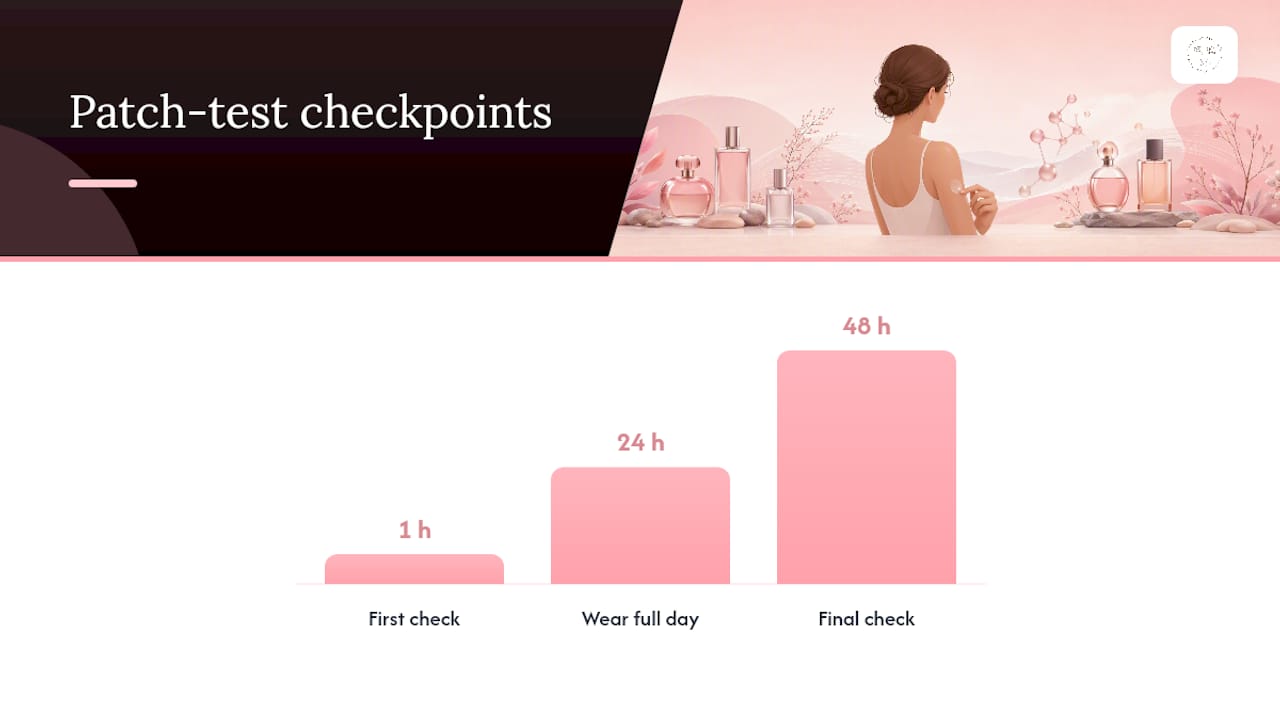
For the test itself, fragrance specialists recommend a patch-and-trial protocol: apply a small amount to your inner forearm, leave it uncovered, and check it at one hour, 24 hours, and 48 hours for redness, itching, or any delayed reaction. Wear the scent for a full day before deciding, since fragrance changes character over hours as top notes fade and base notes emerge.
Decision rules make this simpler. Buy if the ingredient list is disclosed, the scent holds up after 24 hours on skin with no irritation, and the base notes still appeal to you after they settle. Return if you notice any redness, itching, or blistering within 48 hours, or if the brand won’t answer a direct ingredient question. Consult a dermatologist if a reaction is severe, spreading, or doesn’t resolve within a day or two of stopping use.
Pro Tip: If a brand’s ingredient list looks abbreviated, email them before you buy. A brand serious about ingredient transparency will usually respond with specifics; a brand that goes quiet or gives you a vague marketing line just answered your question a different way.
Which Ingredients Should You Avoid, and Why?
Four categories account for most of the concern behind the clean-fragrance movement. Knowing their names, and their aliases, is the single most useful skill for reading a label quickly.
- Phthalates, often used to help fragrance last longer on skin, appear under abbreviations like DEP or DBP and have drawn scrutiny over hormone-disruption concerns.
- Synthetic musks, including musk ketone and musk xylene, are prized for scent longevity but have raised environmental persistence questions, since some accumulate in waterways and body tissue.
- Parabens, more commonly flagged in skincare than fragrance, still show up in some perfume formulas as preservatives and carry similar hormone-related concern.
- Formaldehyde releasers, ingredients that slowly release small amounts of formaldehyde to act as a preservative, are a known sensitizer for reactive skin.
The regulatory picture and the consumer-avoidance picture are not the same thing. A synonym like “quaternium-15” or “DMDM hydantoin” might be perfectly legal in a given market while still being exactly what a sensitive-skin shopper wants to skip. Legality is a floor, not a recommendation.
The trade-secret problem makes this harder than it should be. Because a brand can legally list “fragrance” as one line item, dozens of individual compounds, some potentially allergenic, can sit behind that single word with no requirement to name them. When you hit that wall, your best move is contacting the brand directly and favoring companies that publish full INCI lists or respond transparently to ingredient questions, since that willingness itself is a signal worth weighing.
A useful reference point: fragrance formulas can legally contain dozens of individual aroma chemicals under a single “fragrance” listing, according to advocacy research into the industry’s disclosure practices. That single line item is one of the biggest reasons ingredient transparency has become the central battleground in clean beauty, more than any specific chemical debate.
Our transparent beauty labeling piece breaks down how to read a cosmetics label in more depth if you want to go further than fragrance alone.
What Does a “Clean” Scent Actually Smell Like?
“Clean” and “fresh” get used interchangeably, but they describe different things. Fresh is an olfactory family, citrus, aquatic, and green notes fall under it, while clean is more of a formulation philosophy about what’s been left out. A rich amber or warm musk fragrance can be formulated clean; it just won’t smell fresh.
That said, certain profiles show up disproportionately often in the clean-fragrance space:
- Soapy, aldehydic scents that read like fresh linen or a just-showered feeling
- Bright citrus tops (bergamot, yuzu, grapefruit) layered over a soft base
- Aquatic notes that mimic sea air or rain without leaning synthetic-sharp
- Airy, low-dose musks that give warmth without heaviness
- Soft florals like white tea, jasmine, or rose in restrained concentrations
For application, less is more on sensitive skin. Apply to pulse points, wrists, inner elbows, the base of the throat, rather than broad swaths of skin, and consider spritzing clothing instead of skin if you’re prone to reactions. Fabric holds scent longer without the direct skin contact that triggers most sensitivities.
Layering is where a lot of people go wrong. Perfumery guidance suggests applying different scents to separate pulse points, rather than mixing two fragrances directly on the same patch of skin, so they blend in the air instead of fighting each other on your wrist. Try your lighter scent on your wrists and something warmer at your collarbone; the two will meet as you move rather than clash in one spot.
If you’re navigating a fragrance-sensitive workplace or event, non-perfume scent options, a lightly scented lip balm, a botanical oil applied sparingly, are worth having on hand. Our fragrance-free makeup comparison covers alternatives if you want beauty products that skip added scent entirely.
What Do Sensitive-Skin Experts Say About Wearing Fragrance?
Fragrance and sensitive skin have a complicated relationship, and most guidance treats them as separate topics when they’re not. Caitlin Grey, who writes on botanical cosmetics and sensitive-skin formulation, points out that the products surrounding your fragrance matter almost as much as the fragrance itself.
The mistake I see most often isn’t the perfume choice. It’s applying a bold scent directly onto skin that’s already inflamed, dry, or freshly exfoliated. Fragrance sits differently on compromised skin, and it reacts differently too.
Certain natural botanical beauty brands formulate with that layered reality in mind. Their products often list full ingredient panels and use botanical bases with plant-derived ingredients chosen to support skin health rather than just sit on top of it.
A simple ritual helps: moisturize with a gentle, fragrance-light balm before applying any scent, wait a few minutes for it to absorb, then apply your perfume to pulse points rather than over the moisturized area directly. After a long day of wearing fragrance, a calming post-wear step, even something as simple as a plant-based lip treatment, helps close the ritual instead of just ending it.
Pro Tip: If your skin runs sensitive, apply fragrance to clothing seams or hair instead of bare skin on days when your skin barrier already feels compromised. You still get the scent experience without the direct contact.
How Much More Does Clean Perfume Cost?
Clean perfume tends to sit anywhere from comparable to noticeably higher than conventional fragrance, and the gap comes down to sourcing and batch size more than marketing. A mass-market conventional eau de toilette often runs somewhere in the $30 to $80 range at drugstore or department store counters. Clean and indie fragrance houses frequently price similar concentrations between $60 and $180, with niche clean perfumers sometimes charging more for small-batch, naturally derived materials.
The cost driver isn’t mysterious. Sourcing traceable botanicals, running smaller production batches, and paying for third-party safety testing all add expense that mass fragrance houses avoid through massive scale and synthetic-heavy formulas. A conventional perfume house can buy synthetic musk by the ton; a clean-focused brand sourcing a specific rose absolute in smaller quantities pays a premium per ounce that shows up in the final price tag.
That doesn’t mean higher price guarantees higher quality or better transparency. Some mid-range clean brands publish full ingredient panels and test rigorously at $40 to $60 a bottle, while some luxury-priced fragrances still hide behind a single “parfum” line item. Price is a rough proxy for production cost, not a proxy for ingredient honesty. The smarter move is comparing ingredient disclosure and testing claims across price points rather than assuming the $150 bottle is automatically cleaner than the $45 one.
Which Clean Perfume Brands Are Worth Knowing?
The clean-fragrance space splits roughly into three tiers: mass-retail clean lines, independent niche perfumers, and skin-focused beauty brands offering scent-adjacent products rather than traditional eau de parfum.
Retailer-vetted programs, like the exclusion lists set by major clean-beauty retailers, give you a starting filter for mass availability, though the definitions and rigor vary by retailer, so treat “clean” shelf placement as a first screen, not a final verdict. Independent and artisanal perfumers, the kind featured in documentary coverage of natural perfumery, often work with smaller batches of natural absolutes and essential oils, producing more complex, less uniform scent profiles than mass-market synthetics allow.
If you’re building a sensitive-skin fragrance routine rather than hunting for a signature eau de parfum, scent-adjacent botanical products deserve a place in the conversation. One brand’s approach leans this direction: rather than competing on a traditional perfume shelf, it offers lightly scented, plant-based products, like a tinted lip oil or a calendula-based balm, formulated for skin health first, with scent as a gentle byproduct rather than the main event. That’s a genuinely different category from a 100ml bottle of eau de parfum, and it fills a real gap for shoppers who want a hint of botanical scent without full-strength fragrance exposure.
Whichever tier you shop, a full ingredient list and a clear return policy matter more than the brand name on the box.
Where Should You Buy Clean Perfume, and How Do You Spot Fakes?
Buying direct from a brand’s own website is the safest route for both authenticity and ingredient information. Brand sites are far more likely to publish current, accurate ingredient panels than third-party marketplaces, and you get a direct channel to ask questions before you buy.
Specialty clean-beauty retailers, whether a dedicated clean-beauty shop or a department store’s clean-certified section, offer a useful middle ground. They’ve typically vetted the brand’s ingredient claims to some baseline standard, though as covered earlier, that standard isn’t universal across retailers.
Marketplace listings deserve more caution. Counterfeit fragrance is a real problem on open marketplaces, and a fake bottle defeats the entire purpose of buying clean, since you have no idea what’s actually inside it. A few authenticity checks that apply across most fragrance purchases:
- Compare batch codes against the brand’s official website if they publish them
- Be suspicious of prices dramatically below the brand’s own listed price
- Check that box printing, cap fit, and glass quality match official product photos
- Buy directly from the brand or an authorized retailer whenever the option exists
For clean fragrance specifically, add one more check: authentic clean brands almost always make their ingredient list easy to find, on the box, the website, or both. A listing that’s vague about ingredients on top of being suspiciously cheap is two red flags stacking into one clear “skip it.”
Do Clean Perfumes Last as Long as Conventional Ones?
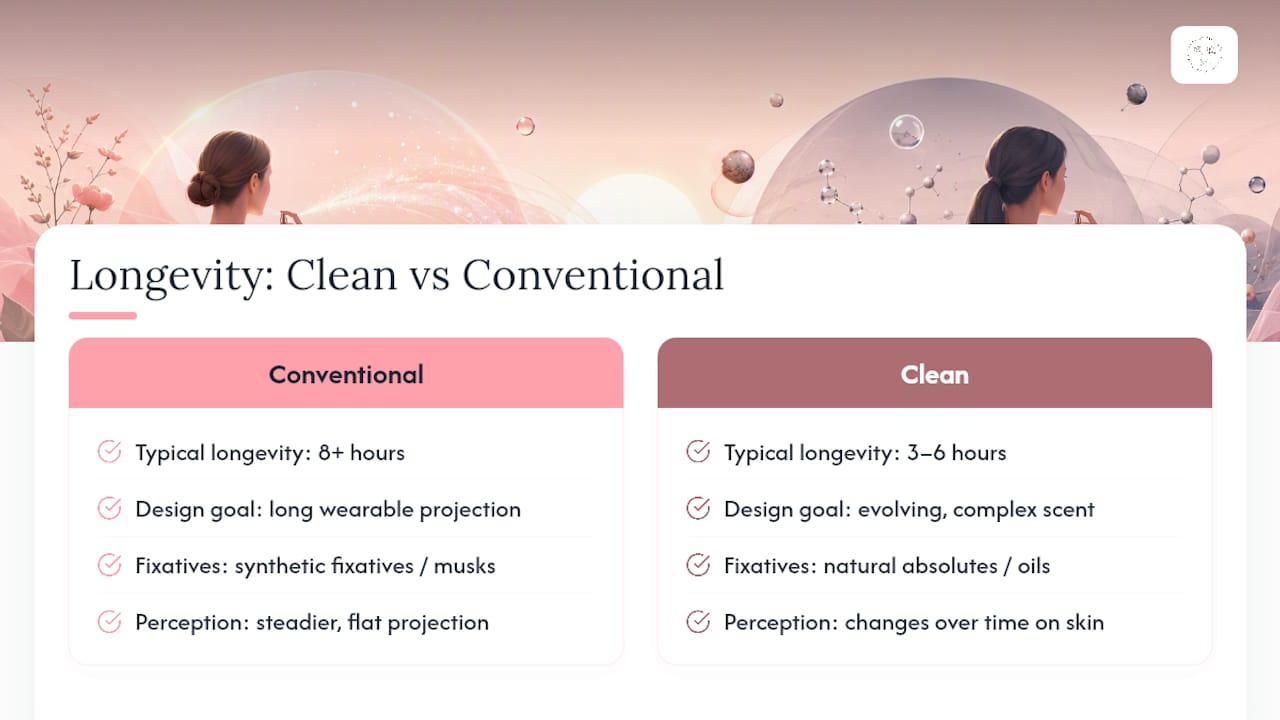
Generally, no, not at the same concentration, and that’s a tradeoff worth knowing before you buy. Conventional perfumes often rely on synthetic fixatives and stabilized synthetic musks specifically engineered for extended wear, sometimes eight hours or more from a single application. Clean formulations, especially those built around natural absolutes and essential oils, tend to fade faster, often landing in the three to six hour range depending on concentration and skin chemistry.
This isn’t a flaw so much as a different design goal. Natural aromatic materials evolve over time on skin, top notes appear first, then fade into a different heart and base as the hours pass, which produces a more complex, changing scent experience but a shorter overall lifespan than a synthetic fixative engineered for flat, extended projection.
A few practical adjustments close most of the gap. Applying to slightly damp, freshly moisturized skin extends wear time because oils in skin cream help trap and slow-release fragrance molecules. Reapplying at the midpoint of your day, rather than expecting one application to carry through 12 hours, is standard practice among clean-fragrance wearers rather than a sign the product underperformed. Layering a scented body product, like a lightly fragranced balm, underneath your perfume can also extend perceived longevity without adding a second competing scent on top.
If all-day projection without reapplication matters more to you than ingredient minimalism, that’s a legitimate tradeoff to weigh rather than a reason to write off clean fragrance entirely.
What This Guide Gets Right That Most Clean-Beauty Advice Misses
Most clean-perfume content treats “avoid these ingredients” as the whole story. It isn’t. The research here points to something more useful: transparency behavior matters more than any single ingredient list, because a brand willing to answer a direct question about its “fragrance” line item is telling you something a perfect-looking label can’t.
The conventional advice oversells natural as automatically safer. It’s not. Some essential oils are more allergenic than the synthetics they’re meant to replace, and the smarter clean brands know this, which is why the best ones use selective synthetics rather than swearing off them entirely.
What actually deserves priority, in order: disclosure first, patch testing second, scent profile third. Too many buyers reverse that order, chasing a note they love before confirming the brand will even tell them what’s in it. Fix that sequence and you avoid most of the regret purchases people make in this category, expensive bottles that turn out to irritate skin or hide behind vague labeling nobody bothered to question upfront.
— Caitlin Grey
A Gentler Way to Wear Scent: Purelightbotanicalbeauty’s Approach
Purelightbotanicalbeauty isn’t a perfume house, and it won’t pretend to compete with a 100ml bottle of eau de parfum. What it offers instead is a genuinely different lane for readers who love the idea of clean fragrance but want their skin cared for first: plant-based products where a light, botanical scent is a gentle byproduct of ingredients chosen for skin health, not the main event.
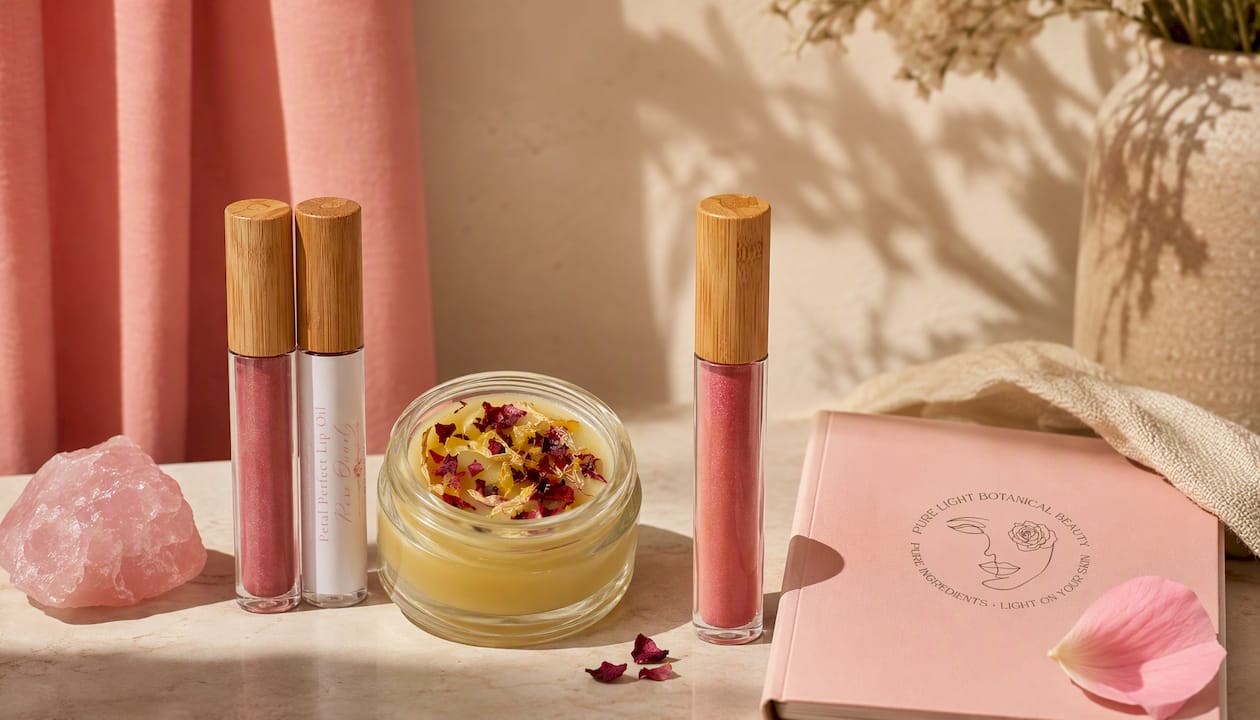
The Botanical Crème Blush™ and Petal Perfect Lip Oil™ Duo pairs two of the brand’s gentlest formulas for readers who want a soft, everyday botanical presence without full-strength fragrance exposure. If your skin runs sensitive or reactive, the Botanical Beauty Balm™ in Calendula & Rose leans on calming plant ingredients with only the lightest natural scent trace, a good fit for the post-fragrance care ritual described earlier in this guide. For lips specifically, the Petal Perfect Lip Oil™ delivers nourishment with a soft rose note rather than an added synthetic fragrance load.
If you want more than a product, a holistic skin consultation walks through your specific sensitivities, including how fragrance and skincare interact on your particular skin, before you spend money guessing. Start by browsing the nourishing cosmetics collection to see which botanical formula fits your routine.
Sources Worth Bookmarking
A few sources go deeper than this guide’s scope allows:
- Women’s Voices for the Earth’s fragrance industry reporting — covers trade-secret disclosure limits and why “fragrance” on a label can conceal dozens of compounds.
- Tatler Asia’s clean-versus-fresh explainer — clarifies the terminology confusion between marketing language and olfactory scent families.
- PBS’s natural perfumery coverage — documents artisanal production methods for readers curious about how natural fragrance differs from mass synthetic manufacturing.
FAQ
What Is the Cleanest Perfume Brand?
There’s no single certified “cleanest” brand, since no universal regulatory standard exists for the term. The most reliable indicator is a brand that publishes its full ingredient list, discloses individual fragrance components rather than one vague “fragrance” line, and answers ingredient questions directly rather than deflecting them.
Is There Such a Thing as Clean Perfume?
Yes, though “clean” describes a formulation philosophy and disclosure practice rather than a regulated category. A clean perfume typically avoids ingredients like phthalates, certain synthetic musks, and formaldehyde releasers, and comes from a brand willing to disclose what’s actually in the bottle.
Is There a 100% Natural Perfume?
Fully natural perfumes exist, mostly among small-batch and artisanal perfumers working with essential oils and absolutes, but they’re a minority of the market. Fully natural doesn’t automatically mean safer for sensitive skin, since some natural aromatic materials are potent allergens in their own right.
What Scent Smells the Cleanest?
Soapy, aldehydic notes and bright citrus tops are the profiles most commonly described as smelling “clean,” alongside airy aquatic and soft musk notes. That said, “clean” as a formulation choice can apply to any scent family, including warm ambers and rich florals, so scent character and ingredient transparency are separate questions.
How Much Should I Expect to Pay for a Clean Perfume?
Clean and indie perfume brands commonly price a full bottle higher than mass-market conventional fragrance, typically starting around mid-range prices. If you want a lighter, scent-adjacent alternative, Purelightbotanicalbeauty’s Petal Perfect Lip Oil™ is priced at $44.44 and offers a subtle botanical scent alongside skin-nourishing ingredients.