

Jojoba oil is technically a liquid wax ester, not a true plant oil, which is why it behaves so differently on skin and hair than almond or coconut oil. Its best-documented uses are moisturizing and supporting the skin barrier, plus conditioning dry or brittle hair strands. It works topically only, and if you have sensitive or eczema-prone skin, a patch test before regular use is the responsible first step.
TL;DR:
- Jojoba oil is composed of 97 to 98 percent wax esters, making it more stable and resistant to oxidation compared to triglyceride oils.
- Its structure closely resembles human sebum, which explains its light absorption and suitability for reactive or sensitive skin.
- Evidence supports jojoba’s ability to support skin barrier function and reduce water loss, but it does not provenly treat acne, eczema, or promote hair regrowth.
- Proper patch testing and moderation in application are crucial, especially for sensitive skin, to prevent mild irritation or buildup.
- High-quality jojoba should be cold-pressed or organic, in dark packaging, and free from added fragrances or fillers for optimal safety and efficacy.
Table of Contents
- What Is Jojoba Oil Made Of, and Why Does That Matter?
- Does Science Actually Support Jojoba’s Skin and Hair Claims?
- How Do You Actually Use Jojoba on Skin and Hair?
- Is Jojoba Oil Safe for Sensitive Skin? Patch Testing and Warnings
- How Do You Choose a High-Quality Jojoba Oil?
- Does Jojoba Oil Really Regrow Hair or Cure Acne?
- How Pure Light Botanical Beauty Approaches Jojoba in Formulation
- Where the Evidence Leads, and What to Actually Do With It
- Ready to Try Jojoba in a Formulated Routine?
- Key Sources on Jojoba Oil’s Evidence and Safety
What Is Jojoba Oil Made Of, and Why Does That Matter?
Most bottles labeled “oil” in your bathroom cabinet, from rapeseed to sunflower, are triglycerides. Jojoba is not. It is a liquid wax ester, mostly wax esters rather than the fatty-acid triglycerides that make up nearly every other plant oil on the shelf. That single structural difference explains almost everything jojoba does on skin, and why it has earned a permanent spot in formulations built for reactive, easily inflamed skin.
Wax esters are molecules formed from a fatty acid bonded to a fatty alcohol, instead of the glycerol backbone found in triglycerides. This structure is close to what your own skin produces naturally.
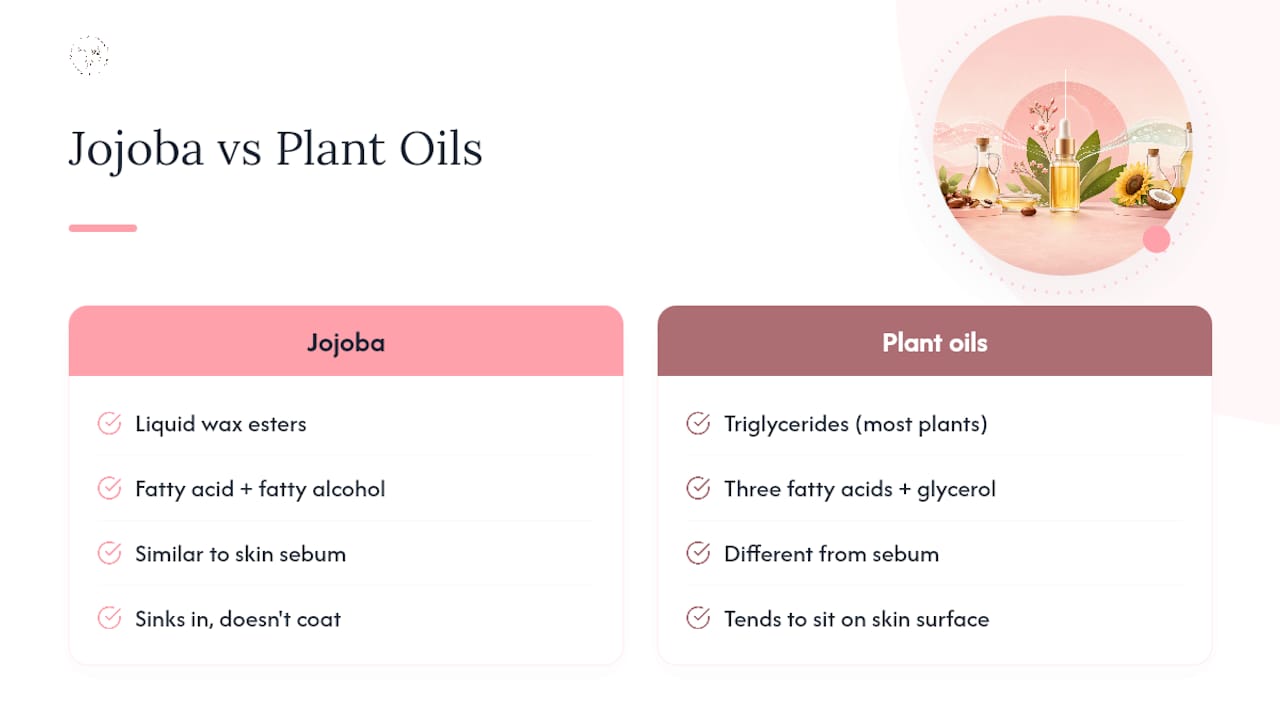
Pro Tip: If you want to understand why jojoba “sinks in” instead of sitting on top of skin the way heavier oils do, think of it less as an oil and more as a texture-matched partner to your own sebum. The molecule is shaped to blend in, not coat over.
Why the wax-ester structure changes how it feels and performs
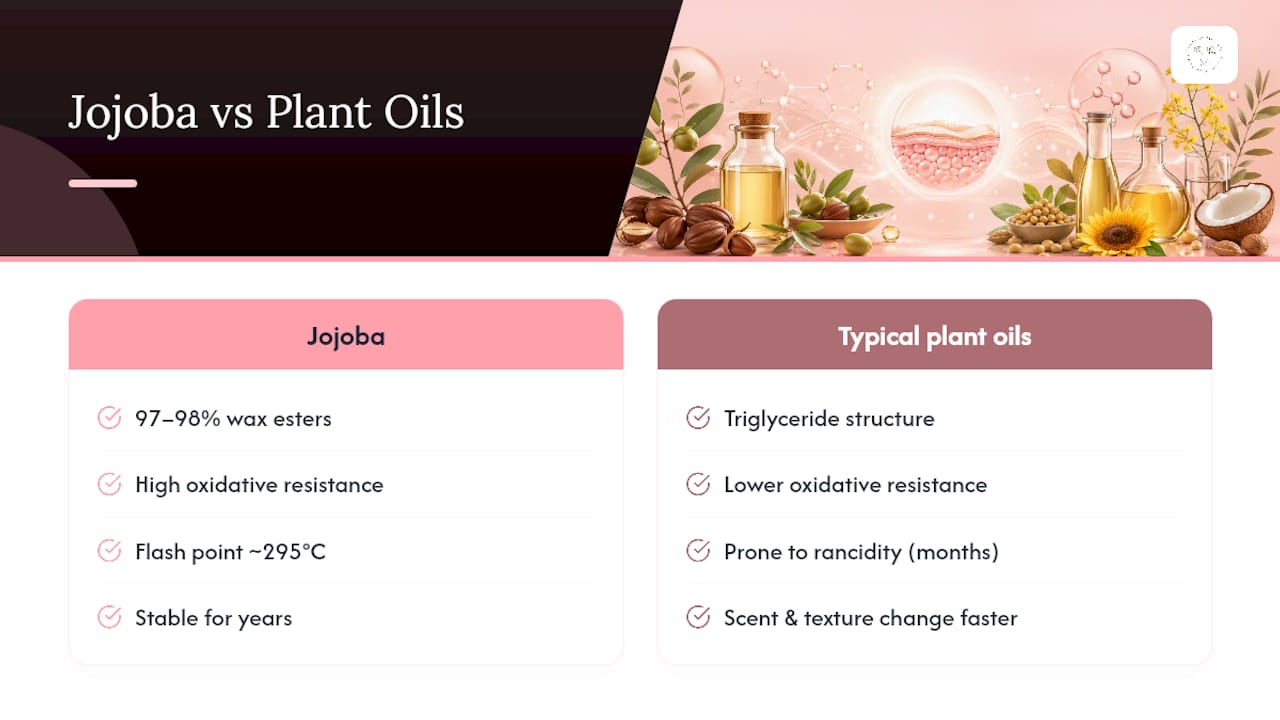
Human sebum, the oil your skin produces on its own, is also rich in wax esters. Jojoba’s molecular resemblance to sebum is part of why it spreads thinly, absorbs without a heavy film, and rarely triggers the clogged-pore reaction some heavier plant oils cause. For someone managing eczema-prone patches or a face that reacts to richer creams, that resemblance matters more than any marketing claim.
The wax-ester structure also delivers a stability advantage most people never think to ask about. Jojoba is markedly resistant to oxidation, meaning it does not go rancid the way flaxseed or hemp oil can within months of opening. Its high flash point and low iodine value, both markers chemists use to judge oxidative resistance, mean a properly stored bottle can remain stable for years rather than months, and its scent and texture change far more slowly than triglyceride oils.
By the Numbers: Jojoba oil is composed of roughly 97 to 98 percent wax esters, compared to the triglyceride structure found in nearly all other common cosmetic plant oils.
That composition also explains the industrial side of jojoba’s reputation. Its dominant fatty components, largely eicosenoic and erucic-type chains, give it a flash point near 295°C, which is why it shows up in lubricants and long-shelf cosmetic bases as well as skincare bottles.
Refined versus unrefined: what processing actually changes
Cold-pressed, unrefined jojoba retains its light golden color, a faint nutty scent, and natural tocopherols (a form of vitamin E) that contribute to its own oxidative defense. Refined, bleached, and deodorized jojoba strips out that color, scent, and much of the antioxidant content, but the core wax-ester skeleton stays intact.
- Unrefined/cold-pressed: retains tocopherols, has a mild scent and golden hue, favored by people who want a closer-to-source product.
- Refined: virtually colorless and odorless, gentler choice for anyone whose skin reacts to plant-derived fragrance compounds, still chemically stable.
- Neither form is “fake”: both are legitimate jojoba, the choice is about sensory preference and sensitivity, not purity.
If your skin flares at the faintest trace of natural fragrance, refined jojoba is often the safer starting point, even though the unrefined version carries a marginally richer antioxidant profile.
Does Science Actually Support Jojoba’s Skin and Hair Claims?
The evidence is real but uneven. Jojoba’s moisturizing and barrier-support effects have solid backing across medical overviews and reviews. Its anti-inflammatory and skin-repair signals come mostly from laboratory and ex-vivo research, which is promising but not the same as a large human clinical trial.
A comprehensive 2021 literature review on jojoba’s chemistry and pharmacology found consistent antioxidant and anti-inflammatory activity across various studies, while also noting that much of that evidence comes from in vitro or animal work rather than controlled human trials. That distinction matters for anyone reading a product label that implies jojoba is clinically proven for a specific skin condition.
What the strongest evidence actually shows
Medical overviews from sources including WebMD and Cleveland Clinic converge on a consistent, modest claim: jojoba’s most reliable benefit is reducing water loss and supporting the skin’s barrier function, making it genuinely useful for dry or sensitive skin. None of these sources frame jojoba as a treatment for acne, eczema, or infection. It is a supportive emollient, not a substitute for prescribed care.
- Barrier support and moisture retention: well-documented across consumer medical guidance.
- Non-comedogenic behavior for most users: tied directly to its sebum-like wax-ester structure.
- Antioxidant and anti-inflammatory activity: supported broadly, though largely from preclinical research.
- Acne, eczema, or hair-regrowth treatment: no robust randomized clinical trial evidence exists for any of these.
What the newer lab research adds, and where to be careful with it
A 2024 study published in Frontiers used an ex-vivo human skin organ culture model, meaning real human skin tissue kept alive and tested outside the body, rather than a live clinical trial. Researchers applied topical jojoba wax and measured a roughly 30 percent reduction in inflammatory signals (IL-6, IL-8, and TNFα) triggered by a bacterial irritant, alongside increased production of pro-collagen III and hyaluronic acid, both markers of skin structure and hydration.
By the Numbers: In that ex-vivo model, jojoba wax reduced inflammatory cytokine secretion significantly while increasing pro-collagen III and hyaluronic acid synthesis.
That is a genuinely interesting finding, and it gives a plausible mechanism for why jojoba feels calming on irritated skin. It is not the same as proving jojoba clears eczema flares in a clinical setting. Ex-vivo tissue models sit a rung below live human trials in the evidence hierarchy. Interestingly, the same research noted that combining jojoba with an emulsifier improved how well the skin absorbed it and strengthened the anti-inflammatory effect, a hint that how a product is formulated may matter as much as whether jojoba is in it at all.
Where the evidence runs out
Ask jojoba to regrow hair, cure acne, or replace a dermatologist’s eczema treatment, and you have moved past what any credible source currently supports. The honest read: jojoba is a well-tolerated, sebum-mimicking emollient with early anti-inflammatory signals. Use it to support a routine, not to replace one built around medical guidance.
How Do You Actually Use Jojoba on Skin and Hair?
Application matters as much as the product itself, especially for reactive skin that punishes overzealous routines. Here is a straightforward way to work jojoba oil into a daily routine without overwhelming your skin barrier or your hair.
- Cleanse first, apply while skin is still damp. Jojoba absorbs more evenly and helps seal in water when applied to slightly damp skin rather than bone-dry skin.
- Start with two to three drops for the face. Warm the oil between your fingertips before pressing it into skin, rather than dragging it across, which reduces friction on sensitive areas.
- Layer it correctly. Apply water-based serums first, then jojoba, then sunscreen last if you are heading into daylight. Jojoba’s light texture rarely interferes with sunscreen performance, but always let it absorb for a minute before the next layer.
- For body and cuticles, use targeted amounts. A few drops massaged into rough elbows, knees, or cuticles works better than a full-body slather, since a little goes further than the texture suggests.
- On hair, separate ends from scalp. Apply a small amount to the mid-lengths and ends to reduce breakage and add shine. If you want scalp benefits, use a lighter hand and space applications out to avoid buildup at the roots.
- Watch frequency on fine hair. Daily scalp application can leave fine or oily hair looking weighed down. Two to three times a week is usually enough to notice a conditioning effect without residue.
Pro Tip: If your hair feels greasy the day after using jojoba on your scalp, you are using too much or applying too often, not using the wrong product. Cut the amount in half before abandoning it entirely.
Cosmetically, jojoba shows up far beyond the dropper bottle. Its wax-ester structure makes it a natural fit for lip oils and balms, where the same non-greasy, sebum-mimicking qualities that help facial skin also keep lip products from feeling sticky or heavy. That is part of why formulators building products for sensitive-skin lips reach for it instead of heavier butters that can trap heat and irritation on already-reactive tissue. If you have never layered a facial oil into an existing skincare routine before, a step-by-step guide for using facial oils safely is worth reading before you start, particularly if your skin has a history of reacting to new products.
Is Jojoba Oil Safe for Sensitive Skin? Patch Testing and Warnings
Jojoba is one of the better-tolerated oils for sensitive skin, but “well tolerated” is not the same as “risk-free.” A small percentage of users do experience contact reactions, and there are a few hard rules worth following before you commit to daily use.
Reported adverse reactions are typically mild: redness, itching, or a rash at the application site. Severe allergic reactions are rare but not impossible, which is exactly why medical sources including WebMD recommend a patch test before broader facial or body use rather than skipping straight to a full routine.
How to patch test correctly
- Apply a small amount of jojoba oil to your inner forearm or behind your ear.
- Leave it undisturbed for 24 to 48 hours without washing the area.
- Watch for redness, swelling, itching, or bumps during that window.
- If nothing happens, you can move forward with facial or scalp use in small amounts.
- If irritation appears at any point, wash it off immediately and discontinue use.
By the Numbers: A patch test on the inner forearm or behind the ear for one or two days is the standard low-cost method medical sources recommend for catching contact sensitivity before wider cosmetic use.
Why jojoba is topical only
Ingestion is a firm no. WebMD and other medical sources are specific on this point: swallowing jojoba oil can cause gastrointestinal upset, and it carries no established nutritional or therapeutic benefit taken orally. Keep it out of food, out of supplements, and away from small children and pets who might mistake a dropper bottle for something edible.
When to stop and call a professional
Discontinue use and consult a clinician if you notice spreading redness, swelling, oozing, or signs of infection anywhere jojoba has been applied, or if you experience a rapid allergic reaction like hives or difficulty breathing, which requires emergency care rather than a wait-and-see approach. For anyone managing an active eczema flare, loop in a dermatologist before adding any new emollient, jojoba included, since a flare-compromised barrier reacts differently than healthy skin.
How Do You Choose a High-Quality Jojoba Oil?
Not every bottle on a shelf marked “jojoba oil” deserves your money, and the differences are not always obvious at a glance. A few label habits will save you from buying something diluted, adulterated, or already partly oxidized before it reaches your cart.
Extraction method comes first. Cold-pressed, unrefined jojoba retains more of its natural tocopherol content and a faint golden color and nutty scent. Solvent-refined jojoba strips color and odor but keeps the same wax-ester backbone intact, and it is often the gentler pick for skin that reacts to natural fragrance compounds. Neither is objectively better; the right choice depends on whether your skin tolerates trace natural aromatics.
Read past the front label. A bottle listing “100% jojoba oil” with nothing else in the ingredients is what you want for a single-ingredient product. Terms like “cosmetic grade” or “fragrance-free” are useful qualifiers, and third-party organic certification adds a layer of verification worth paying slightly more for if it fits your budget.
- Look for “100% Simmondsia chinensis seed oil” or “100% jojoba oil” with no other listed ingredients.
- Fragrance-free labeling matters if you have reactive or eczema-prone skin.
- Third-party organic or purity certifications add a verification layer beyond the brand’s own claims.
- Avoid products where jojoba is buried in a long ingredient list behind fragrance or unnamed “botanical extracts.”
Packaging tells you how the oil was handled after bottling. Amber or dark glass protects jojoba from light-driven oxidation, and a properly sealed cap prevents air exposure that shortens shelf life. Store your bottle at room temperature, away from direct sun and stovetop heat. Because jojoba is naturally oxidation-resistant, a well-stored bottle can remain usable for a couple of years, noticeably longer than most triglyceride oils.
Red flags worth walking away from: vague blends marketed only as “jojoba oil” that actually list several other oils first, added synthetic fragrance in a product meant for sensitive skin, and pricing that seems too low for a wax ester that requires proper cold pressing to retain its benefits. If you are still comparing jojoba against other lightweight options, a rundown of plant oils suited to sensitive skin can help you see where it fits relative to squalane, rosehip, or argan oil, each of which behaves differently on reactive skin.
Does Jojoba Oil Really Regrow Hair or Cure Acne?
No, and this is where marketing tends to outrun the science by a wide margin. Jojoba has a genuinely useful role in a skin and hair routine, but it is not the miracle ingredient some product copy implies.
Hair regrowth claims do not hold up. Cleveland Clinic’s guidance is direct on this: jojoba can act as a leave-in conditioner, reducing protein loss, cutting breakage, and adding shine to dry or brittle strands. None of that translates into stimulating new hair growth, and no credible clinical evidence supports jojoba as a regrowth treatment. If thinning hair is your concern, jojoba can make existing strands look and feel healthier while you address the underlying cause with a dermatologist, not instead of that conversation.
Acne and eczema: helper, not therapy. Because jojoba mimics sebum and tends to be non-comedogenic for most users, it can be a lighter alternative to heavier oils that clog pores on acne-prone skin. That is a legitimate, practical benefit. It is not the same as jojoba treating active acne or resolving an eczema flare. Medical overviews are consistent that jojoba works as a supportive emollient in a broader routine, and it should never replace a prescribed treatment for either condition.
- Myth: Jojoba regrows hair. Reality: it conditions and protects existing strands, nothing more.
- Myth: Jojoba cures acne. Reality: it may be a gentler moisturizer choice for acne-prone skin, but it does not treat breakouts.
- Myth: More jojoba means better results. Reality: overuse on scalp or face causes buildup and can leave skin feeling greasy rather than balanced.
- Myth: Jojoba is safe to ingest because it is natural. Reality: ingestion can cause gastrointestinal upset and is not recommended.
Misuse is more common than allergy. The most frequent problem people run into with jojoba is not sensitivity, it is overapplication: too many drops, too often, especially on the scalp, leading to buildup that gets blamed on the oil itself rather than the amount used. Dialing back the quantity, not abandoning the product, usually solves it.
How Pure Light Botanical Beauty Approaches Jojoba in Formulation
The brand treats jojoba as a dependable, sebum-mimicking emollient suitable for sensitive skin routines, rather than a cure-all. Formulation decisions start from the same question every dermatologically cautious reader should ask: does this ingredient calm skin, or does it just perform well in a marketing photo?
The brand pairs jojoba with calming botanicals such as calendula and rose, chosen for their historical use on reactive, eczema-prone skin. The goal is a formula that behaves consistently, batch after batch, on skin that does not tolerate guesswork.
- Formulations prioritize non-comedogenic, sensitive-skin-friendly oils and waxes, jojoba among them.
- Ingredient lists are kept short and legible rather than padded with filler botanicals.
- Products are designed to slot into an existing skincare routine, not replace medical treatment for eczema or acne.
- Reformulation happens when new evidence, not trend cycles, suggests a better approach.
Readers curious about how these ingredient choices show up in a full routine can see the broader philosophy on the Purelightbotanicalbeauty site, where product formulation notes sit alongside the brand’s wellness content rather than being hidden behind marketing copy.
Where the Evidence Leads, and What to Actually Do With It
The honest takeaway from the research is less exciting than most product pages suggest, and that is precisely why it is trustworthy. Jojoba earns its reputation as a moisturizer and barrier supporter, not as a treatment for acne, eczema, or hair loss, and conflating those categories is where most marketing overreaches.
What the conventional advice gets wrong is treating “natural” as a substitute for “clinically proven.” Jojoba’s ex-vivo anti-inflammatory data is genuinely promising, but a lab result on cultured skin tissue is not a guarantee of what happens on your face after six weeks. The gap between those two things is exactly where skepticism belongs.
If you take one thing from this guide, prioritize the boring part: patch test first, apply in modest amounts, and judge results over weeks rather than days. Jojoba rewards patience and restraint far more than it rewards enthusiasm.
— Caitlin Grey
Ready to Try Jojoba in a Formulated Routine?
Single-ingredient jojoba oil is a solid starting point, but most people managing sensitive or eczema-prone skin want it paired with other calming botanicals rather than applied alone every day. That is where a formulated product earns its place over a plain dropper bottle.
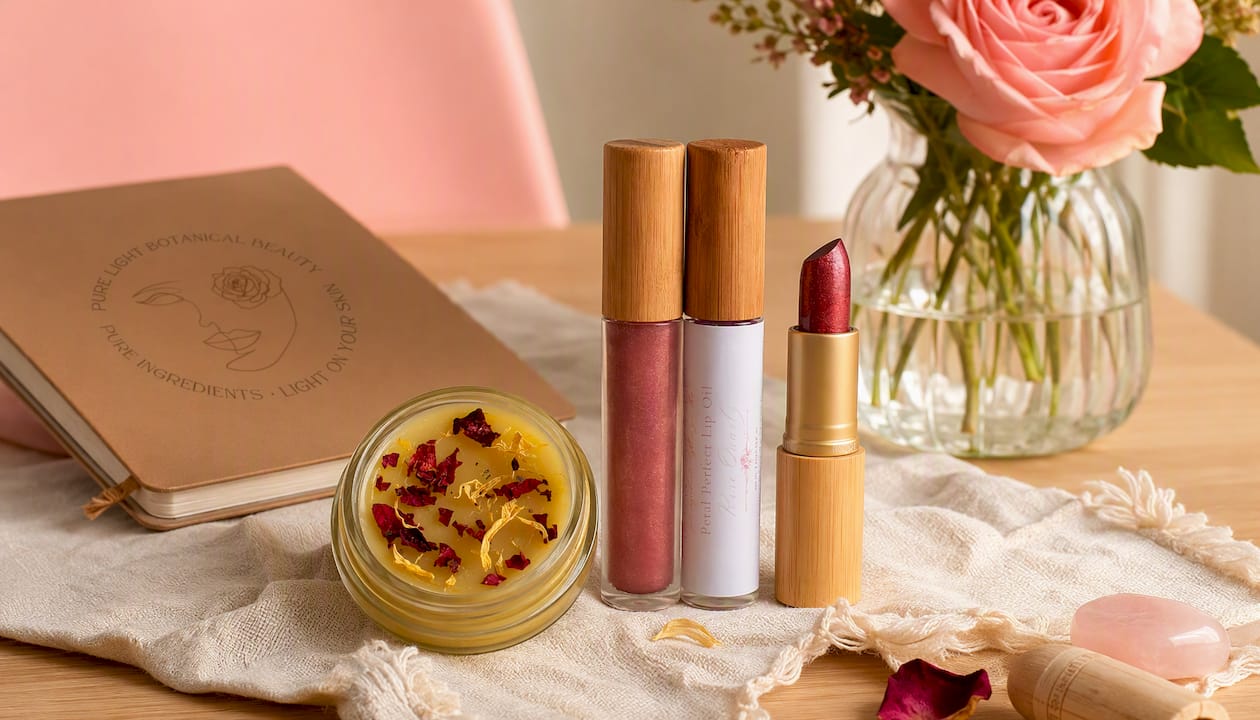
The Botanical Beauty Balm™ ~ Calendula & Rose combines jojoba’s barrier-supporting qualities with calendula and rose, two botanicals long favored for calming reactive skin, making it a fitting next step after the face routine outlined earlier. For lips, which have their own thin, easily dried skin, the Petal Perfect Lip Oil™ delivers the same lightweight, non-sticky feel jojoba brings to facial skin, minus the trip to mix your own DIY lip treatment. And if color is part of your routine, the Nourishing Lipstick™ ~ Cherry Quartz works nourishing oils directly into the formula, so pigment does not come at the cost of comfort. Browse the full lineup and find the piece that fits your routine.
Key Sources on Jojoba Oil’s Evidence and Safety
For readers who want to go deeper than this guide, these are the core references behind the claims made here:
- A comprehensive review on jojoba’s chemistry, pharmacological activity, and toxicity, covering composition and preclinical evidence.
- The 2024 Frontiers ex-vivo human skin study on jojoba wax’s anti-inflammatory and collagen-supporting effects.
- Cleveland Clinic and WebMD consumer health overviews covering practical benefits, patch testing, and ingestion safety.