

TL;DR:
- Using patch tests before applying facial oils helps sensitive skin avoid reactions and flares.
- Start with small amounts on damp skin, layering carefully and applying oils at the right time for best results.
Finding a skincare product that genuinely nourishes without triggering a flare-up feels like searching for something rare and precious. If you have sensitive skin or eczema, you already know that routine product introductions can turn into days of redness, itching, and frustration. Plant-based facial oils offer a beautiful promise: deep nourishment, restored glow, and skin-barrier support rooted in nature. But the promise only delivers when you use them correctly. This guide walks you through every step, from safety fundamentals to smart troubleshooting, so you can finally enjoy the calm, radiant skin you deserve.
Table of Contents
- What you need to know before using facial oils
- Choosing the right facial oil for sensitive skin
- Step-by-step: Applying facial oils for maximum comfort and results
- Verifying results and troubleshooting issues
- Why sensitive skin needs a patient approach to facial oil
- Explore gentle facial oils for sensitive skin support
- Frequently asked questions
Key Takeaways
| Point | Details |
|---|---|
| Patch test always | Always patch test any facial oil for at least seven days before full-face use. |
| Pick gentle plant oils | Choose oils proven safe for sensitive or eczema-prone skin like rosehip or jojoba. |
| Use minimal amount | Apply just 2–3 drops, warming between palms, and press gently without rubbing. |
| Observe skin changes | Monitor skin for irritation, adjusting frequency or oil type as needed. |
| Sequence matters | Layer facial oil last at night or before sunscreen/makeup in the morning for best results. |
What you need to know before using facial oils
Now that you understand the importance of gentle, plant-based oils, let’s set the foundation for safe usage.
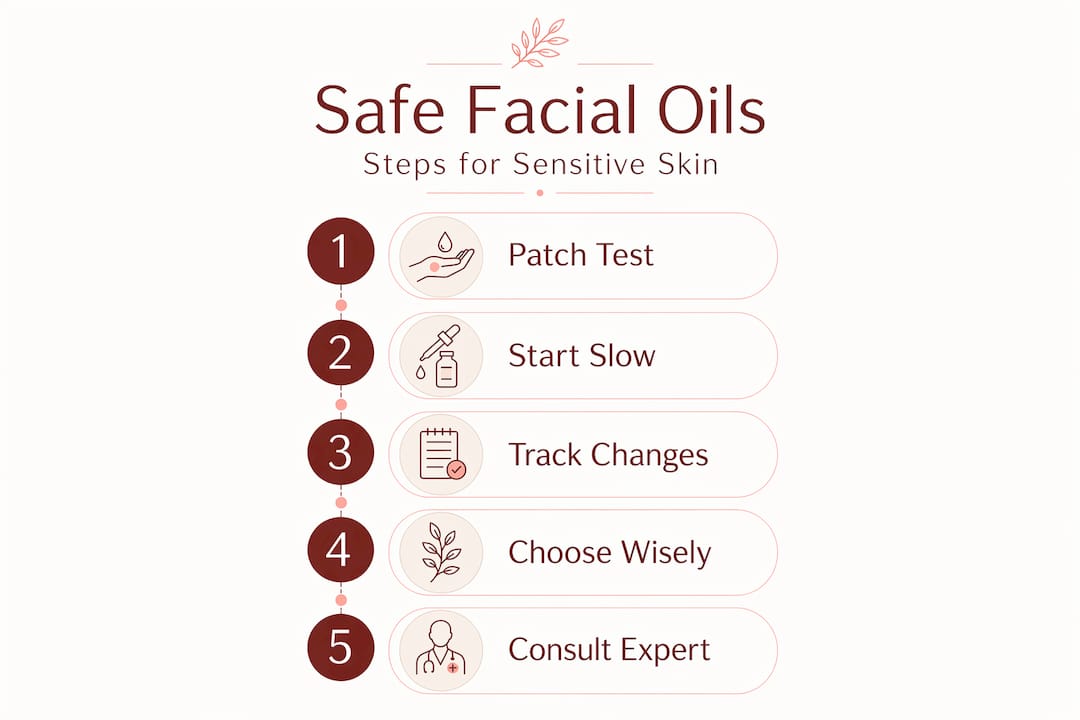
Sensitive skin is reactive skin. It responds quickly to new inputs, which means even the most beloved botanical oil needs to earn your trust before it gets full access to your face. The most important thing you can do before applying any new oil is a patch test.
What patch testing actually means
A patch test is simple: apply a small amount of oil to a discreet area, like the inner wrist or behind your ear, and observe for several days. Healthline describes a monitoring period of 7 to 10 days for new skincare products, especially those likely to trigger contact dermatitis. If you notice redness, itching, or swelling at any point, wash the area immediately and discontinue use. This one step can save you from a full-face reaction that takes weeks to calm.
Vogue advises trying a small test patch before applying a new face oil to a larger area, and starting slowly, such as once or twice a week, to gauge how your skin responds. For eczema-prone skin especially, this is not optional advice. It is your first line of defense.
Understanding the adjustment period versus irritation
Some women experience a brief adjustment period when they introduce a new oil. Skin may feel slightly different for a day or two. This is not the same as a reaction. A reaction produces visible redness, a burning sensation, new breakouts, or increased itch. Adjustment simply feels like change, not discomfort.
“Listen to your skin. It speaks clearly when something isn’t working.” This is the foundational truth of sensitive skincare.
Here is a quick reference to help you recognize what’s normal and what isn’t:
| Symptom | Normal adjustment | Likely reaction |
|---|---|---|
| Slight tightness on day 1 | Yes | No |
| Persistent redness after 24 hours | No | Yes |
| Mild warmth on application | Yes | No |
| Itching that worsens over days | No | Yes |
| Skin feels softer by day 3 | Yes | No |
| New breakouts along jaw or cheeks | No | Yes |
Pro Tip: Keep a simple skin journal when introducing a new oil. Note the date, how much you used, and any changes you observe. Even a brief daily note helps you spot patterns that your memory might miss.
Before you explore the world of using face oils naturally, know that the best results come from starting with less and adding more, never the reverse. Begin with one or two drops, no more than twice a week. Patience here is not a luxury. It is the strategy.
Choosing the right facial oil for sensitive skin
With safety in mind, it’s time to pick the facial oil that aligns with your skin type and values.
Not all plant-based oils are created equal when it comes to sensitive or eczema-prone skin. Some oils are rich in linoleic acid, a fatty acid that helps repair the skin barrier and is generally well-tolerated. Others are high in oleic acid, which is denser and better suited to drier or more resilient skin types.
Gentle oils worth knowing
Here are some of the most skin-friendly oils for sensitive or reactive complexions:
- Jojoba oil: Technically a wax ester, jojoba closely mimics the skin’s natural sebum. It is lightweight, non-comedogenic (meaning it won’t clog pores), and unlikely to trigger reactions.
- Rosehip seed oil: Rich in essential fatty acids and vitamin A, rosehip supports cell turnover and skin-barrier repair. It is especially helpful for eczema-prone skin that also deals with scarring or uneven texture.
- Squalane: Derived from olives or sugarcane, squalane is exceptionally gentle and stable. It absorbs quickly and rarely causes irritation, making it a favorite for reactive skin types.
- Sea buckthorn oil: High in omega fatty acids and carotenoids, sea buckthorn supports skin-barrier integrity and has anti-inflammatory properties particularly useful for eczema.
- Hemp seed oil: Rich in omega-3 and omega-6 fatty acids, hemp seed oil helps regulate oil production while delivering deep hydration without heaviness.
| Oil | Key benefit | Eczema-friendly | Texture |
|---|---|---|---|
| Jojoba | Mimics natural sebum | Yes | Lightweight |
| Rosehip seed | Barrier repair | Yes | Medium |
| Squalane | Ultra-gentle, fast-absorbing | Yes | Very light |
| Sea buckthorn | Anti-inflammatory | Yes | Rich |
| Hemp seed | Fatty acid balance | Yes | Light-medium |
Explore more about safe plant oils for sensitive skin to see detailed profiles of each.
Spotting signs of incompatibility
Vogue emphasizes that listening to your skin’s response when starting a new oil is essential. If an oil is not working for you, the practical move is to reduce how often you use it, reduce how much you apply, or stop altogether. There is no benefit in pushing through a reaction.
Signs that an oil may not suit your skin include persistent clogged pores, a sudden increase in eczema flare frequency, unusual sensitivity to temperature, or a greasy residue that never fully absorbs. These are not signs to ignore or push through.
Pro Tip: If you are managing active eczema flares, consult with a dermatologist before introducing any new oil, even natural ones. Some essential oils used as additives in skincare blends can be potent irritants for eczema-prone skin.
You can also browse soothing facial oils specifically curated for women dealing with sensitivity and reactive skin conditions.
Step-by-step: Applying facial oils for maximum comfort and results
Once you’ve selected your oil, follow these steps to ensure a gentle, effective experience.
Application technique matters just as much as the oil you choose. Many women apply facial oil the same way they apply moisturizer, rubbing it in with strokes across the skin. This approach can drag and pull, especially on skin that is already sensitive or inflamed.
Your gentle application routine
- Cleanse your face with a mild, fragrance-free cleanser. Pat dry with a soft cloth, leaving your skin slightly damp.
- Apply your water-based layers first. If you use a toner or hydrating serum, apply those now. Let them absorb for 30 to 60 seconds.
- Add your moisturizer if you use one, and let it settle briefly.
- Measure your oil. Two to three drops is the ideal starting amount for the whole face. More is rarely better.
- Warm the oil between your palms by gently pressing them together for five seconds. This light warmth helps the oil spread more smoothly.
- Press and pat the oil onto your skin using upward and outward motions. Vogue recommends pressing and patting rather than aggressive rubbing to avoid unnecessary friction on delicate skin.
- Allow the oil to absorb for at least one to two minutes before layering anything else on top.
“Less is genuinely more when your skin is sensitive. Two drops of a well-chosen oil does more than ten drops of the wrong one.”
Morning versus night application
The timing of your oil application matters more than most people realize. Vogue India notes that facial oil is generally used as the last step at night, applied after your serum and moisturizer, and in the morning it goes on before sunscreen or makeup. Because oil is occlusive (meaning it forms a barrier on top of skin), anything applied after it has difficulty penetrating. This is why it anchors your nighttime routine and acts as a primer layer in the morning.
For those who want to wear face oil before makeup, apply just one drop and allow it to fully absorb before moving on to sunscreen and then makeup. This prevents that dreaded “sliding” feeling that happens when oil sits too fresh under foundation.
Understanding layering skincare naturally can transform the effectiveness of every product in your routine, not just your oil.
Callout: A 2024 consumer survey found that women who followed a consistent facial oil routine for at least four weeks reported a 60% improvement in skin comfort and hydration levels compared to those who applied oil irregularly.
If you are specifically working with rosehip oil, our guide on rosehip oil application offers more detailed steps tailored to that specific oil’s absorption needs.
Verifying results and troubleshooting issues
Applying oil gently is just the beginning. Let’s ensure your skin is truly benefiting with smart monitoring and troubleshooting.

Monitoring your skin is not about obsessing in the mirror every hour. It is about creating a simple feedback loop that tells you whether the oil is working, not working, or needs adjustment.
How to track your skin’s response
- Take a baseline photo before you begin, in natural light without makeup. Do this weekly for the first month.
- Note texture changes. Is your skin smoother after a week? Rougher? Drier in places?
- Track flare-ups. If eczema flares coincide with oil introduction, that is a data point worth recording.
- Monitor your overall comfort level. Does your skin feel more settled after cleansing? Less tight? These are positive signals.
- Check for comedones. New blackheads or whiteheads forming within weeks of starting a new oil may indicate the oil is too heavy for your pore type.
Common mistakes and how to fix them
- Using too much oil: Reduces to one to two drops and observe for a week.
- Applying oil on completely dry skin: Always apply on slightly damp skin for better absorption.
- Layering oil over heavy creams: If your moisturizer is thick, your oil may not penetrate. Try a lighter moisturizer, or skip it at night and use only oil.
- Using fragrant oils: Fragrance is one of the most common irritants for sensitive skin. Stick to unscented, pure plant oils.
- Introducing multiple new products at once: This is one of the most common mistakes. Introduce products one at a time, at least two weeks apart, so you can identify the source of any reaction.
“Skin that reacts is not difficult skin. It is communicative skin. The goal is to learn its language.”
Healthline confirms that patch testing, done properly over 7 to 10 days, remains one of the most reliable ways to identify incompatible products before a full reaction occurs.
If you experience a sudden flare after introducing an oil, consult our face oils troubleshooting guide for step-by-step guidance. Understanding the role of oils in skin health also helps you make more informed decisions about the products you choose.
Why sensitive skin needs a patient approach to facial oil
Most skincare guides focus on the “what” and skip past the “how long.” They tell you which oils to use and how to apply them, but they rarely talk about the weeks of patient observation that determine whether your skin truly benefits.
Here is the uncomfortable truth: the women who get the most from facial oils are the ones who slow down. They resist the urge to add more drops when results feel slow. They wait out the early adjustment period instead of abandoning a promising oil after three days. They treat their skincare routine as a ritual, not a checklist.
Holistic beauty practitioners who work specifically with reactive skin often describe facial oils not as a quick fix but as an amplifier. When your skin barrier is already partially supported by gentle cleansers and hydrating serums, a well-chosen oil seals all of that nourishment in and gives your skin the conditions it needs to truly repair.
Vogue India notes that face oils are not hydrators on their own. They are emollients and occlusives that seal in the hydration delivered by water-based layers beneath them. This is a crucial reframe. If you skip your hydrating serum and go straight to oil, you are locking in dryness, not moisture. The oil is only as effective as what it is protecting.
Sensitive skin also thrives on consistency over intensity. A small amount of oil used faithfully every night for six weeks will outperform a generous application used sporadically. Your skin barrier does not rebuild overnight. It needs repeated, gentle signals that repair is safe.
Understanding the deeper holistic skin health picture helps you stay the course when progress feels slow. Beauty rooted in patience is beauty that actually lasts.
Explore gentle facial oils for sensitive skin support
If this guide has resonated with you, your next step is finding oils that match both your skin’s needs and your values.

At Pure Light Botanical Beauty, every formula is crafted with the same care and intention you have just read about: clean, plant-based ingredients selected specifically for women who want nourishment without compromise. Whether you are navigating eczema, managing reactive skin, or simply looking for a gentler approach to your daily ritual, there is something here for you. Start with the plant oil guide to explore which botanicals align best with your skin, then browse the full collection to find products that honor your skin exactly as it is.
Frequently asked questions
How do you safely introduce facial oils for eczema-prone skin?
Patch test any new oil for 7 to 10 days and begin with infrequent application, such as once or twice a week, before gradually increasing if no irritation appears.
What’s the best order to layer facial oil with moisturizer and sunscreen?
Apply facial oil after moisturizer as your last step at night and before sunscreen and makeup in the morning, since its occlusive nature limits absorption of products applied after it.
How can you tell if a facial oil isn’t compatible with your skin?
Look for persistent redness, increased itchiness, or new skin texture changes. If these signs appear, reduce the amount you use or stop entirely and allow your skin to settle.
Can facial oils cause breakouts on sensitive skin?
Yes, some oils are comedogenic and may clog pores or trigger flare-ups. Patch testing slowly and introducing oils gradually is the most reliable way to reduce that risk.
Recommended
- How to Use Face Oils for Sensitive Skin Naturally – Pure Light Botanical Beauty
- How to Use Botanical Oils for Sensitive Skin Relief – Pure Light Botanical Beauty
- Use Face Oil Before Makeup: 40% Fewer Flare-Ups 2026 – Pure Light Botanical Beauty
- 7 Types of Plant Oils for Skin: Safe Choices for Sensitive Skin – Pure Light Botanical Beauty