

The most reliable treatment for glowing skin combines a professional procedure, whether that’s a Hydrafacial, chemical peel, microneedling session, or a targeted laser, with a consistent, gentle at-home routine built for your specific skin type. Sensitive or eczema-prone skin needs slower escalation and calming, plant-based actives rather than aggressive resurfacing. Maintenance resources like You Glow Girl™ help you keep that clinical glow alive between appointments.
TL;DR:
- Professional treatments like microneedling and chemical peels require multiple sessions over weeks to achieve lasting glow and texture improvements, especially for scars or pigmentation.
- Immediate, visible results are best achieved with Hydrafacial or oxygen facials, which require no downtime and are ideal before events.
- Proper timing, such as spacing treatments several weeks apart and avoiding retinoids beforehand, enhances safety and healing, particularly for darker or sensitive skin.
- Consistent at-home routines focusing on gentle cleansing, sun protection, hydration, and barrier repair are crucial to maintaining professional treatment benefits.
- Botanical-based care and tailored product routines support sensitive or reactive skin during recovery, preventing irritation and prolonging glow.
Table of Contents
- Which Professional Treatments Actually Deliver Glowing Skin?
- How Do You Choose the Right Treatment for Your Skin?
- What’s the Best At-Home Routine to Sustain a Glow?
- When Should You Schedule Treatments, and What Should You Avoid?
- How Do Botanical Formulas Support Sensitive Skin After Treatment?
- Do Supplements and Vitamins Actually Improve Skin Radiance?
- Why Most Advice on Glowing Skin Skips the Hard Part
- How You Glow Girl™ Helps You Maintain Results
Which Professional Treatments Actually Deliver Glowing Skin?
Clinicians reach for a handful of proven procedures when a patient asks for a face treatment for glowing skin, and each one solves a slightly different problem. Knowing what each does helps you walk into a consultation with the right questions instead of a vague request to “look more radiant.”
- Microneedling (with or without PRP or exosomes): stimulates collagen and smooths texture, though it typically requires several sessions spaced weeks apart.
- Chemical peels (light to medium): resurfaces dull outer layers and brightens tone, but darker skin tones need a practitioner experienced in avoiding pigment complications.
- Hydrafacial or microdermabrasion: delivers an immediate, hydrated glow with almost no downtime, which is why it’s a favorite before events.
- Lasers and IPL: target pigmentation and uneven tone, with downtime and results that depend heavily on the practitioner’s skill and your skin’s reaction.
- LED therapy and oxygen facials: low-risk add-ons that calm inflammation and add surface radiance without any real recovery time.
Dermatologist-recommended treatments like these produce visible, lasting improvements in texture, hydration, and tone when matched correctly to skin type, which is the entire point of the sections below.
How Do You Choose the Right Treatment for Your Skin?
Picking among these options comes down to three questions: What’s the actual concern, how much downtime can you tolerate, and what does your skin type allow safely?
If you need a fast, photographable glow for an event this weekend, a Hydrafacial or oxygen facial is your best bet. These noninvasive treatments produce the most immediate, visible results and are genuinely popular pre-event choices precisely because they require zero recovery. If you’re working toward long-term texture change or scarring improvement, you’re in different territory: microneedling and light peel courses build results progressively, often over three to six sessions. Dermatologists frequently combine procedures, such as microneedling paired with PRP or a structured course of light peels, because progressive collagen remodeling responds better to repetition than to a single dramatic session. For pigmentation correction specifically, lasers and IPL tend to outperform peels, but they also carry the highest risk when skin tone and practitioner experience aren’t matched properly.
Here’s the breakdown by practical concern:
- Best for dullness and dehydration: Hydrafacial or oxygen facial. Immediate results, no downtime, one to two sessions often enough.
- Best for texture and acne scarring: microneedling, sometimes with PRP. Results build over three to six sessions with a few days of redness each time.
- Best for pigmentation and uneven tone: chemical peels or laser/IPL. Multiple sessions typical, downtime varies from none to a week.
- Best for sensitive or reactive skin: light peels or LED therapy first, escalating slowly with a clinician’s guidance.
Pro Tip: Book a consultation before committing to a laser or aggressive peel if you have darker skin. Post-inflammatory hyperpigmentation is a real risk with the wrong wavelength or acid strength, and a board-certified provider will know which protocols are safer for your tone.
Higher-risk scenarios deserve extra caution. Combining darker skin with aggressive resurfacing is exactly where inexperienced providers cause the most damage, so this is the one situation where a specialist consultation isn’t optional.
What’s the Best At-Home Routine to Sustain a Glow?
Professional treatments jumpstart your skin, but daily habits are what keep clear and glowing skin looking that way between appointments. Simple, consistent habits, gentle cleansing, sun protection, hydration, and stress management, are the foundation of healthy, radiant skin and help prevent premature aging.
Morning routine:
- Gentle cleanser to remove overnight buildup without stripping the barrier.
- Antioxidant serum, ideally stabilized vitamin C, to defend against environmental damage.
- Moisturizer with SPF 30 or higher, non-negotiable, even indoors.
Evening routine:
- Gentle cleanser again.
- A targeted active, retinoid or an AHA/BHA if your skin tolerates it.
- Multi-weight hyaluronic acid applied to slightly damp skin.
- A barrier-repair moisturizer with ceramides to lock everything in.
Applying hyaluronic acid to damp rather than dry skin makes a measurable difference in how much water it actually holds in the epidermis and dermis, which is why practitioners build this small detail into clinical hydrating protocols.
Weekly, add one to three chemical exfoliation sessions if your skin tolerates it, a hydrating mask, and a few minutes of facial massage to support microcirculation. None of this works in isolation from lifestyle. Smoking narrows the tiny blood vessels in your outer skin layers, cutting off the oxygen and nutrients your complexion needs to look alive, so quitting is one of the most direct upgrades you can make. Our glowing skin routine guide breaks this sequence down further if you want a printable version.

When Should You Schedule Treatments, and What Should You Avoid?
Timing matters more than most people realize. Winter is often the smarter window for resurfacing and collagen-stimulating treatments, since lower UV exposure and cooler conditions reduce complication risk and support faster healing.
- Space microneedling sessions several weeks apart; multiple sessions are typically needed for meaningful change.
- Light peels are often spaced several weeks apart; medium peels require longer recovery intervals between sessions.
- Laser and IPL spacing depends entirely on the device and your skin’s response, so follow your provider’s specific plan.
- Stop retinoids and strong actives several days before any resurfacing procedure, and commit to strict sunscreen use afterward.
- Watch for excessive redness, oozing, or dark spots forming post-treatment. Those are signs to call your dermatologist, not wait it out.
Choose a board-certified provider for anything beyond a basic facial. Credentials matter far more here than convenience or price.
How Do Botanical Formulas Support Sensitive Skin After Treatment?
Post-procedure skin is compromised skin, temporarily more permeable and more reactive than usual, which is exactly when harsh synthetic ingredients do the most damage. Purelightbotanicalbeauty builds formulas around clean, plant-based ingredients specifically because sensitive and eczema-prone skin needs barrier support, not more irritation, during that recovery window.
Calm skin is glowing skin. When the barrier is intact and inflammation is low, light reflects evenly off the surface instead of catching on dry patches or redness, and that’s the real mechanism behind most “glow” people chase with treatments in the first place.
Botanical humectants, gentle antioxidants, and barrier-repair lipids slot naturally into both your AM/PM routine and your post-procedure care, calming reactivity while the skin rebuilds. For a deeper walkthrough tailored to reactive skin, our sensitive skin routine guide covers ingredient substitutions worth knowing before your next appointment.
Do Supplements and Vitamins Actually Improve Skin Radiance?
Topical treatments address the surface, but skin radiance is also built from the inside. Vitamin C, beyond its role in serums, supports collagen synthesis when consumed through diet, and a nutrient-poor diet undercuts even the best clinical protocol. Omega-3 fatty acids help maintain the lipid barrier that keeps moisture locked in, which is precisely what prevents the dull, tight look that follows dehydration.
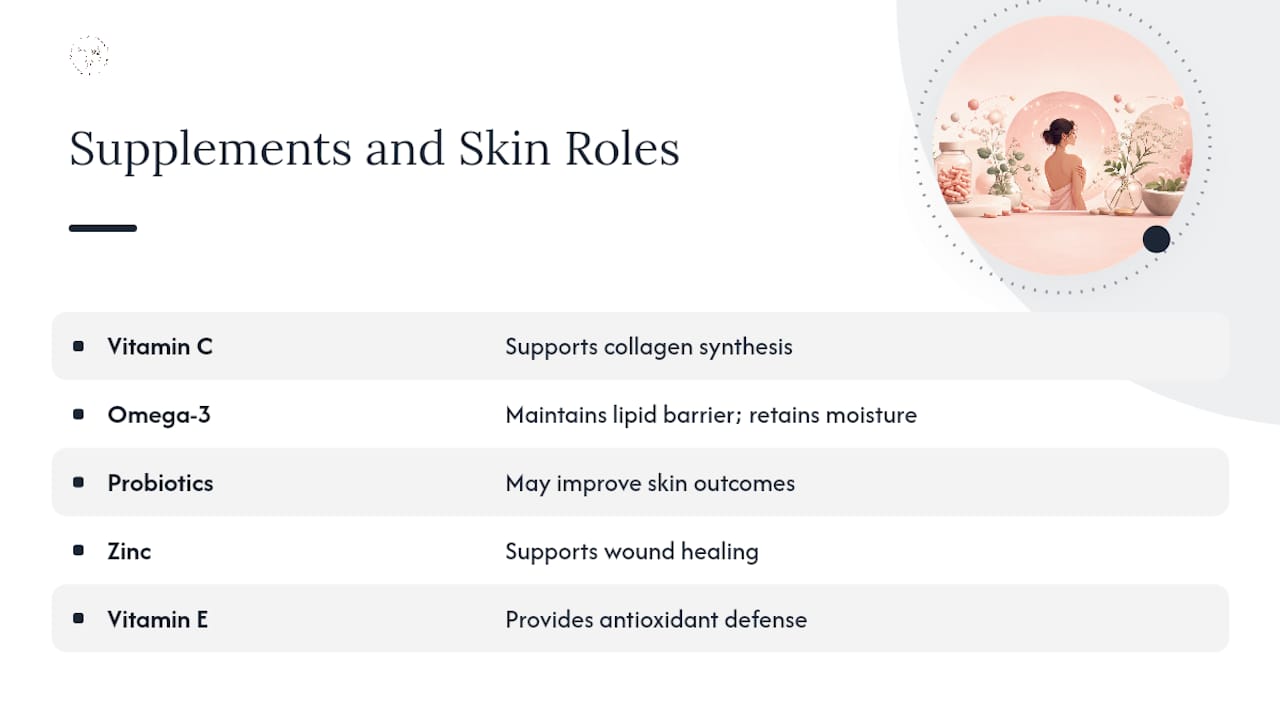
Some evidence links probiotics to better skin outcomes, and cutting back on sugar and refined carbohydrates appears to reduce aging-associated changes in the skin. That’s a meaningful detail if you’re investing in professional treatments but still eating in a way that works against them. Zinc and vitamin E show up frequently in skin-focused supplement formulations for their role in wound healing and antioxidant defense, both relevant if you’re recovering from microneedling or a peel.
None of this replaces sunscreen or a good cleanser. But treating radiance as purely topical ignores half the equation. Sleep quality and stress management belong in this conversation too. Poor sleep and chronic stress elevate cortisol, which degrades collagen over time and shows up first as dullness and uneven tone, often before any other sign appears. If you’re spending money on professional treatments, protecting that investment with seven to eight hours of sleep and basic stress hygiene is the cheapest insurance available.
Why Most Advice on Glowing Skin Skips the Hard Part
The conventional wisdom treats glowing skin like a shopping list: buy the serum, book the facial, done. What the research actually supports is less convenient. Glow is the visible result of an intact barrier and low inflammation, which means the treatment matters less than the sequencing and the maintenance around it.
Where most advice falls short is in pretending one Hydrafacial or one peel creates a lasting change. It doesn’t. Progressive treatments like microneedling need three to six sessions to remodel collagen, and even instant-gratification options like Hydrafacial fade within days without a routine behind them. I’d also push back on the assumption that more aggressive always means better results. For sensitive or eczema-prone skin, a slower, layered approach with barrier-repair ingredients consistently outperforms an aggressive peel that triggers a flare.
Prioritize the boring part first: sunscreen, hydration, and a barrier-safe routine. The clinical treatments work far better on skin that’s already been prepared to hold onto the results.
— Kaitlyn
How You Glow Girl™ Helps You Maintain Results
Booking the treatment is the easy part. Sticking to the routine that protects your results for months afterward is where most people fall off, and that’s the exact gap You Glow Girl™ was built to close. Instead of guessing at product order or ingredient safety, you get structured ritual templates, ingredient transparency, and step-by-step routines designed specifically for sensitive skin navigating post-procedure care.

If you’re recovering from a peel, easing into microneedling, or simply committed to keeping your barrier calm while you chase a natural glow, this resource walks you through it without the trial and error. It’s especially useful if you’ve been told your skin is “too reactive” for standard advice; every ritual inside is built around gentle, plant-based principles instead of generic skincare templates. Explore You Glow Girl™ and start building the maintenance side of your glow with the same care you put into choosing your treatment.