

Clean skincare is a marketing term for products that avoid certain ingredients and emphasize transparency, not a regulated safety label. No government agency defines it, so “clean” means whatever the brand or retailer selling it decides. Safety still comes down to the specific ingredients in the bottle, how the formula is preserved, and how your own skin responds. This guide walks through what to avoid, what the evidence actually supports, and how to shop with a clearer eye.
TL;DR:
- Contact allergens like MI/MCI, synthetic fragrance, and formaldehyde are the most proven irritants in clean skincare and should be prioritized for avoidance.
- Regulatory gaps mean that brand standards for “clean” products vary widely, and third-party certifications are inconsistent, requiring consumers to scrutinize ingredient lists carefully.
- Evidence supports avoiding formaldehyde-releasers and known contact allergens, while concerns about endocrine disruptors and carcinogens are less conclusive at typical usage levels.
- Reading full ingredient lists and testing products on sensitive skin can help reduce risks, especially for lip and eye products where absorption is higher.
- “Natural” ingredients are not inherently safer, as botanical extracts can cause allergies, and sourcing contamination may introduce additional risks.
Table of Contents
- What People Mean by “Clean” Skincare
- Commonly Avoided Ingredients and Real-World Examples
- How Strong Is the Science Behind Clean Skincare Claims?
- How to Read Ingredient Lists and Choose Safer Products
- Clean vs. Natural vs. Organic vs. Non-Toxic: What Each Label Actually Means
- Why “Natural” Doesn’t Automatically Mean Safer
- Where Pure Light Botanical Beauty Draws the Line
- Ready to Put This Into Practice?
- Where This Article’s Claims Come From
- An Editorial Take on the Clean Beauty Conversation
What People Mean by “Clean” Skincare
Here’s the part most shoppers never learn: there is no government body that certifies a product as clean. In the United States, the FDA regulates cosmetic safety broadly but does not maintain an approved “clean” ingredient list, which leaves the term open for interpretation. That gap gets filled by industry groups and individual retailers, who write their own restricted-ingredient lists and enforce them with varying degrees of rigor.
This creates real inconsistency on shelves. A product banned from one retailer’s clean shelf might sit comfortably on another’s, because the standards were built by different teams with different priorities.
- Some retailers publish detailed “unacceptable ingredients” lists that run into the hundreds of chemicals.
- Others rely on vague language like “made without harsh chemicals” with no published criteria at all.
- Third-party seals exist, but their rigor varies. A handful require lab testing and audits; others amount to a paid logo license.
- “Clean” often gets bundled with cruelty-free, sustainable, or vegan claims, even though those are separate issues from ingredient safety.
That last point matters more than shoppers realize. A brand can be genuinely committed to ethical sourcing while still using a fragrance blend that triggers contact dermatitis in sensitive skin. Health and ethics are not the same question, even when marketing treats them as one.
Commonly Avoided Ingredients and Real-World Examples
Most “clean” ingredient lists fall into three practical categories, and knowing which is which helps you weigh risk instead of reacting to a scary-sounding name on a label.
Irritants and allergens are the best-documented concern. Methylisothiazolinone and methylchloroisothiazolinone (often listed as MI/MCI), along with synthetic fragrance blends and formaldehyde, are established causes of contact dermatitis. This is the strongest, most consistent evidence in the entire clean beauty conversation.

Potential endocrine disruptors carry a murkier picture. Certain parabens and phthalates have been flagged for hormone-related effects, but much of that evidence comes from animal studies or biomarker associations rather than clear human outcomes at typical cosmetic-use levels.
Potential carcinogens round out the list, with formaldehyde releasers and 1,4-dioxane contamination drawing the most attention. Formaldehyde’s link to irritation and sensitization is well established; its cancer risk at cosmetic exposure levels is a separate, more debated question.
- Contact allergens: MI/MCI, synthetic fragrance, formaldehyde
- Endocrine-disruption concerns: select parabens, certain phthalates
- Carcinogen concerns: formaldehyde-releasing preservatives, 1,4-dioxane residues
One category deserves extra attention: lip and eye products. You ingest lip balm and lipstick in small amounts throughout the day, and eye-area skin absorbs more readily than skin elsewhere on the face. That’s a reasonable argument for holding those specific products to a slightly higher ingredient standard than, say, a rinse-off body wash.
Pro Tip: Keep a mental short list of just three ingredients to scan for first: fragrance (parfum), MI/MCI, and formaldehyde releasers like DMDM hydantoin. These have the clearest allergy evidence, so they’re worth your attention before anything else on the label.
How Strong Is the Science Behind Clean Skincare Claims?
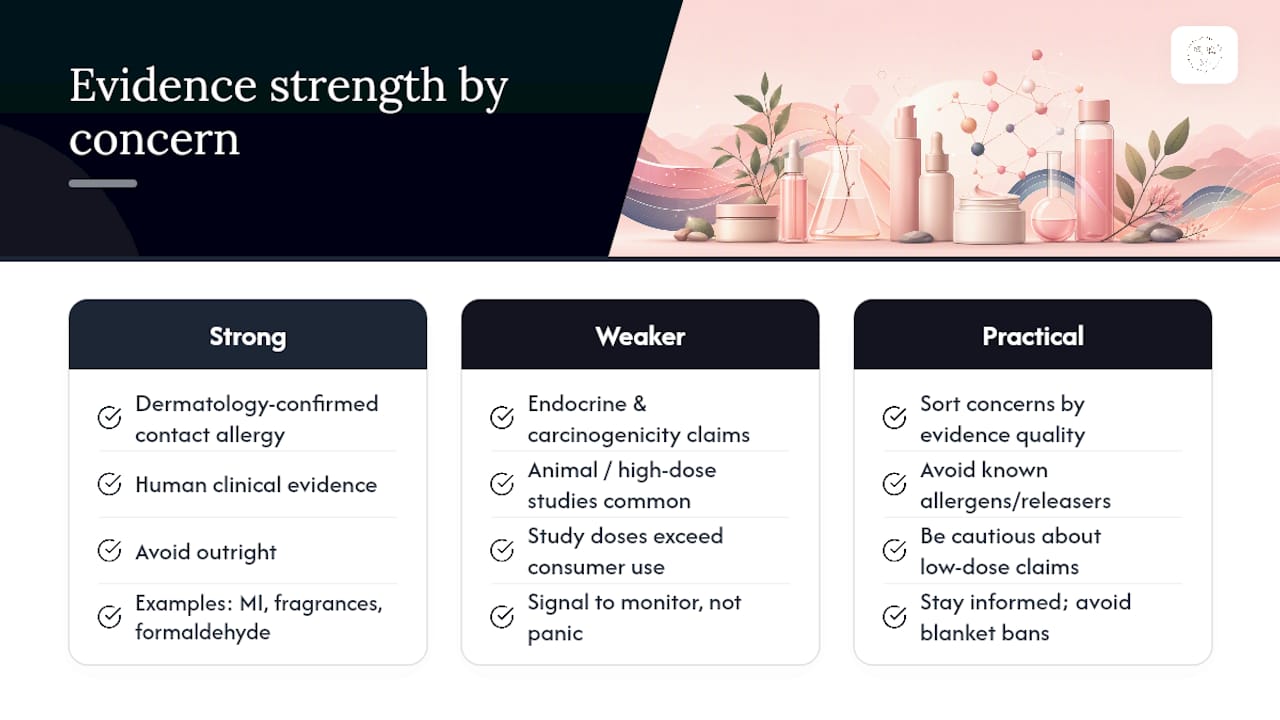
Not all ingredient concerns carry equal weight, and treating them as though they do is where a lot of clean beauty messaging goes wrong. Contact allergy evidence is genuinely strong. Dermatology research has repeatedly confirmed that MI/MCI, fragrance mixes, and formaldehyde cause skin reactions in a meaningful share of the population. That part of the clean skincare argument holds up under scrutiny.
Endocrine disruption and carcinogenicity claims sit on shakier ground. A lot of the underlying research relies on animal models or exposure levels far higher than what you’d encounter using a moisturizer twice a day. Translating a high-dose rodent study into a warning about your daily face cream requires a leap that the data doesn’t always support.
Evidence that low-dose topical exposures cause systemic endocrine effects in humans remains limited. Consumer guidance in this area should stay cautious without tipping into alarmism, because the exposure math for a typical skincare routine looks nothing like the studies driving the headlines.
That’s not a reason to shrug off every ingredient debate. It’s a reason to sort concerns by evidence quality instead of by how alarming they sound. Dermatology guidance generally lands here: treat known allergens and formaldehyde releasers as worth avoiding outright, and treat biomarker-based endocrine studies as a signal to stay informed rather than a reason to panic over a single ingredient on a 30-item list.
How to Read Ingredient Lists and Choose Safer Products
You don’t need a chemistry degree to shop smarter. You need a short routine you actually repeat every time you consider a new product.
- Pull the full ingredient list before you buy. Most brands post it online now, so check the product page or a reputable ingredient database before it ever reaches your cart. Scan first for fragrance, MI/MCI, and formaldehyde releasers.
- Check the preservative system on anything water-based. Any product containing water needs a preservative to prevent bacterial and mold growth, so a water-containing formula with no visible preservative is a red flag, not a win. The goal isn’t zero preservatives; it’s the right preservative at a safe concentration.
- Look for real transparency, not just a “clean” badge. A brand that publishes its full ingredient list, explains its sourcing, and holds a credible third-party certification is telling you more than one that slaps “non-toxic” on the front label and stops there.
Patch-testing deserves its own mention. If you have sensitive or eczema-prone skin, test any new product on your inner forearm for 48 hours before applying it to your face. Our ingredient list guide walks through this process step by step. If a product you already use has never caused a reaction, there’s little reason to abandon it just because an ingredient made headlines elsewhere.
Pro Tip: Screenshot the ingredient list of any product that works well for you. When you’re deciding whether a new “clean” claim is meaningful, you’ll have your own working baseline to compare it against.
Clean vs. Natural vs. Organic vs. Non-Toxic: What Each Label Actually Means
These four words get used almost interchangeably in marketing, but they answer different questions, and none of them is a synonym for safe. Understanding the terminology used across the industry helps you stop shopping by buzzword.
- Clean: avoids a brand-defined list of ingredients; no legal definition; no certification body owns the word.
- Natural: implies plant or mineral origin; also unregulated in most markets, and a natural sourcing does not make an ingredient non-irritating.
- Organic: the one term with real certification teeth in many regions, but it typically governs how an ingredient was farmed, not whether the finished formula is gentle on skin.
- Non-toxic: a consumer-facing phrase with no standardized threshold or testing requirement behind it.
If you’re prioritizing your skin’s health, ingredient-level safety and preservative quality matter more than which of these four labels appears on the box. If sustainability or farming practices matter to you personally, organic certification is the more meaningful signal. They’re separate questions worth answering separately.
Why “Natural” Doesn’t Automatically Mean Safer
A plant-derived ingredient can irritate skin just as easily as a synthetic one, sometimes more so. Essential oils and botanical extracts are common contact allergens, and concentrated citrus oils, lavender, and certain tree extracts show up regularly in dermatology case reports of skin reactions.
Sourcing adds another layer of risk that “natural” doesn’t address on its own. Plants grown in contaminated soil or treated with pesticides can carry heavy metals or chemical residue into a finished product, which is why sourcing transparency matters as much as the ingredient name itself.
- Patch-test any new essential-oil-containing product, even one marketed as gentle.
- Ask whether a brand discloses sourcing and testing for contaminants, not just ingredient origin.
- Favor well-formulated plant-based products that pair botanicals with modern preservation and stability testing, rather than raw, unformulated extracts.
A well-formulated botanical product accounts for concentration and stability. A jar of pure, undiluted plant extract with no formulation behind it is a bigger gamble than either camp likes to admit.
Where Pure Light Botanical Beauty Draws the Line
Clean skincare, done honestly, is a discipline, not a slogan. That’s the belief guiding how we build every formula at Purelightbotanicalbeauty: gentle botanicals, transparent ingredient lists, and a refusal to hide behind a buzzword when a customer with eczema or reactive skin is trusting us with their face.
We publish full ingredient lists because we’d rather earn your confidence through information than through a badge with no teeth behind it. Every formula gets built and tested with sensitive and eczema-prone skin specifically in mind, not as an afterthought bolted onto a mainstream product line. That means weighing preservative systems carefully, sourcing botanicals with contamination testing in mind, and being honest when a plant-derived ingredient still carries allergy potential worth flagging.
If you want the fuller philosophy behind that approach, our clean beauty explainer goes deeper into how we think about the word “clean” and why we treat it as a standard to meet rather than a label to slap on.
Ready to Put This Into Practice?
Reading ingredient lists and cross-checking preservatives is the right first step, but building an actual routine around those principles is where most people stall out. That’s exactly the gap our starter offerings are built to close.
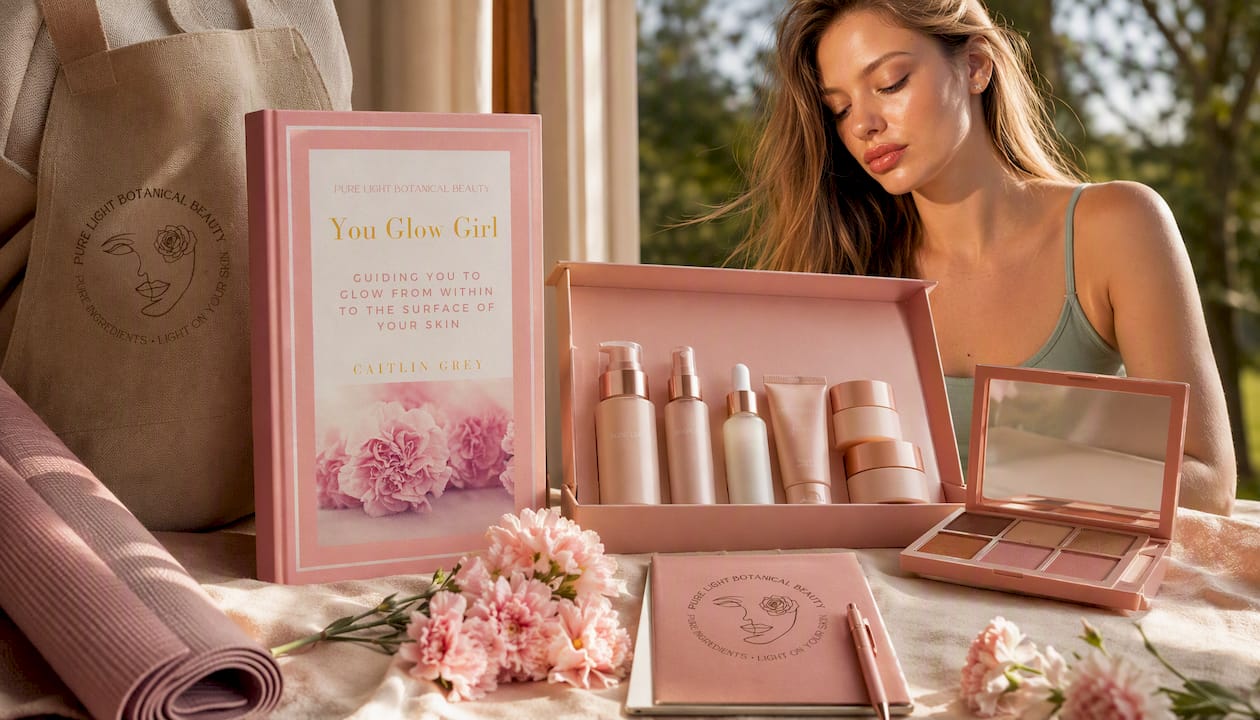
The 7-Day Fresh Start Skin Ritual™ is our most direct answer for anyone who wants a guided, ingredient-transparent routine without spending hours researching every product category from scratch. It walks you through a full week of gentle, botanical-based skincare built specifically with sensitive and eczema-prone skin in mind, applying every buying criterion covered in this guide, from preservative awareness to full-disclosure sourcing, in a format you can follow immediately.
For readers who want expert hands on their skin rather than a solo routine, Radiant Makeup Services offers clean, natural makeup application tailored to sensitive-skin clients. And if you’d rather absorb the philosophy at your own pace before buying anything, You Glow Girl™ is a ritual-based e-book that blends clean beauty guidance with practices for approaching skincare as self-care rather than a chore.
Start with the 7-Day Fresh Start Skin Ritual™ if you want a concrete plan this week, or explore Radiant Makeup Services if a guided application is what you need most.
Where This Article’s Claims Come From
- Harvard Health’s review of clean cosmetics and the science behind the trend
- Healthline’s explainer on what “clean beauty” actually means
- MDedge’s clinical dermatology perspective on the clean beauty movement
- Label Lookout’s side-by-side ingredient comparison of clean versus conventional makeup
An Editorial Take on the Clean Beauty Conversation
The clean beauty debate has a habit of collapsing two very different questions into one: “Is this ingredient dangerous?” and “Do I trust this company?” Those aren’t the same question, and treating them as one is how otherwise smart shoppers end up avoiding a well-studied preservative while ignoring an untested essential oil blend that’s far more likely to cause a reaction on their specific skin.
What gets underestimated in most coverage of this topic is how much the format of a product changes the risk calculation. A lip product held on the mouth for hours and partially ingested deserves more scrutiny than a rinse-off cleanser that’s on skin for thirty seconds before it goes down the drain. Almost no consumer-facing clean beauty content makes that distinction clearly, yet it’s one of the more useful filters you can apply.
The other overlooked nuance: “natural” gets treated as the safer default when the actual allergy and irritation data doesn’t support that assumption. Essential oils cause real, documented reactions. A synthetic ingredient with decades of toxicology data behind it can be the more predictable choice for reactive skin, even though it sounds less appealing on a label. Clean skincare done well isn’t about chasing the most “natural” version of everything. It’s about knowing which specific ingredients have earned their reputation and which ones are riding on a marketing narrative that outpaced the evidence.
— Kaitlyn
Recommended
- Clean Beauty Terminology Explained: A Deep Dive – Pure Light Botanical Beauty
- Complete Guide to the Advantages of Clean Cosmetics – Pure Light Botanical Beauty
- What is Clean Beauty? Understanding Its Importance and Benefits – Pure Light Botanical Beauty
- The Essential Guide to Clean Cosmetics Benefits – Pure Light Botanical Beauty