

TL;DR:
- Squalane does not hydrate by pulling water into the skin; instead, it seals in existing moisture to prevent water loss.
- It functions as a semi-occlusive emollient, enhancing skin softness and reducing water evaporation when layered over hydrating serums.
Most people assume that if something is called hydrating, it must be pulling water into the skin. That assumption leads to a lot of confusion when they try squalane and wonder why it feels so different from their hyaluronic acid serum. The role of squalane in hydration is not about adding water. It is about keeping the water you already have from escaping. That distinction is small in wording but enormous in practice, and understanding it will change how you build your skincare routine from the ground up.
Table of Contents
- Key Takeaways
- What squalane actually is and how it works
- How squalane compares to other hydrating ingredients
- Who benefits from squalane and how to use it
- What the science says about squalane and hydration
- Common myths about squalane and hydration
- My perspective on getting the most from squalane
- Squalane-infused beauty made to nourish your skin
- FAQ
Key Takeaways
| Point | Details |
|---|---|
| Squalane seals, not attracts, moisture | It works as a semi-occlusive to prevent water loss, not to add water to skin. |
| Layer squalane after water-based products | Apply it over hydrating serums to lock in the moisture they deliver. |
| Safe for virtually all skin types | Non-comedogenic and biocompatible, making it suitable for dry, oily, and sensitive skin. |
| Clinical data supports its efficacy | A 28-day study showed measurable decreases in water loss and increases in skin hydration. |
| Quality matters significantly | Pharmaceutical-grade squalane is stable and will not oxidize or irritate skin. |
What squalane actually is and how it works
Squalane and squalene sound nearly identical, but they behave very differently on your skin. Squalene is a naturally occurring lipid your body produces. Your skin makes it as part of sebum, but production drops noticeably after your mid-20s. The problem with squalene in skincare is that it oxidizes and causes irritation when exposed to air or UV light. Squalane is the hydrogenated, fully saturated version of squalene. That process makes it chemically inert and stable with a long shelf life and no peroxidation under normal conditions.
Because squalane so closely resembles the oils your skin already makes, your skin recognizes it and accepts it without confusion or resistance. This biocompatibility is one of its most underrated qualities.
Here is what squalane does functionally once it reaches your skin:
- Forms a breathable surface layer that slows transepidermal water loss (TEWL) without completely blocking oxygen exchange
- Softens the outer skin texture by filling in microscopic gaps between surface skin cells
- Integrates with skin lipids to support the skin’s natural protective function
- Reduces flaking and rough patches rapidly, often within days of consistent use
Importantly, squalane does not integrate structurally into the lipid bilayer the way ceramides do. It sits above that structure and creates a protective, breathable layer rather than rebuilding the architecture of the barrier itself.
Pro Tip: Look for “sugarcane-derived squalane” or “olive-derived squalane” on the label. Plant-based sources tend to be more sustainable and are just as effective as shark-derived versions that older products once used.
How squalane compares to other hydrating ingredients
This is where most skincare advice gets muddled. Hydration is not a single mechanism. Different ingredients work through completely different pathways, and mixing them up leads to both unrealistic expectations and missed results.
Here is a clear breakdown of the three categories and where squalane fits:
| Ingredient type | How it works | Examples |
|---|---|---|
| Humectant | Draws water from the environment or deeper skin layers into the upper layers | Hyaluronic acid, glycerin, aloe vera |
| Emollient | Fills in gaps between skin cells to smooth texture and support softness | Squalane, jojoba oil, shea butter |
| Occlusive | Creates a physical barrier on skin’s surface to prevent water from evaporating | Petrolatum, beeswax, lanolin |
Squalane sits in the emollient and semi-occlusive categories. It does not attract water like hyaluronic acid does, but it holds the water that hyaluronic acid or glycerin delivered. Think of a humectant as a sponge that pulls water in, and squalane as the lid you place over that sponge to keep it from drying out.
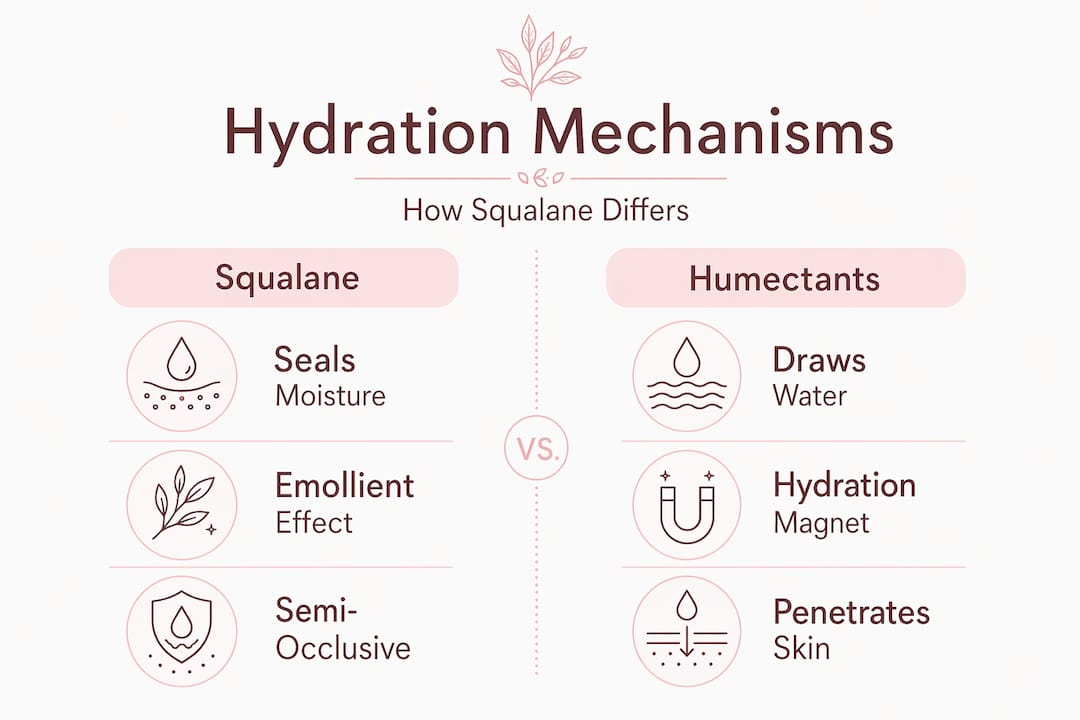
This is why using squalane alone on dehydrated skin often feels good but does not fully solve the problem. You are sealing the surface, but if there is not much moisture underneath to seal in, the effect is limited. Combining it with a water-based hydrating serum is where the real benefit happens.
Ceramides play a different role again. They are structural lipids that make up the mortar between skin cells in the barrier. Squalane can increase ceramide synthesis in keratinocytes by roughly 22% in cell studies, which is a meaningful supportive benefit, but it cannot replace ceramides if the barrier is severely compromised.
Pro Tip: Apply a few drops of squalane immediately after your water-based serum while your skin is still slightly damp. That slight dampness gives the squalane something to seal in right away, which noticeably improves how long your skin stays soft.
Who benefits from squalane and how to use it
The short answer is almost everyone. Squalane is one of the few oils that earns a low comedogenic rating, meaning it is unlikely to clog pores even on acne-prone skin. That makes it genuinely rare in the world of facial oils.
For dry skin: Squalane shines here. It reduces the tight, flaky feeling that dry skin often carries, especially during colder months. Layering it over a humectant serum gives you both the water replenishment and the moisture retention your skin needs.

For oily or combination skin: This sounds counterintuitive, but squalane can help regulate oil production over time. When skin is perpetually stripped of moisture, it overproduces sebum as a compensation response. Providing the right lightweight oil breaks that cycle.
For sensitive skin and eczema-prone skin: Because squalane mimics the skin’s own natural oils, it is far less likely to trigger inflammation or reactivity than heavier plant oils or synthetic emollients. It is one of the most skin-compatible choices for anyone working through a barrier repair routine.
For aging skin: Sebum production declines with age, meaning the skin’s natural semi-occlusive function weakens. Adding squalane back into the routine addresses a genuine physiological gap that emerges over the years.
Common layering mistakes to avoid:
- Applying squalane before water-based serums, which prevents absorption of the hydrating layer underneath
- Using too much at once, which can leave skin looking greasy rather than dewy
- Skipping the water layer entirely and relying on squalane alone for hydration
For guidance on applying oils safely, especially if you have reactive skin, this resource on facial oils for sensitive skin from Purelightbotanicalbeauty walks through exact techniques worth reading before you start.
Pro Tip: Two to three drops is usually enough for the entire face. Warm it between your palms before pressing it gently into skin rather than rubbing it in. That technique improves absorption and avoids disturbing any serum applied underneath.
What the science says about squalane and hydration
Clinical research on squalane is not as abundant as research on retinol or hyaluronic acid, but what exists is consistent and encouraging.
The most cited data point in dermatological contexts is that squalane reduces TEWL by 25 to 30%, which is a meaningful improvement in how well skin holds onto its internal moisture. A 28-day study specifically focused on older adults found that consistent use of squalane-containing emollients produced a measurable decrease in TEWL of 1.07 ± 0.29 g/m²/h alongside an increase in hydration levels of 2.09 ± 0.95 units. Those numbers reflect real changes in how the skin feels and functions day to day.
“Squalane is clinically shown to reduce water loss through the skin surface while improving overall softness and suppleness, making it one of the most skin-compatible emollients available.”
Squalane also reduces visible flaking and improves smoothness faster than most people expect. Results on surface texture often appear within days rather than weeks. This is partly why it earns such loyal fans among people who have struggled with rough, dehydrated skin for years.
What squalane does not do is repair structurally damaged lipid barriers on its own. Ceramides accomplish that kind of deeper repair more effectively. The smart approach is to understand both ingredients for their distinct strengths and use them together when barrier repair is the goal. You can read more about why skin needs hydration and how barrier function fits into the bigger picture on the Purelightbotanicalbeauty blog.
Common myths about squalane and hydration
A lot of misinformation circulates around squalane, and some of it actively prevents people from using it correctly. Here are the most persistent myths worth clearing up:
- “Squalane hydrates skin on its own.” This is the most common misunderstanding. Squalane seals existing moisture but does not introduce water into the skin. On dehydrated skin with no prior water-based layer, its effect will feel limited.
- “Squalane will clog my pores.” Squalane has a very low comedogenic rating and is consistently recommended even for acne-prone skin types when used in appropriate amounts.
- “Only dry skin types should use squalane.” Oily and combination skin can absolutely use squalane. The key is using a small amount and layering it correctly.
- “All squalane products are the same.” The source and purity of squalane matter. Pharmaceutical-grade squalane is fully saturated and will not oxidize. Lower-quality versions can degrade over time and reduce effectiveness.
- “Squalane can fix a severely compromised skin barrier.” It supports barrier function and even nudges ceramide production upward, but it cannot replace the structural lipid repair that ceramides provide. Setting realistic expectations here leads to better outcomes.
Correcting these myths does not diminish squalane’s genuine strengths. It actually makes space to use it in a way that delivers on its real promise.
My perspective on getting the most from squalane
I have watched the conversation around squalane shift enormously over the past several years. When it first gained popularity, people treated it like a miracle oil that could replace everything else in their routine. Then the backlash came, with claims that it did not really do much. In my experience, both extremes miss the point entirely.
What I have learned is that squalane works beautifully when you respect what it actually is: a moisture-sealing emollient, not a hydrator. The moment I started applying it after a properly layered water-based routine rather than alone, the difference was undeniable. Skin held its softness far longer through the day, and that uncomfortable tightness that dry skin types know well became much less frequent.
I also feel strongly that ingredient quality is something most consumers underestimate. The purity of the squalane in a product determines how stable and effective it will be. A beautifully marketed product with low-quality squalane will oxidize faster and may even irritate sensitive skin over time. I always look for transparency in sourcing and prefer plant-derived squalane from brands that are honest about their formulation choices.
The other thing I want to emphasize is that every skin is genuinely individual. Some people find two drops of squalane transformative. Others find they need to pair it with a richer ceramide cream underneath to see full results. There is no single formula, and the most rewarding part of skincare is learning to listen to what your own skin responds to over time.
— Kaitlyn
Squalane-infused beauty made to nourish your skin
At Purelightbotanicalbeauty, every product is built on the belief that clean, plant-based ingredients can do the work of both healing and beautifying at the same time.
The brand’s lip oils and botanical formulas are crafted with carefully sourced plant oils, including squalane, to give you that layered moisture experience directly in your makeup routine. You get the color, the feel, and the skin-nourishing benefit in one step. Products like the Petal Perfect Lip Oil are designed to fit naturally into a holistic, skin-first approach to beauty. Explore the full collection at Purelightbotanicalbeauty and find formulas that take care of your skin while you wear them.
FAQ
What is the role of squalane in hydration?
Squalane acts as a semi-occlusive emollient that prevents water from evaporating off the skin’s surface. It seals in moisture delivered by humectants like hyaluronic acid rather than adding water itself.
Does squalane help hydration for dry skin?
Yes. Squalane is particularly effective for dry skin because it slows transepidermal water loss by up to 25 to 30% and improves skin smoothness and suppleness relatively quickly with consistent use.
Can oily skin types use squalane?
Oily skin types can use squalane safely. It has a low comedogenic rating and will not clog pores, and its lightweight texture makes it far less likely to feel heavy or cause breakouts compared to heavier facial oils.
How should I layer squalane in my skincare routine?
Apply squalane after any water-based serums or toners and before a heavier moisturizer if you use one. Using it after water-based products seals the moisture those products delivered into your skin.
Is squalane better than hyaluronic acid for hydration?
They serve different functions and work best together. Hyaluronic acid draws moisture into the skin while squalane locks it there. Using both in sequence gives you deeper and longer-lasting hydration than either ingredient alone.
Recommended
- 7 Types of Plant Oils for Skin: Safe Choices for Sensitive Skin – Pure Light Botanical Beauty
- Why skin needs hydration: guide for sensitive skin 2026 – Pure Light Botanical Beauty
- Why hydration matters for sensitive skin: a natural guide – Pure Light Botanical Beauty
- Top hydrating botanicals for sensitive skin: soothe and restore – Pure Light Botanical Beauty