

For eczema-prone and sensitive skin, “beauty so clean” should mean plant-based cosmetics chosen for what they leave out, not just what they claim to be. The safe approach is fragrance-free formulas, full ingredient lists you actually read, and one new product introduced at a time. If a rash keeps returning despite careful choices, a dermatologist and patch testing come next, not another product swap.
TL;DR:
- Fragrance-free formulations are essential since “unscented” products often contain masking fragrances that can trigger sensitivities.
- Short, transparent ingredient lists that avoid common allergens like citrus oils, tea tree, and certain botanicals improve safety for eczema-prone skin.
- Introduce one new product at a time and monitor reactions for at least a week to identify specific triggers accurately.
- Patch testing by a dermatologist is recommended if dermatitis persists or spreads despite careful product choices.
- Buying directly from brands that provide clear sourcing and ingredient transparency simplifies safe product selection and routine building.
Table of Contents
- What “Beauty So Clean” Really Means for Eczema-Prone Skin
- How Do You Evaluate a Clean Beauty Product Before Buying?
- What’s the Safest Way to Try New Clean Makeup?
- When Should You See a Dermatologist for Reactions?
- What Products Does Beauty So Clean Actually Offer?
- What Certifications Actually Signal Product Safety?
- Where Can You Buy Clean Beauty Products, and What Do They Cost?
- How Does Beauty So Clean Compare to Other Clean Beauty Options?
- A caring, evidence-minded approach to clean beauty
- Ready to Start Your Own Slow, Safe Transition?
- Authoritative Sources and Further Reading
- FAQ
What “Beauty So Clean” Really Means for Eczema-Prone Skin
“Clean” and “plant-based” are marketing categories. They are not safety guarantees, and treating them as one is where a lot of well-meaning skin care goes wrong. The FDA has been direct about this: terms like “hypoallergenic,” “natural,” and “organic” carry no single federal definition in cosmetics, which means any brand can print them on a label regardless of what the formula actually does to reactive skin.
The American Academy of Dermatology puts a finer point on it. More than 15,000 substances that touch skin can trigger allergic reactions, and fragrance sits near the top of that list. People with atopic dermatitis face a higher risk across the board, because a compromised skin barrier lets irritants penetrate more easily than they would in healthy skin.
Here is the part that surprises a lot of shoppers: botanical does not mean gentle. Plant extracts and essential oils carry their own allergen profiles, and they vary from batch to batch depending on growing conditions and extraction methods. A rose oil that soothed your skin last spring is not chemically identical to the bottle you buy this fall.
How Do You Evaluate a Clean Beauty Product Before Buying?
Reading a label well takes about ninety seconds once you know what you are scanning for. Skip the front-of-package claims entirely and go straight to the ingredient panel.
Here is the checklist worth keeping on your phone:
- Look for the words “fragrance-free,” not “unscented.” Unscented often means fragrance was added specifically to mask other scents, not that it was left out. Fragrance-free means no fragrance ingredients at all.
- Scan the full INCI list for the big four allergen classes: fragrance or perfume, certain preservatives, some dyes, and metals like nickel. The FDA flags all of these as common culprits, and fragrance can legally appear as a single vague word covering dozens of unlisted components.
- Treat natural rubber and latex-derived ingredients with caution if you have any known sensitivity, since they show up in some brushes and applicators, not just formulas.
- Watch for repeat offenders among botanicals: certain citrus oils, tea tree (melaleuca), and Compositae-family extracts (think chamomile, calendula, ragweed relatives) are documented sensitizers, especially with repeated use.
- Favor short, simple formulas over long ones. Fewer ingredients mean fewer variables if your skin reacts, and reactive skin does better with restraint than with a fifty-ingredient “active” blend.
- Check the practical details: manufacturer contact information, a batch number, an expiration date, and clear usage directions. If a product cannot tell you when it was made, it cannot tell you when to stop using it.
Pro Tip: Keep the box or tube even after you toss the empty bottle. If a reaction shows up two weeks later, that packaging is the only record of exactly which ingredients touched your skin.
For a deeper walkthrough of ingredient shopping specific to eczema, our guide to choosing makeup for eczema breaks down label language product category by product category.
What’s the Safest Way to Try New Clean Makeup?
Switching your entire routine at once feels efficient. It is also the fastest way to end up with a flare and no idea which of the six new products caused it.
- Introduce one product at a time, waiting at least a week before adding the next. If nothing surfaces, move on to the next item.
- Start with low-contact, non-leave-on items rather than moisturizers or serums you wear all day. A cream blush worn for a few hours tells you less risky information faster than an overnight balm.
- Do a home patch test first. Apply a small amount to the inner forearm, leave it undisturbed, and check at 24 and 48 hours. Reactions from botanical ingredients can be delayed, sometimes appearing days after exposure, so do not clear a product after only a few hours.
- Keep a simple product-and-symptom diary, logging the date, the product, where you applied it, and what happened. This single habit is what turns a guessing game into a pattern a clinician can actually use.
- Treat lip and eyelid products with extra caution. Skin on the lips and eyelids is thinner and more permeable, and ingredients from lip products in particular tend to spread beyond where they were applied, which is why recurrent lip dermatitis is so common.
- Never change your cleanser and moisturizer in the same week you are testing a new cosmetic. If something reacts, you want exactly one variable to blame.
Pro Tip: If a new lip product causes any tingling within the first hour, wipe it off immediately and do not reapply “to see if it settles.” Tingling on delicate lip skin is often the earliest signal, not a normal adjustment period.
Our transition guide for clean makeup walks through this pacing in more detail, including how to sequence a full routine swap over several weeks.
When Should You See a Dermatologist for Reactions?
Stop self-managing and book an appointment if dermatitis keeps recurring or spreads beyond the original site, if lip or eyelid irritation returns more than once, or if you notice any systemic symptoms like widespread hives or swelling. The same applies if you have already eliminated obvious suspects and reactions continue.
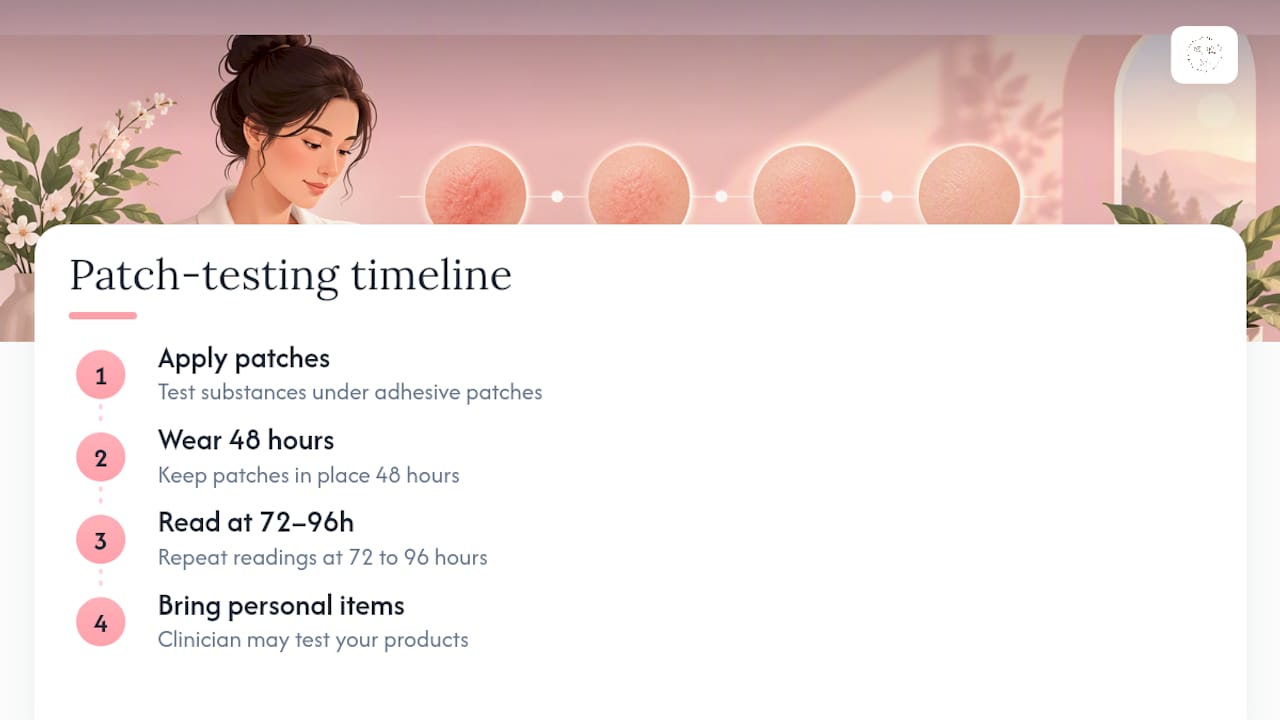
Patch testing is the diagnostic tool dermatologists use to pin down the exact allergen. The process involves applying small amounts of test substances under adhesive patches, worn for 48 hours, with readings taken again at 72 to 96 hours because some reactions take days to surface. Standard commercial panels do not include every botanical ingredient on the market, which is why bringing your own products and their ingredient lists to the appointment matters. A clinician testing your actual lip oil or blush directly often finds what a generic panel misses.
What Products Does Beauty So Clean Actually Offer?
At Purelightbotanicalbeauty, “clean” is not a front-label word. It is the design brief behind every formula, built specifically with sensitive and eczema-prone skin as the baseline case, not the exception.
The line centers on a small set of purposeful products rather than a sprawling catalog. The lipstick product brings color to lips without a heavy synthetic load. The lip oil product targets concerns about lip and eyelid vulnerability, delivering botanical care instead of fragrance-heavy oils. The blush and beauty balm round out the range, giving color and complexion support without long ingredient decks that make patch testing harder to interpret.
Every formula is built on the same premise: plant-based ingredients chosen for skin support, sourced with an emphasis on transparency rather than trend chasing. That means shorter ingredient lists, ingredient sourcing you can ask about, and a formulation philosophy that treats sensitive skin as the design starting point rather than an afterthought addressed with a “gentle” sticker.
Beyond products, the brand extends into guided experience: makeup services for those wanting professional application of skin-safe products, and online coaching for those interested in the ritual and mindset side of clean beauty alongside product selection.
What Certifications Actually Signal Product Safety?
Certification language on cosmetics can be more marketing than substance, and it helps to know which labels carry real weight versus which are self-declared with no third-party check behind them.
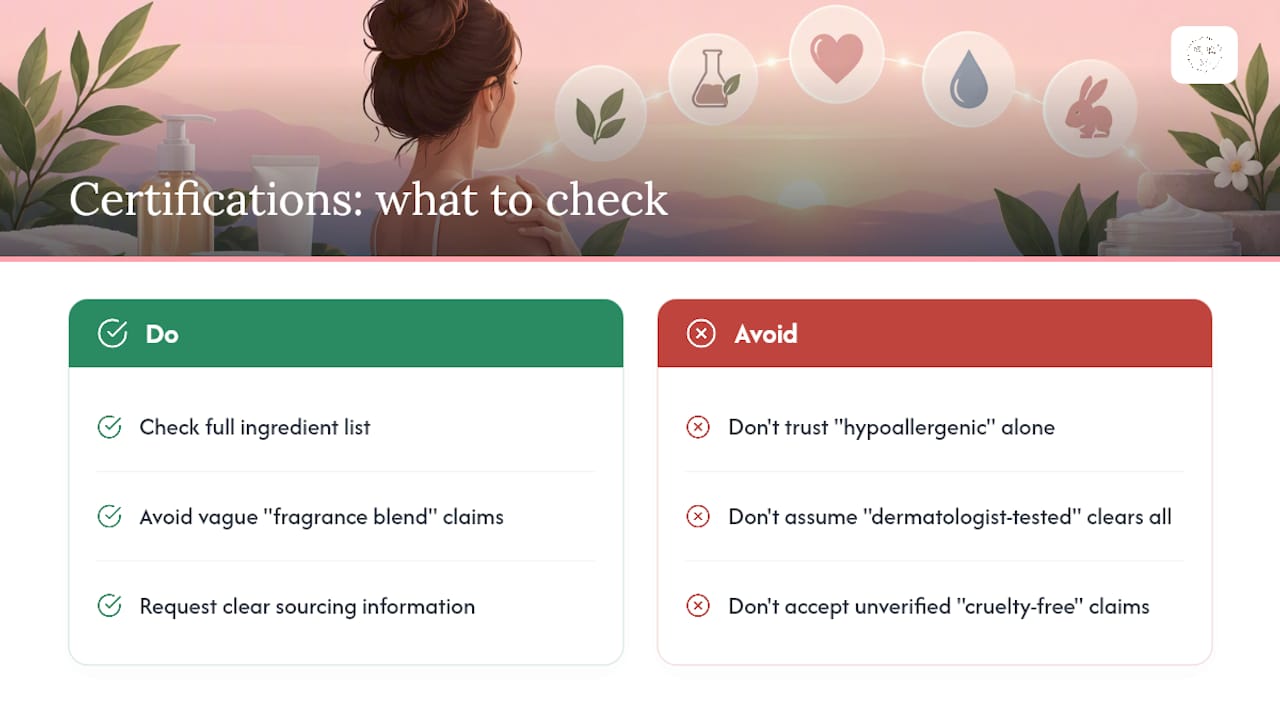
Cruelty-free claims mean a product was not tested on animals, but the term has no single verifying body, so consistency depends heavily on the brand’s own transparency about sourcing and testing partners. Dermatologist-tested means a dermatologist evaluated the product at some point in development. It does not mean the product was cleared for every skin condition, and it says nothing about the sample size or the conditions tested against.
Hypoallergenic is the label most worth treating skeptically. As the FDA has noted, there is no federal standard defining what qualifies a product for that word, so two “hypoallergenic” products can carry entirely different allergen profiles. This is exactly why ingredient-list literacy matters more than any single certification stamp: a short formula with fragrance genuinely absent tells you more than a certification badge ever will.
What matters more in practice is transparency you can verify yourself: a full ingredient list disclosed without vague catch-alls like “fragrance blend,” clear sourcing information available on request, and formulas built around the allergen classes dermatology guidance flags most often (fragrance and preservatives lead that list). Purelightbotanicalbeauty’s approach leans into that transparency, treating the ingredient panel itself as the real certification. Our piece on why botanical ingredients matter goes further into how sourcing decisions affect sensitivity risk.
Where Can You Buy Clean Beauty Products, and What Do They Cost?
Purelightbotanicalbeauty sells directly through its own storefront, which keeps the supply chain short and the ingredient information consistent from batch to batch, rather than relying on third-party retailers who may not update sourcing details.
Pricing sits at a clear, single price point per product rather than tiered “premium” versions with hidden formula differences. For example, Nourishing Lipstick™, Petal Perfect Lip Oil™, and Botanical Crème Blush™ are each offered at specific price points, with Botanical Beauty Balm™ starting from a certain amount depending on the version selected. For readers who want hands-on guidance rather than a self-directed purchase, services such as Radiant Makeup Services, Eczema Healing Consultation, and Holistic Health Coaching are available at progressively higher price levels.
Buying direct also means you get access to educational resources tied to each purchase, including guidance on how to layer or introduce a new product without disrupting a routine that is already working for your skin. That matters more for reactive skin than for a general beauty audience, since the sequencing of a new product often determines whether it succeeds or triggers a flare.
How Does Beauty So Clean Compare to Other Clean Beauty Options?
Most clean beauty categories fall into one of two camps: mass-market “clean” lines that swap a few synthetic ingredients for marketing purposes while keeping long, complex formulas, or boutique natural brands that lean heavily on essential oils without accounting for the batch-to-batch variability dermatology research has flagged as a real allergen risk.
The gap that matters for eczema-prone skin is formulation intent. A brand built for general “clean” positioning treats sensitive skin as one segment among many. A brand built specifically around eczema and sensitivity, the way Purelightbotanicalbeauty is, treats fragrance exclusion and short ingredient decks as the default, not an upgrade tier. That distinction shows up in practice: fewer ingredients per product, explicit fragrance-free formulation rather than “unscented” workarounds, and product lines sized around low-contact, easy-to-isolate items like lip oil and cream blush rather than heavy, all-day leave-on formulas that make patch-testing harder if a reaction occurs.
Neither approach eliminates allergy risk entirely. Plant-based ingredients still carry sensitization potential, and no brand can promise otherwise. What differs is how much friction stands between you and figuring out what caused a reaction, and a shorter, more transparent formula gives you fewer variables to untangle.
A caring, evidence-minded approach to clean beauty
I have spent enough time in this category to know that “clean” gets used as a finish line when it should be treated as a starting question. Botanicals are not automatically gentle, and dermatology research backs that up again and again. What actually protects reactive skin is patience: one product at a time, a diary you actually keep, and lip and eyelid products treated with real caution rather than an afterthought.
None of that is in tension with loving your products or treating a skincare routine as a small daily ritual. It just means reading the ingredient list before you read the marketing copy, and knowing when a persistent flare means it is time to call a dermatologist rather than try one more “natural” swap.
— Caitlin Grey
Ready to Start Your Own Slow, Safe Transition?
Purelightbotanicalbeauty exists because most “clean” brands ask sensitive skin to adapt to their formulas, instead of building formulas around what reactive skin actually needs. That is the concrete difference here: short, fragrance-free ingredient decks designed with eczema-prone skin as the baseline, not a niche add-on.
If you want a professional guiding your product choices in real time, Radiant Makeup Services puts a trained eye on your specific skin before anything touches your face. If you would rather start at home, the 7-Day Fresh Start Skin Ritual gives you a guided, one-step-at-a-time framework at no cost, which is currently offered as a free gift against its $77.77 value. And if you want ongoing support that pairs product selection with the emotional and ritual side of self-care, Beauty Within™ Online Coaching walks alongside you well past the first product swap.
Browse the full product catalog or explore coaching and service options to find your next step.
Authoritative Sources and Further Reading
- Eczema Triggers and Friendly Products — American Academy of Dermatology
- Allergens in Cosmetics — U.S. Food and Drug Administration
- Using Cosmetics Safely — U.S. Food and Drug Administration
- Botanical Cosmetics and Allergic Contact Dermatitis — peer-reviewed review
FAQ
Is “Unscented” the Same as “Fragrance-Free”?
No. “Unscented” often means a masking fragrance was added to cancel out other scents, while “fragrance-free” means no fragrance ingredients were used at all. For eczema-prone skin, the American Academy of Dermatology recommends looking specifically for “fragrance-free” on the label.
Can Natural or Plant-Based Ingredients Still Cause a Reaction?
Yes, and this is one of the most misunderstood parts of clean beauty. Botanical extracts and essential oils vary by batch and growing conditions, and certain plant families like Compositae are well-documented sensitizers regardless of how “natural” the product claims to be.
How Long Does a Patch Test Take?
A dermatology patch test typically stays on the skin for 48 hours, with a follow-up reading at 72 to 96 hours because some reactions are delayed. A quick at-home test on your forearm follows similar timing: apply, wait at least 24 to 48 hours, and watch for any delayed response before assuming a product is safe.
What Does Beauty So Clean by Purelightbotanicalbeauty Cost?
Individual products range from 33.33 USD for the Nourishing Lipstick™ and Botanical Crème Blush™ to 44.44 USD for the Petal Perfect Lip Oil™, with Botanical Beauty Balm™ starting from 44.44 USD. Coaching and service options range from 222 USD for Radiant Makeup Services up to 2888 USD for Beauty Within™ Online Coaching.
Should I See a Dermatologist Before Trying Clean Makeup?
You do not need a dermatologist to start a careful transition, but you should see one if you have a history of recurrent dermatitis or a known allergy pattern. Anyone who develops repeated or spreading reactions during a slow, one-at-a-time product introduction should stop and seek a professional patch test rather than continuing to guess.