

The best way to get glowing skin is deceptively simple: cleanse gently, exfoliate with restraint, hydrate with a humectant sealed under a barrier moisturizer, wear SPF 30 or higher every single day, and protect your sleep. Hydration and smoothness show up within days. Tone and texture take weeks. If your skin is sensitive or eczema-prone, the same principles apply, just applied more slowly, and a short plan below shows you exactly where to start.
TL;DR:
- Consistency in sequencing barrier repairs before layering actives is key to sustainable glowing skin, especially for sensitive and eczema-prone skin.
- Daily use of SPF 30 or higher protects against environmental stressors that undermine skin radiance and prevents irritation from active ingredients.
- Rapid improvements in hydration and surface smoothness can be seen within days, but tone and texture may require several weeks of routine adherence.
- Gentle, barrier-supporting ingredients like ceramides, hyaluronic acid, and niacinamide are safer starting points for reactive skin and support long-term glow.
- Introducing actives such as retinoids or acids gradually and with patience ensures visible results without worsening irritation or compromising the skin barrier.
Table of Contents
- What is the best way to get glowing skin, really?
- Core routine: morning and evening steps for every skin type
- Which active ingredients actually deliver glow, and how do you introduce them safely?
- What lifestyle changes actually move the needle on skin radiance?
- How do you jump-start glowing skin in 7 to 14 days?
- Why this approach works for sensitive and eczema-prone skin
- The editorial take: what actually matters here
- Let You Glow Girl™ guide your ritual, not just your routine
- Selected sources and further reading
What is the best way to get glowing skin, really?
Glow isn’t a filter or a genetic lottery ticket. It’s an optical effect, created by three things working together: surface smoothness, hydration, and even tone. When those three levers move in the right direction, light reflects off your skin evenly instead of scattering across rough patches or dry flakes, and that’s what reads as “radiant” to the eye.
That means the fastest path to visible improvement isn’t a single miracle product. It’s a routine that hits all three levers at once, which is exactly why dermatologists and clinical reviewers keep landing on the same basic sequence: cleanse, moisturize, protect, with careful exfoliation and targeted actives layered in once your skin can handle them. For sensitive and eczema-prone skin, the order matters just as much as the ingredients, because a compromised barrier will sabotage every other step you take.
Core routine: morning and evening steps for every skin type
Your morning routine exists to protect what you built overnight. Your evening routine exists to repair what the day took away. Here’s the order that respects both jobs:
- Morning: Cleanse (or rinse if your skin is dry), apply a vitamin C or antioxidant serum, layer a humectant like hyaluronic acid, seal with a barrier moisturizer, and finish with broad-spectrum SPF 30 or higher.
- Evening: Double-cleanse if you wore sunscreen or makeup, apply treatment actives (retinoid or exfoliant, not both), then hydrate and moisturize to lock everything in.
Let your cleanser sit on damp skin for about 30 seconds before rinsing. That dwell time gives the surfactants a chance to actually lift sunscreen and makeup residue, rather than just skimming the surface in a quick lather-and-rinse.
Skin type changes the details, not the sequence. Oily skin can handle a gel cleanser and lighter gel moisturizer. Dry skin needs a cream cleanser and a richer occlusive at night. Combination skin often does best zoning products by area. Sensitive or eczema-prone skin should skip fragrance, alcohol-based toners, and anything foaming aggressively, leaning instead on ceramide-rich, plant-derived formulas that support the barrier rather than strip it.
Apply hyaluronic acid to damp skin, then immediately seal it with moisturizer. Skipping that seal lets the humectant pull moisture from your skin instead of the air, which leaves you drier than when you started.
Pro Tip: If your skin starts stinging, flaking, or looking shiny in a “raw” way rather than a dewy way, strip back to just cleanser, moisturizer, and SPF for a week before reintroducing actives one at a time.
A radiant complexion routine built on these fundamentals gives your skin room to recover between active treatments, which matters more than most people realize.
Which active ingredients actually deliver glow, and how do you introduce them safely?
Four ingredients carry most of the evidence for visible radiance, and each one works through a different mechanism.
- Vitamin C brightens tone and defends against environmental stress; use it in the morning under sunscreen.
- Hyaluronic acid draws water into the skin’s surface layer, plumping fine lines and boosting light reflection almost instantly.
- Niacinamide supports the barrier and helps even out tone with minimal irritation risk, making it a safe entry point for reactive skin.
- Retinoids and gentle exfoliating acids speed cell turnover, improving texture and pigment, but they demand patience and sun protection.
Retinoids are where most people sabotage their own progress. Dermatologists consistently advise starting at low frequency, often once a week, and building up slowly while sandwiching the retinoid between layers of moisturizer to buffer irritation. If you notice redness, tightness, or flaking that doesn’t settle within a day or two, pull back to the previous frequency before pushing forward again.
Timelines vary by ingredient. Hyaluronic acid can visibly plump skin within hours. Niacinamide often shows tone improvement within a few weeks of consistent use. Retinoids and exfoliating acids are the slow burners, frequently taking several weeks to meaningfully change texture and pigment, and they only hold those gains when daily SPF 30 or higher is non-negotiable.
For a deeper walk-through of layering order and product choices, a routine that actually works breaks down how to sequence these actives without overwhelming reactive skin.
What lifestyle changes actually move the needle on skin radiance?
Topicals do maybe half the work. The rest comes from how you sleep, eat, and manage stress.
- Sleep 7 to 9 hours. Skin repair happens overnight, and shorted sleep measurably reduces hydration and firmness.
- Lower chronic stress. Elevated stress hormones disrupt the skin barrier directly, so even a few minutes of daily breathing work, walking, or journaling pairs well with topical care.
- Eat for repair. Aim for roughly 1.2 to 1.6 grams of protein per kilogram of body weight and one to two servings of oily fish a week for omega-3s, both of which support collagen and barrier function.
- Stay hydrated and move your body. After sweating, rinse promptly rather than letting salt and oil sit on the skin for hours.
Smoking and heavy alcohol use work against every one of these efforts, constricting blood flow and dehydrating skin from the inside, which is worth remembering before you invest in another serum. For more on how these habits interact with topical care, your natural radiance guide covers the lifestyle side in more depth.
How do you jump-start glowing skin in 7 to 14 days?
- Days 1 to 3: Simplify to cleanser, hydrating serum, moisturizer, and SPF. Let your barrier settle.
- Day 4: Add one controlled exfoliation session, then follow immediately with extra moisturizer.
- Days 5 to 10: Reintroduce one active ingredient (niacinamide or a low-frequency retinoid), watching for irritation.
- Days 11 to 14: Add nightly facial massage for two minutes to boost circulation, and keep sleep consistent.
Expect visible plumping and smoothness within the first week. Tone evening and deeper texture changes need several more weeks of consistency, and a professional facial or gentle chemical peel can accelerate results if your skin tolerates it well.
Why this approach works for sensitive and eczema-prone skin
Barrier repair research backs this up directly: ceramides and humectants restore the skin’s surface and improve smoothness, which is exactly why a barrier-first sequence outperforms an aggressive, active-heavy routine for reactive skin.
Skin that reacts easily doesn’t need more products. It needs the right products in the right order, with enough patience between steps for the barrier to actually hold.
For eczema-prone skin specifically, that means prioritizing ceramide and plant-lipid formulas before anything exfoliating or acidic. Our routine guide for sensitive skin walks through those adaptations in detail. If irritation, cracking, or flare-ups persist beyond two weeks of gentle care, see a dermatologist rather than continuing to experiment on your own.
The editorial take: what actually matters here
Most glowing-skin advice sells complexity when the real lever is consistency. The conventional wisdom pushes readers toward stacking five serums at once, chasing whatever active ingredient is trending, and treating irritation as a sign to push harder rather than a signal to pull back. That approach backfires fastest on sensitive and eczema-prone skin, where inflammation compounds instead of resolving.
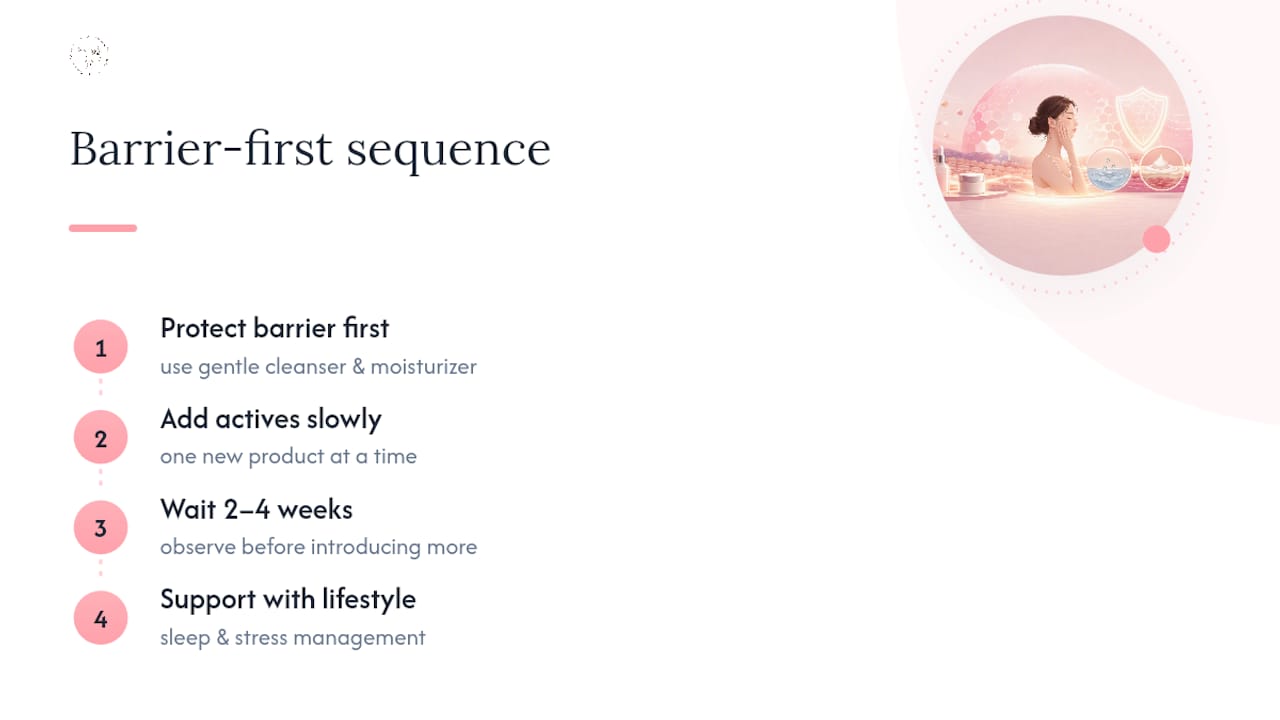
What the evidence actually supports is almost boring by comparison: protect the barrier first, add actives one at a time, and give each change two to four weeks before judging it. Sleep and stress management aren’t wellness add-ons here. They’re mechanically tied to how well your skin barrier holds up, which means skipping them undercuts everything applied topically.
If there’s one priority to take from this, it’s sequencing over stacking. Fix the barrier, then layer in glow, not the reverse. A guided ritual removes the guesswork of what to touch first and gives reactive skin the structure it actually needs.
— Caitlin Grey
Let You Glow Girl™ guide your ritual, not just your routine
Following a barrier first sequence is straightforward on paper, harder to stick with day after day without a structure to lean on. You Glow Girl™ ~ Transformative Beauty Rituals was built for that exact gap. It walks you through gentle-ingredient guidance, sequencing, and the mindset shifts that turn a skincare routine into an actual ritual, one you’ll want to keep, not one more thing on a checklist.

Every step outlined above, from cleanse-and-seal mornings to slow-introduction actives, maps directly onto the rituals inside the guide, so you’re not piecing together advice from five different sources. It’s written with reactive and eczema-prone skin in mind, which means the pacing respects your barrier instead of rushing past it. If you’re ready to stop guessing at order and timing, explore You Glow Girl™ and start building a routine that actually holds.
Selected sources and further reading
- Mayo Clinic, “Skin care: 5 tips for healthy skin”
- Medical News Today, “How to get glowing skin: 11 tips for diet, skin care, and more”
- DermApproved, “What skin ‘glow’ really is and how to get it”
- Curology, “The science behind real glowing skin”
- RealSimple, dermatologist guidance on introducing actives