

Personal reflection determines what you actually see when you look in the mirror: it decides whether beauty registers as affirming or as a threat. Reflection shapes attention, filters meaning, and dictates whether a glance at your own face becomes a moment of care or a small act of self-punishment. What follows is the evidence behind that claim and the exercises that put it to work.
TL;DR:
- Frequent mirror checking and comparison escalate body dissatisfaction and reinforce appearance-contingent self-worth, especially under harsh lighting or in hurried moments.
- Deliberate, kindness-based mirror routines and journaling can gradually shift self-perception, fostering internal value rather than external validation.
- Slowing down during product application and noticing textures or sensations helps in identifying sensitivities and supports skin health, particularly for eczema-prone skin.
- Internalizing beauty standards from culture and social media heightens the pressure to meet external ideals, making reflective practice essential to differentiate personal values.
- Professional support remains crucial when insecurities are rooted in trauma or long-term dysmorphia, as self-reflection alone may not suffice in deeper cases.
Table of Contents
- The Role of Personal Reflection in Beauty: What the Research Shows
- Why Mirror Habits and Comparison Often Make Self-Judgment Worse
- How to Turn Mirror Time Into Reflective Ritual
- Applying Reflection to Ritual Beauty With Sensitive Skin in Mind
- What Psychological Theories Explain This Connection?
- How Do Culture and Society Shape Reflective Beauty Standards?
- How Does Social Media Change Self-Reflection and Beauty Ideals?
- Case Examples: How Reflection Changes Body Image Over Time
- Where Personal Reflection Falls Short
- A Personal Note on Learning to Look
- How Purelightbotanicalbeauty Supports Reflective Beauty Rituals
- Key Research and Further Reading
The Role of Personal Reflection in Beauty: What the Research Shows
Beauty is not a fixed judgment your brain renders once and files away. It’s a running conversation between what you notice and what you believe about yourself, and that conversation is exactly what personal reflection interrupts, redirects, or deepens. Researchers studying what’s called the Aesthetic Self Effect found something worth sitting with: when people’s aesthetic taste changes (their music, their art preferences, even their visual style), observers and the people themselves perceive it as a genuine shift in identity. Not a shift in preference. A shift in who someone is.
That finding matters more than it first appears. It means aesthetic choices, including how you style your lips or blend a blush, are not surface decisions layered on top of a stable self. They’re identity work, on par with how we treat moral or political change. When you change your beauty ritual, you’re not just changing your look. You’re renegotiating a piece of how you understand yourself.
Two implications follow for daily choices:
- A deliberate aesthetic decision (choosing a lip oil shade because it feels like you, not because an algorithm suggested it) reinforces a stable sense of self.
- A reactive decision (buying something because you feel inadequate in the moment) can leave you feeling like you’re chasing an identity rather than expressing one.
Quick fact: the Aesthetic Self Effect research found that shifts in aesthetic taste produce identity-change impressions comparable in strength to shifts in someone’s moral or political views. Beauty is never “just” beauty. It’s identity, rendered in color and texture.
This is why self-development in beauty and personal growth are so intertwined. You cannot separate the ritual from the self performing it.
Why Mirror Habits and Comparison Often Make Self-Judgment Worse
Mirrors are neutral. What you bring to them rarely is. A 2023 study published in Frontiers in Psychology linked frequent visual comparison, meaning repeated checking against other people’s appearances or your own past images, to greater body dissatisfaction and harsher self-evaluation. The mirror itself didn’t change. The frequency and intent of the looking did.
This connects to a concept psychologists call appearance-contingent self-worth: when your sense of value rises and falls with how you rate your appearance in any given moment. It’s an unstable foundation. A bad-lighting bathroom or a tired morning face can tank your mood for hours, because the metric you’re using to judge yourself has no floor.
Common mirror-time traps look like this:
- Scanning for flaws first, treating the mirror as an inspection rather than a greeting.
- Comparing your current reflection to an old photo or someone else’s face, which research links directly to increased dissatisfaction.
- Standing under harsh lighting and mistaking shadow for flaw.
- Rushing the glance, which leaves only the critical, fast-judgment part of your brain in charge.
Beauty editors and longtime practitioners describe the mirror not as a verdict machine but as a relationship. Kinder internal dialogue at the mirror changes posture, changes presence, and eventually changes the aesthetic choices you make. Treat it that way, and the whole exchange softens.
The corrective isn’t complicated: swap audit for observation. Interventions built around self-compassion and mindful mirror practice have been shown to reduce body dissatisfaction and increase body appreciation over time. The mirror doesn’t have to be an adversary. It just needs a different set of instructions.
How to Turn Mirror Time Into Reflective Ritual
You can change your relationship with your reflection in a week, not a year, if you’re consistent about it. These four steps give you a structure to work from.
- Brief the mirror-work. Spend 30 to 60 seconds each morning looking at your face with the explicit goal of noticing, not judging. Say one neutral or kind observation out loud.
- Schedule it, don’t wait for motivation. Attach it to something automatic, like brushing your teeth, so it becomes routine rather than a mood-dependent event.
- Journal the difference between values-driven and rescue choices. Before you buy or apply anything, ask: am I choosing this because it feels like me, or because I feel inadequate right now?
- Anchor a morning ritual to presence. Give yourself two extra minutes, use one sensory cue (a scent, a texture, a sound), and let that anchor mark the start of intentional self-care rather than rushed maintenance.
Pro Tip: Keep a small notebook by your mirror. After each mirror-work session, jot one word describing how you feel. Patterns emerge within two weeks, and they’ll tell you more about your beauty relationship than any product ever could.
Applying Reflection to Ritual Beauty With Sensitive Skin in Mind
Slow application is not a luxury. It’s information. When you take the time to feel a formula on your skin rather than swipe and rush, you notice tightness, sensitivity, or ease, and that noticing is a form of self-kindness you cannot get from speed. This matters even more for eczema-prone or reactive skin, where mindfulness during application often catches irritation before it becomes a flare.
A simple sequence to try:
- Cleanse gently, without scrubbing, and let your hands linger a moment longer than usual.
- Take three slow breaths before touching any product to your face.
- Apply a lip oil like Purelightbotanicalbeauty’s Petal Perfect Lip Oil with deliberate, unhurried strokes, noticing texture and scent rather than rushing to the next step.
- Close with one line in a journal: how did that feel, not how did it look.
For sensitive or eczema-prone skin, adapt by patch-testing new products on the inner wrist first, applying in thinner layers, and choosing formulas built around plant-based, non-irritating ingredients so the ritual supports skin health rather than testing its limits. Explore more in this piece on holistic beauty rituals for sensitive skin.
What Psychological Theories Explain This Connection?
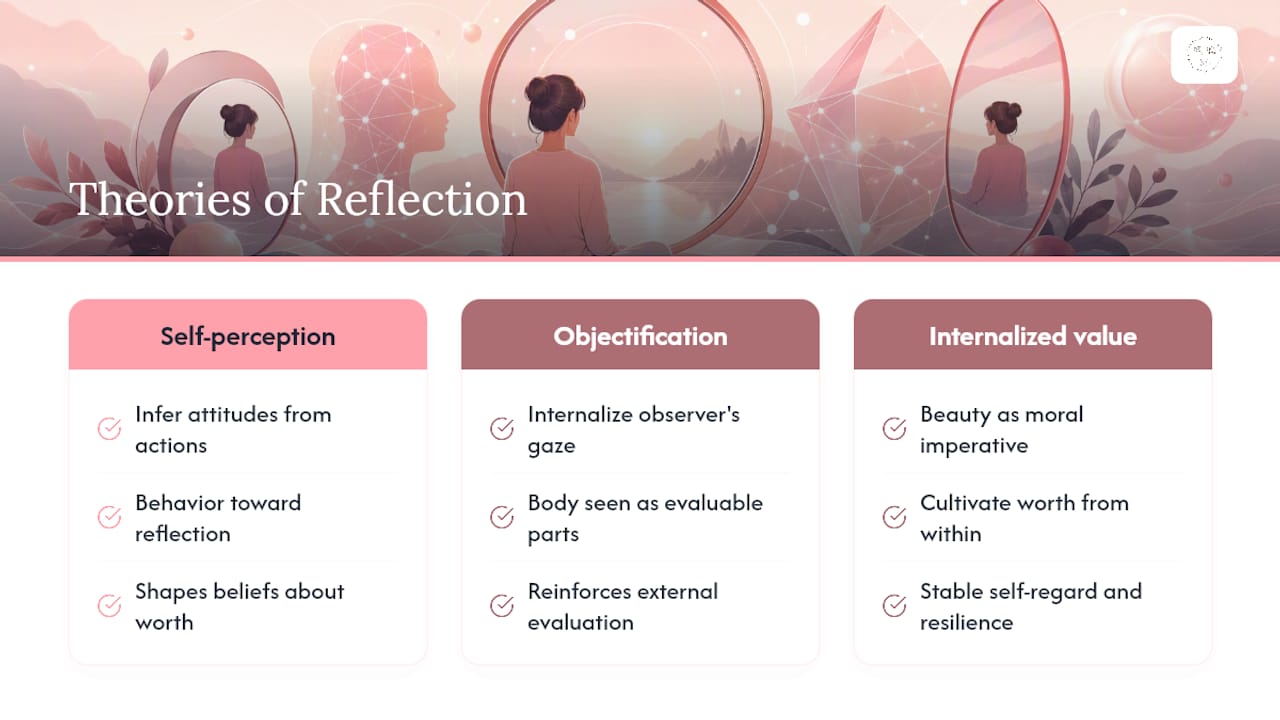
Self-perception theory offers one useful lens: we often infer our own attitudes by observing our own behavior, which means the way you act toward your reflection (with care or with criticism) shapes what you come to believe about your worth, not just the other way around. Objectification theory offers another angle, describing how internalizing an outside observer’s gaze on your body fragments self-perception into parts to be evaluated rather than a whole self to be experienced.
Philosophers add a third layer. Heather Widdows and other contemporary scholars argue that beauty ideals function less like preferences and more like moral imperatives, quiet expectations we feel obligated to meet. Their proposed corrective is cultivating internalized value, meaning a sense of worth generated from within rather than borrowed from an external standard. That’s a philosophical argument, but it lines up with the psychological research: people who anchor self-worth internally show more resilience against appearance-based setbacks than people whose self-worth is contingent on how they rate their reflection that day.
Put together, these frameworks suggest reflection is not passive. It’s an active practice that either reinforces external, contingent judgment or builds internal, stable self-regard, depending entirely on how you use it.
How Do Culture and Society Shape Reflective Beauty Standards?
No one reflects in a vacuum. The standards you measure yourself against were built long before you looked in the mirror this morning, shaped by family, media, geography, and era. What counts as beautiful in one culture or decade often reads as unremarkable, or even undesirable, in another.
This is where the ethical dimension of beauty standards becomes hard to ignore. When beauty functions as a moral imperative, something you feel obligated to pursue rather than simply enjoy, cultural pressure and personal reflection start pulling in opposite directions. Reflection asks, “What do I actually value here?” Culture often answers first, and loudly.
The practical takeaway isn’t to reject cultural beauty standards outright. It’s to notice which ones you’ve absorbed without examining, and which ones genuinely align with how you want to show up. That distinction only becomes visible through the kind of deliberate, unhurried reflection this article keeps returning to. Skipping that step means outsourcing your standards to whichever culture happened to raise you.
How Does Social Media Change Self-Reflection and Beauty Ideals?
Social platforms compress the distance between comparison and judgment to almost nothing. A single scroll can expose you to dozens of curated faces before you’ve even finished your coffee, and each one arrives with an implicit invitation to measure yourself against it.

This is the same visual-comparison mechanism the Frontiers in Psychology research flagged, just running at a much higher frequency and volume than any mirror could produce on its own. The dissatisfaction pathway is identical: rapid, repeated comparison converts ordinary noticing into harsh self-evaluation. Social media simply supplies more raw material for it, faster, and with less friction than a bathroom mirror ever could.
The counter to this isn’t necessarily abstinence from social platforms. It’s building a reflective habit strong enough to interrupt the comparison reflex before it hardens into judgment. A person with an established mirror-work practice tends to metabolize a curated feed differently than someone whose only self-assessment happens through comparison. Reflection, done consistently offline, becomes a kind of buffer against the online version of the same pressure.
Case Examples: How Reflection Changes Body Image Over Time
Practitioner interviews and long-form essays on beauty and self-perception describe a consistent pattern: people who move from reactive to reflective aesthetic decision-making report greater and more durable satisfaction with their choices. One widely cited essay on mirror practice describes the shift as treating the reflection like a relationship rather than a report card, and notes that kinder internal dialogue at the mirror changes posture and presence well before it changes any actual product choice.
Clinical commentary from aesthetic medicine literature adds a caution worth taking seriously here: appearance-contingent self-worth predicts lower satisfaction after cosmetic procedures specifically when the decision was made under urgent, self-critical motives. The procedure itself wasn’t the variable that mattered most. The motive behind it was.
That distinction shows up just as clearly in smaller, everyday choices. Someone who chooses a bold lip color because it reflects a mood they genuinely want to express tends to feel differently about that choice, days later, than someone who bought the same product hoping it would quiet a moment of insecurity. Both people end up wearing the same shade. Only one of them made a values-aligned decision, and that difference is what determines whether the choice still feels good next week.
Where Personal Reflection Falls Short
Reflection is a powerful lever, not a universal fix. Deep-seated beauty insecurities, especially ones rooted in trauma, body dysmorphia, or long-term appearance-based bullying, often need more support than journaling or mirror-work alone can provide. Reflective exercises are a strong complement to professional care in these cases, not a replacement for it.
There’s also a pacing problem. Reflection asks for patience, and patience is exactly what feels scarce when someone is in acute distress about their appearance. A person having a hard morning doesn’t always have the bandwidth to sit with a journal prompt. Recognizing that limitation matters as much as recommending the practice itself.
Cultural pressure compounds the difficulty. Even the most disciplined internal reflection has to contend with beauty standards that are, as philosophers studying the ethics of beauty point out, structured more like moral obligations than personal preferences. Reflection can help you notice when you’re chasing an externally imposed standard, but noticing it doesn’t automatically dissolve the pressure to meet it. Some of that work is social and structural, not purely internal.
None of this makes reflection less worth practicing. It makes it one tool among several, best used consistently, and best paired with professional support when the insecurity runs deeper than a single ritual can reach.
A Personal Note on Learning to Look
There was a stretch of years when I treated my own reflection the way most of us are trained to: as a checklist to clear before leaving the house. The shift didn’t come from a single dramatic realization. It came from slowing the glance down by thirty seconds and asking a different question. Not “what’s wrong here” but “what do I notice.” That small change in framing, repeated daily, did more for how I felt about my face than any product ever did.
Try it right now if you can. Look at your reflection for one slow breath, and name one neutral thing you see before you name anything you’d change.
— Caitlin Grey
How Purelightbotanicalbeauty Supports Reflective Beauty Rituals
Building a genuine reflective practice is harder alone than with structure, which is exactly the gap Purelightbotanicalbeauty’s Beauty Within™ ~ Online Coaching is built to close. Instead of another routine borrowed from someone else’s morning, the coaching program guides you through building rituals that match your own values, with accountability that keeps mirror-work and journaling from quietly slipping off your calendar the way most good intentions do.

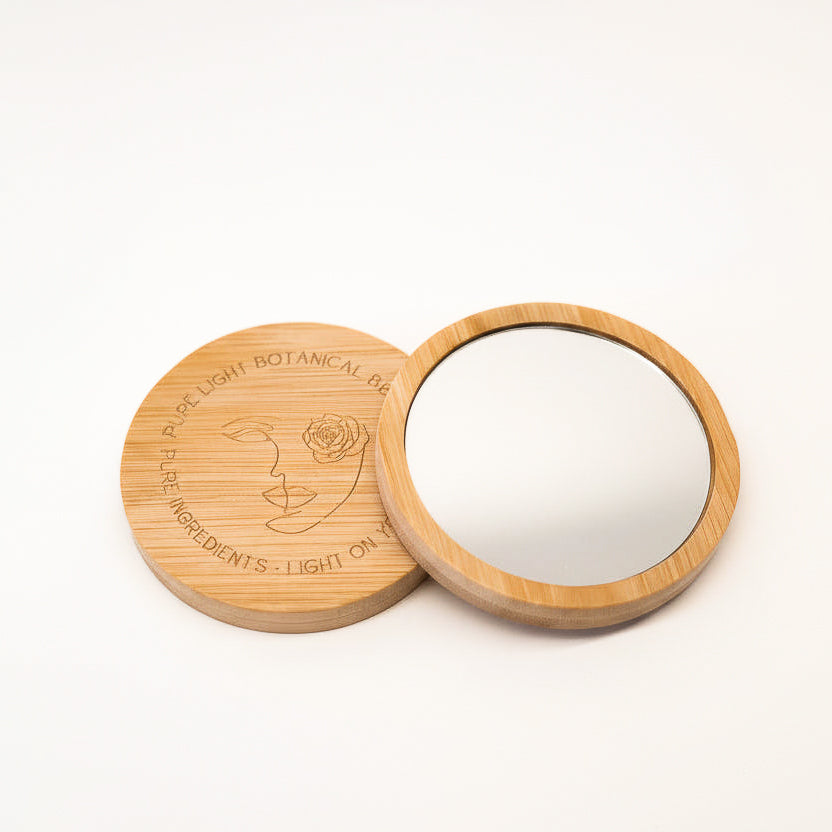
The Bamboo Hand-Mirror plays a smaller but specific role: a tactile, deliberately chosen object signals to your nervous system that this moment is different from a rushed glance in a bathroom mirror. Picking it up becomes the cue that starts the practice, not just a tool for checking your face. Paired with plant-based formulas suitable for sensitive and eczema-prone skin, these two offerings give you both the guidance and the physical anchor to move from reactive mirror-checking to a ritual that actually reflects who you are. Start with the coaching program if you want structure, or bring intention to your existing routine with the hand-mirror today.
Key Research and Further Reading
- The Aesthetic Self — The importance of aesthetic taste in music and art for our perceived identity, a peer-reviewed study on how aesthetic shifts read as identity change.
- Frontiers in Psychology (2023) — , the study linking habitual visual comparison to increased body dissatisfaction.
- “Your Reflection Is a Relationship,” — an essay on mirror practice and the emotional weight of self-talk, published by The AllBright.