

TL;DR:
- Self-awareness transforms beauty practices from fixing flaws into supporting genuine well-being and self-expression.
- By understanding our motivations and beliefs about beauty, we foster lasting confidence rooted in self-acceptance, not external validation.
Most women spend years trying to perfect their reflection without ever questioning who taught them what “perfect” looks like. The role of self-awareness in beauty is not about skincare steps or the right shade of blush. It’s about understanding why you reach for the products you do, what you’re hoping they’ll fix, and whether that motivation comes from a place of genuine self-care or quiet self-criticism. When you begin to understand that distinction, your entire relationship with beauty shifts. What follows is a clear, grounded look at how self-awareness shapes confidence, beauty choices, and the rituals that actually nourish you.
Table of Contents
- Key Takeaways
- The role of self-awareness in beauty perception
- How self-awareness shapes your beauty choices
- External pressures vs. internal self-worth
- What science says about self-awareness and beauty
- Practical ways to build self-awareness for beauty confidence
- What I’ve learned about beauty and self-awareness
- Beauty that begins within: how Purelightbotanicalbeauty supports your journey
- FAQ
Key Takeaways
| Point | Details |
|---|---|
| Self-awareness redefines beauty | True self-awareness shifts beauty from fixing flaws to actively supporting your wellbeing and authentic expression. |
| Internal motivation lasts longer | Beauty choices driven by self-worth rather than external validation produce more durable confidence and satisfaction. |
| Social media distorts self-perception | Algorithmic beauty standards create measurable self-surveillance and anxiety; media literacy is a protective tool. |
| Self-compassion supports resilience | High self-compassion is linked to 26% lower stress and 33% greater resilience in daily habits. |
| Mindful rituals reinforce self-trust | Beauty practices rooted in self-awareness build consistent habits that deepen self-trust over time. |
The role of self-awareness in beauty perception
Before you can understand how self-awareness impacts beauty, it helps to separate it from its imposter: self-consciousness. Self-consciousness is the uncomfortable spiral of “do I look okay? Does she look better? Why does my skin look like this?” It’s reactive, anxious, and exhausting. True self-awareness is something else entirely.
True self-awareness is non-judgmental observation. It means noticing your thoughts and feelings without immediately labeling them as problems to fix. Most people have never experienced it because the two feel so similar from the inside. The difference is what comes after you notice something. Self-consciousness judges. Self-awareness observes, then asks what the observation means.
In the context of beauty, this plays out across four recognizable levels:
- Behavioral awareness: Noticing the habits you repeat automatically, like reaching for concealer before you’ve even looked in the mirror.
- Emotional awareness: Recognizing the feeling driving the habit, whether that’s anxiety, joy, ritual, or habit on autopilot.
- Values awareness: Understanding what you actually believe about beauty and where those beliefs originated.
- Aspirational awareness: Clarifying how you want to relate to your appearance, separate from how you currently do.
The importance of self-awareness in beauty becomes clear when you move through these levels. Positive self-perception connects directly to better mental health and lower depression rates. Self-compassion, the practice of treating yourself with the same warmth you’d offer a friend, acts as a stabilizing force within this process. It is not an indulgence. It is the condition that makes honest self-observation possible without tipping into shame.
Pro Tip: When you catch yourself criticizing your appearance, add one moment of appreciation immediately after. This breaks the self-criticism loop and starts rewiring your awareness toward balance.
How self-awareness shapes your beauty choices
Every beauty routine contains a story. Some routines are genuine rituals of care. Others are driven by fear: of aging, of not fitting in, of being seen as less than. Understanding beauty through self-awareness means learning to tell the difference between the two in your own life.
Here is a practical way to examine your current routine:
- Notice the trigger. Do you apply makeup because it makes you feel good, or because you feel anxious going out without it?
- Identify the source. Was this habit formed because someone told you your skin needed hiding? Or did you choose it freely?
- Check the feeling after. Do you feel more like yourself after your routine, or more like a version of yourself that others will approve of?
- Shift the framing. Replacing “I need to cover this” with “I want to care for this” is a small change that carries a lot of weight.
- Repeat with intention. Repeat habits that leave you feeling steady and drop or revise ones that leave you feeling worse about yourself.
Aesthetic decisions loaded with self-criticism tend to feel pressured and temporary. The fix never feels like enough because the underlying belief is still “I am not enough.” When you shift from fixing perceived flaws to genuinely supporting yourself, the motivation becomes intrinsic. You stop looking for external validation to confirm that the ritual worked.
This is where self-confidence and beauty become genuinely linked. Confidence that depends on your appearance behaving a certain way is fragile. Confidence built through self-awareness, through consistent self-care that reflects what you actually value, is far more stable. Confidence is better stabilized when self-worth is decoupled from appearance outcomes and built through reliable self-supporting habits instead.
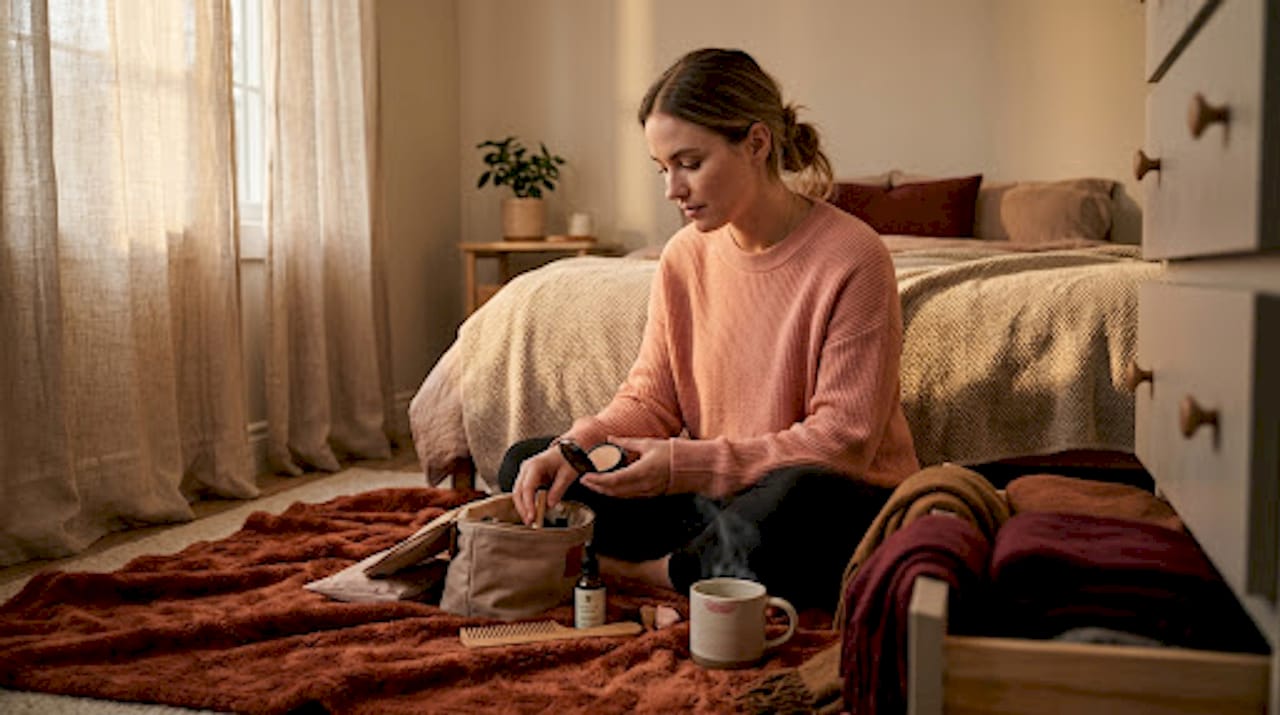
Pro Tip: Try a one-week “intention check” before each beauty ritual. Ask yourself one simple question: Am I doing this for me or for someone else’s approval? The answer will tell you a great deal.
External pressures vs. internal self-worth
The challenge for most people trying to build self-awareness in makeup choices and personal beauty is that external noise is relentless. Social media is not a neutral mirror. It is an environment engineered to generate self-comparison.
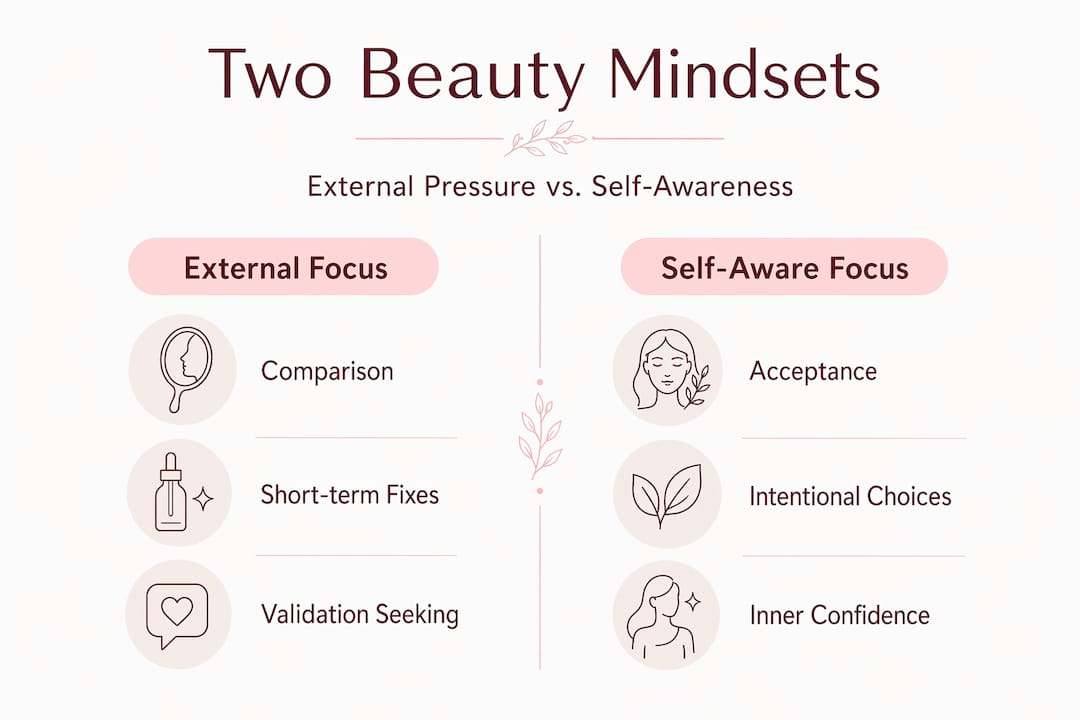
| External Beauty Pressure | Self-Aware Beauty Approach |
|---|---|
| Appearance judged against filtered ideals | Appearance understood in the context of personal values |
| Beauty shaped by trending aesthetics | Beauty shaped by what genuinely feels good and authentic |
| Validation sought through likes and comments | Validation comes from inner alignment and self-acceptance |
| Fixes flaws according to others’ standards | Supports self according to personal care and intention |
| Routine changes to match others | Routine evolves with personal growth and changing needs |
Research on social media’s role in self-perception makes this contrast tangible. Algorithmic recommendations reinforce standardized aesthetic norms and measurably increase self-objectification among young women. The same study introduced the concept of an “imagination tax”: the mental load women carry when they constantly picture how they appear to others, rather than simply being.
The rise of AI-filtered beauty aesthetics compounds this. Pursuing standardized AI beauty can negatively affect mental health, while embracing natural, average features tends to redirect focus toward character over appearance. That is not a consolation prize. It is a genuine mental health strategy.
Self-reflection and beauty standards are most useful when you can recognize which standards you have actively chosen and which you have passively absorbed. Media literacy, the practice of critically questioning what beauty content you consume and who benefits from your insecurity, is one of the most underrated self-awareness tools available. You do not have to reject beauty. You just have to own your reasons for the choices you make.
What science says about self-awareness and beauty
The connection between self-awareness and self-esteem is not just philosophical. There is growing research that maps this relationship concretely.
26% of people report low self-esteem closely linked to their facial appearance perception. Lower self-esteem significantly predicts increased interest in cosmetic interventions, suggesting that beauty decisions are frequently psychological in origin, not purely aesthetic. This does not make those choices wrong. It makes them worth understanding.
“The alignment between internal self-image and external appearance, known as perceptual congruence, is fundamental for wellbeing and self-esteem. When that alignment exists, individuals report better mental health outcomes and lower depression rates.” — JCAD, Perceptual Congruence
That framing matters. Aesthetic and beauty choices that help a person feel more like themselves, more aligned between inside and outside, carry genuine psychological benefit. The key variable is whether realistic expectations and self-regard guide decisions or whether they are driven by a critical inner voice chasing an unattainable standard.
Self-awareness in cosmetics is not about rejecting enhancement. It is about choosing enhancement from a place of self-knowledge rather than self-rejection. That distinction changes the entire emotional experience of beauty care, from routine to ritual, from obligation to genuine nourishment.
Practical ways to build self-awareness for beauty confidence
Cultivating self-awareness is a practice, not a personality trait. These are approaches that work specifically within a beauty and self-care context:
- Mindful observation before mirrors. Before applying anything, take three slow breaths and notice how you actually feel. Not how you look. How you feel. This grounds your routine in the present.
- Ask “what” not “why.” “What am I feeling right now?” produces useful information. “Why do I feel this way about my skin?” tends to spiral. Diagnostic questions over interrogating ones.
- Journal your beauty triggers. Keep a simple note for one week tracking what prompted your routine. You will see patterns quickly.
- Seek honest feedback selectively. Blind spots exist in self-perception. Trusted people who know you well can offer perspective that closes gaps between how you see yourself and how you actually show up.
- Build holistic beauty rituals that reflect inner values. Choose products and practices because they align with what you believe about self-care, not because a trend demands them.
- Practice self-compassion after setbacks. A bad skin day is not a verdict. Self-compassion builds 33% more resilience and reduces burnout, which means it is a practical tool, not a soft one.
The goal is a beauty ritual that matters because it reflects who you are, not one you maintain to manage what others think of you.
What I’ve learned about beauty and self-awareness
I have spent years watching women transform how they feel about themselves, and almost none of those transformations started with a new product. They started with a question. Usually something like: “Why do I feel so uncomfortable being seen without makeup?”
What I’ve found is that the women most at peace with their beauty are not the ones who have the most refined routines or the clearest skin. They are the ones who have done the honest work of understanding why beauty matters to them. And that work is genuinely hard when you are surrounded by content that profits from your doubt.
The thing I feel most strongly about is this: social media does not just distort beauty standards. It actively trains you to experience your own face as a problem to be optimized. That is not a harmless side effect. It is a design feature. Resisting it requires more than willpower. It requires the kind of self-awareness that lets you notice when you are looking at your reflection through someone else’s eyes.
My own beauty authenticity shifted when I stopped asking “does this look good?” and started asking “does this feel like me?” The second question grounds your choices in identity rather than approval. And that shift, from the outside in to the inside out, is where real confidence takes root.
The invitation I would offer you is simple: the next time you pick up a product or look in the mirror, pause for a moment. Ask yourself what you’re actually looking for. The answer will tell you more about your relationship with beauty than any skin quiz ever could.
— Kaitlyn
Beauty that begins within: how Purelightbotanicalbeauty supports your journey
At Purelightbotanicalbeauty, the belief behind every product is that beauty and healing come from the same place. When you build self-awareness, you start choosing care over correction. And that shift deserves products that meet you there.
Purelightbotanicalbeauty blends the artistry of makeup with plant-based ingredients that genuinely nourish your skin, especially if it is sensitive or prone to conditions like eczema. Products like Petal Perfect Lip Oil and Botanical Crème Blush are crafted to feel like self-care, not just coverage. If you are ready to explore beauty as a ritual of self-love, visit Purelightbotanicalbeauty and discover a line built for women who want their beauty to reflect their values.
FAQ
What is the role of self-awareness in beauty?
Self-awareness in beauty means understanding the motivations behind your beauty choices, whether they come from genuine self-care or self-criticism. When you know the difference, your rituals become more nourishing and your confidence becomes more stable.
How does self-awareness affect self-esteem?
Self-awareness supports self-esteem by replacing automatic self-judgment with honest, compassionate observation. Research shows that self-compassion, a key part of self-awareness, is linked to 26% lower stress and significantly greater resilience.
Can social media undermine self-awareness in beauty?
Yes. Algorithmic beauty standards increase self-objectification and create an “imagination tax” that shifts focus from inner experience to external perception, which directly works against authentic self-awareness.
How can I build self-awareness in my beauty routine?
Start with mindful observation before your routine, track your beauty triggers in a journal, and ask “what” questions rather than “why” to avoid rumination. Small, consistent practices build self-knowledge over time.
What is perceptual congruence and why does it matter for beauty?
Perceptual congruence is the alignment between your internal self-image and your external appearance. When that alignment exists, research from JCAD shows it connects to better mental health and lower depression, making it a meaningful goal in self-aware beauty care.
Recommended
- Self-Expression in Beauty: Pathway to Healing and Confidence – Pure Light Botanical Beauty
- Self-love in beauty: Build confidence with natural rituals – Pure Light Botanical Beauty
- Why Beauty Matters for Inner Growth and Healing – Pure Light Botanical Beauty
- What Is Confidence in Beauty? Complete Guide – Pure Light Botanical Beauty