

TL;DR:
- Living with sensitive or eczema-prone skin requires gentle, barrier-supportive products that avoid common irritants. Consistent use of fragrance-free cleansers, ceramide-rich moisturizers, and careful patch testing can promote steady healing and reduce flare-ups. Building a routine around evidence-backed methods and botanical safety helps manage symptoms while honoring natural ingredients.
Living with sensitive or eczema-prone skin can feel like walking through a minefield every single morning. You reach for a product that worked last week, and suddenly your skin is inflamed, itchy, or red before you’ve even had your coffee. The frustration is real, and it’s exhausting. But here’s the truth: your skin isn’t working against you. It’s sending signals, asking for a more thoughtful approach. A stepwise, gentle workflow built around clean, barrier-supportive, plant-based ingredients can quiet those signals and replace the cycle of flares with one of steady, visible healing.
Table of Contents
- Understand your skin’s needs: the sensitive skin baseline
- Gather your essentials: choosing safe, healing ingredients
- Step-by-step self-care skincare workflow
- Patch testing and troubleshooting: stay safe when trying plant-based or new products
- Why evidence beats trends in holistic self-care
- Take the next step with healing self-care
- Frequently asked questions
Key Takeaways
| Point | Details |
|---|---|
| Barrier-first care | Your routine should always prioritize gentle cleansing and prompt, barrier-supportive moisturizing to keep skin healthy. |
| Safe ingredient choices | Choose fragrance-free, plant-based options but always patch test since even naturals can irritate sensitive skin. |
| Patch testing protocol | Test new products on a small area before wide use, watching for delayed irritation up to 24 hours. |
| Evidence over hype | Clinically proven, emollient-focused care is non-negotiable for eczema and sensitive skin management. |
| Consistent workflow habits | Daily application within three minutes after cleansing can lock in hydration and support long-term healing. |
Understand your skin’s needs: the sensitive skin baseline
Sensitive and eczema-prone skin isn’t just “reactive.” It has a structurally compromised skin barrier, meaning the outermost layer of your skin, called the stratum corneum, doesn’t hold moisture or block irritants the way it should. Think of your skin barrier as a brick wall. When it’s healthy, the bricks (your skin cells) sit tightly together, sealed with lipids that lock moisture in and keep harmful substances out. When the barrier is weakened, gaps form. Irritants slip in, moisture slips out, and the result is that familiar cycle of dryness, redness, and flaring.
Several everyday factors quietly erode that barrier:
- Synthetic fragrances in cleansers, lotions, and even laundry detergent
- Artificial dyes that add color to products but zero benefit to skin
- Harsh surfactants like sodium lauryl sulfate (SLS), which strip natural oils
- Over-exfoliation with acids or scrubs too frequently
- Hot water during bathing, which dissolves the skin’s protective lipid layer
- Low humidity environments, which pull moisture from already dry skin
Sensitive and eczema-prone skin needs barrier repair and consistent avoidance of these common irritants. Fragrance-free, minimal-ingredient products form the non-negotiable foundation of any healing routine.
Here’s a quick comparison to help you evaluate what’s already in your cabinet:
| Barrier-friendly features | Barrier-damaging features |
|---|---|
| Fragrance-free formula | Contains synthetic fragrance or “parfum” |
| Short, recognizable ingredient list | Long list with multiple preservatives/dyes |
| Ceramides, glycerin, or oat extract | Alcohol (denat.) high in the ingredient list |
| pH-balanced cleanser (5.5 or under) | Foaming sulfate-based cleanser |
| Occlusive or emollient moisturizer | Mattifying or alcohol-containing lotions |
Pro Tip: Scan ingredient labels from the bottom up. Ingredients listed last appear in the smallest concentrations, but sensitizing preservatives can still cause reactions even in trace amounts.
Building a routine for sensitive skin means first understanding which of these triggers are already embedded in your daily habits, then methodically removing them one step at a time.
Gather your essentials: choosing safe, healing ingredients
With a better sense of your skin’s requirements, let’s choose the most reliable, healing products for your workflow.

Not every “natural” product belongs in a sensitive skin routine, and not every conventional product deserves to be discarded. What matters most is knowing which ingredient categories actively support healing and which ones create hidden risks. Your goal is to build a small, intentional kit you can trust.
Your sensitive skin self-care kit should include:
- A pH-balanced, sulfate-free, fragrance-free gentle cleanser
- A barrier-repair moisturizer with ceramides, glycerin, or colloidal oatmeal
- A simple patch test kit (small adhesive patches or clean bandages)
- Unscented, pure plant oil for spot sealing (sunflower, jojoba, or squalane)
- Soft, clean washcloths made from cotton or bamboo
- A skin journal to track product use and skin responses
The best moisturizers for this skin type are fragrance-free and barrier-supportive, often incorporating occlusive ingredients like shea butter alongside humectants like glycerin and ceramides that actively restore the skin’s structure. Colloidal oatmeal is especially well-researched for its ability to calm itching and support the skin’s acid mantle.
Here’s a closer look at how these ingredients function and why they earn their place:
| Ingredient | Function | Best for |
|---|---|---|
| Ceramides | Rebuild and seal the lipid barrier | Chronic dryness, eczema |
| Glycerin | Draws moisture from the air into skin | All sensitive skin types |
| Colloidal oatmeal | Soothes inflammation and itching | Active flares, redness |
| Shea butter | Seals moisture, softens skin | Very dry or cracked skin |
| Squalane (plant-derived) | Lightweight oil, mimics skin sebum | Oily-sensitive or reactive skin |
| Sunflower seed oil | High in linoleic acid, repairs barrier | Post-flare recovery |
One important note about botanicals: plant-based does not mean non-irritating. Essential oils like lavender, tea tree, and eucalyptus, despite their wellness reputation, are among the most common botanical triggers for sensitive and eczema-prone skin. Introduce any new plant-derived ingredient slowly and always patch test before applying it to a larger area.
Explore the clean beauty for eczema options that have already been formulated with these safety principles in mind, and consider checking a curated list of non-toxic essentials for relief to simplify your shopping.
Step-by-step self-care skincare workflow
With your essentials ready, it’s time to put your self-care routine into action with a stepwise plan.
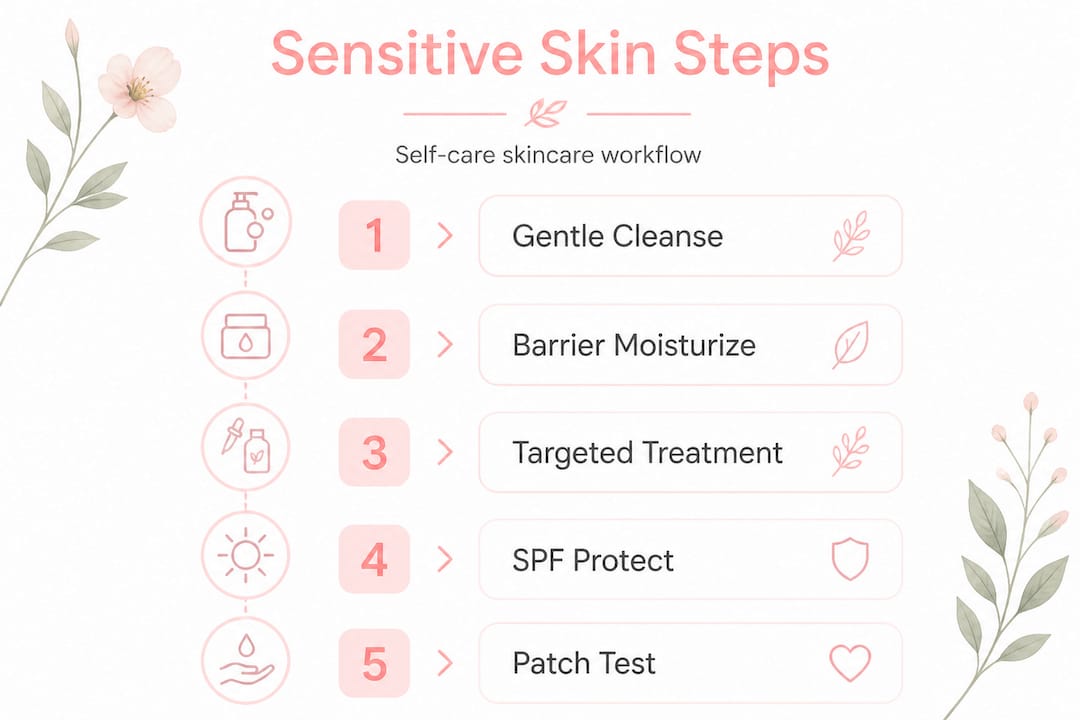
The backbone of an effective sensitive skin workflow is a method called soak and seal. The concept is elegantly simple: you briefly hydrate the skin (bathing or rinsing), then immediately seal that moisture in before it can evaporate. The window is smaller than most people realize. Moisturizing within 3 minutes of bathing is what locks in hydration and actively supports barrier repair. Wait longer, and your already-compromised skin loses more moisture than it gained from the water.
Here’s your daily workflow, step by step:
- Cleanse gently. Use lukewarm (never hot) water and a small amount of your gentle, sulfate-free cleanser. Pat, don’t rub. Spend 30 to 60 seconds cleansing your face or body, then rinse thoroughly.
- Pat dry carefully. Use a soft cotton towel and lightly press the skin. Leave it slightly damp, not bone dry. This is the moisture you’re about to seal in.
- Apply your barrier moisturizer immediately. Within three minutes of stepping out of the water, apply your ceramide or glycerin-based moisturizer while your skin is still slightly dewy. This step is not optional. It is the anchor of the entire routine.
- Add spot treatment if needed. If you have areas of active irritation or dryness, apply a thin layer of soothing plant oil (such as squalane or sunflower oil) over the moisturizer in those spots. This creates an extra occlusive layer precisely where your skin needs it most.
- Allow to absorb before applying anything else. Give your skin 5 to 10 minutes before layering makeup or sunscreen. Layering too quickly can disturb the barrier you just built.
“Moisturizing promptly after bathing isn’t just a suggestion. For eczema and sensitive skin, it’s one of the most clinically consistent interventions available, and skipping it can undo even the most thoughtfully chosen product lineup.”
For your weekly extras, consider a very gentle enzyme exfoliant (not a scrub) once every 7 to 10 days if your skin tolerates it. Avoid exfoliating during any active flare. A soothing oat or honey mask can be a wonderful weekend ritual when skin is calm and stable.
Pro Tip: After washing your hands throughout the day, apply a small amount of your barrier moisturizer to your hands within one minute of drying them. Hands are one of the most common eczema trigger points and are often neglected between morning and evening routines.
The step-by-step glow routine we’ve developed specifically addresses each of these touchpoints, from cleanser choice through to barrier sealing.
Patch testing and troubleshooting: stay safe when trying plant-based or new products
Even with the most carefully chosen ingredients, new products can surprise you, so let’s build a fail-safe into your workflow.
Patch testing is one of the most underused tools in sensitive skin care. Many women skip it because it feels slow or overly cautious. But for eczema-prone skin, a patch test is the difference between discovering a problem on your inner arm and discovering it across your whole face on the morning of an important day. Patch testing before introducing new actives or botanicals is the most direct way to catch delayed or contact reactions before they become a larger issue.
Here’s exactly how to do it at home:
- Choose your test site. The inner forearm is ideal. It’s sensitive enough to mirror how facial skin may react, but easy to monitor and less visible if a reaction does occur.
- Apply a small, pea-sized amount of the new product to the test site and cover loosely with a clean bandage or patch.
- Leave it undisturbed for 24 hours. This step is critical.
- Check at the 24-hour mark. Look for redness, itching, swelling, or any texture change. If none appear, check again at 48 hours, because some reactions are delayed.
- If no reaction occurs, introduce the product into your routine on a small area of your face or body for 3 to 5 days before using it fully.
“Do not wash, scrub, or disturb the patch area during the observation window. Water exposure, friction, or sweating can remove the product and invalidate your results, leading you to miss a reaction that would have appeared otherwise.”
A key principle here: even safe-seeming naturals like essential oils can be triggers. Introduce only one new product at a time. Introducing multiple new items simultaneously makes it nearly impossible to identify which product caused a reaction if one appears.
Pro Tip: Keep a skin journal. Note the date you introduced each new product, what you applied it to, and how your skin responded over the following week. Delayed reactions (up to 72 hours) are common with botanical ingredients and easy to overlook without written records.
When you’re ready to add makeup to your routine, it’s just as important to transition to clean makeup safely using the same paced approach you’d use for skincare.
Why evidence beats trends in holistic self-care
Here’s a perspective that might surprise you: the most powerful thing you can do for eczema-prone skin has nothing to do with the latest trending ingredient or the most aesthetically beautiful bottle on your shelf. It has to do with consistency, moisture, and barrier support, and those three things are anything but exciting.
We live in a wellness culture that often romanticizes “all-natural” approaches to skin health. And while we deeply believe in clean, plant-based beauty as a meaningful and often superior choice, we want to be honest with you. The non-negotiable base of eczema management is moisturizers and emollients, not simply labels that say “botanical” or “organic.” A clean formula with ceramides and glycerin will always outperform a trendy serum with seventeen exotic plant extracts for a skin barrier that’s struggling to hold together.
This doesn’t mean holistic self-care is ineffective. It means the order of operations matters. You build the foundation first: barrier repair, consistent hydration, trigger avoidance. Then you layer in the beautifully formulated plant-based products that align with your values and bring joy to your routine. When you try to skip the foundation and go straight to the exciting additions, you risk feeding the very inflammation you’re trying to quiet.
Holistic care and evidence-led care are not opposites. They work best as partners. The plant-based beauty tips that resonate most deeply for sensitive skin are those rooted in both botanical wisdom and a clear understanding of how the skin barrier actually functions. Build your routine on evidence, then let nature add the beauty. That’s the quiet truth behind every formula we create at Pure Light Botanical Beauty.
Building holistic routines for skin wellness means embracing this layered thinking: science as the structure, botanicals as the soul.
Take the next step with healing self-care
Ready to make gentle, holistic care simple and achievable? Your skin deserves a routine that works with its needs, not against them. And building that routine becomes so much easier when the products you reach for were designed with your specific challenges in mind.
At Pure Light Botanical Beauty, every formula is crafted to support skin health from the first step of your morning ritual to the final moment of your evening wind-down. Our clean, plant-based, barrier-safe approach means you don’t have to choose between skincare that heals and makeup that performs. From our Botanical Crème Blush to our Nourishing Lipstick, each product is formulated to be an act of self-care in itself. Explore our natural skincare routine resources and discover curated guidance designed specifically for sensitive, healing skin.
Frequently asked questions
Why is fragrance-free important for sensitive skin?
Fragrance is one of the most common skin irritants for sensitive and eczema-prone individuals, capable of triggering contact dermatitis or flares even in very small amounts. Choosing fragrance-free products removes one of the most consistent and avoidable risk factors from your routine.
Can I use plant-based skincare if I have eczema?
Yes, many plant-based ingredients are wonderfully safe and effective for eczema-prone skin, but not all of them. Most plant-derived materials are non-irritating, but essential oil blends and highly concentrated botanical extracts can trigger reactive skin, so patch testing every new product is essential.
What’s the soak-and-seal method and why does it matter?
Soak and seal means applying your moisturizer within three minutes of bathing to trap moisture in skin that’s still slightly damp. Moisturizing promptly after bathing is a clinically supported strategy for locking in hydration and reinforcing the skin barrier in eczema and sensitive skin management.
How should I patch test a new product?
Apply a small amount to your inner forearm, cover it lightly, and avoid disturbing the test area for at least 24 hours. Check for redness, swelling, or itching at 24 and 48 hours before introducing the product more broadly into your routine.
Recommended
- 7 Holistic Beauty Routines for Sensitive Skin Wellness – Pure Light Botanical Beauty
- Sensitive skin makeup: calm, clean steps for radiant results – Pure Light Botanical Beauty
- Clean beauty routine for sensitive skin: 5 steps – Pure Light Botanical Beauty
- Step by Step Mindful Makeup for Sensitive Skin Glow – Pure Light Botanical Beauty