

If you have celiac disease or a severe gluten sensitivity, yes: choose a lip product labeled gluten-free. The skin itself rarely absorbs enough gluten to matter, but anything you put on your lips gets licked, sipped from a water glass, and eaten off with your morning toast. That makes chapstick different from your body lotion.
Three things to do right now:
- Check your current stick for an explicit “gluten-free” claim on the label or brand website.
- Scan the ingredient list for wheat, barley, rye, or their technical names (more on those below).
- Keep one confirmed-safe balm in your bag, your car, and your nightstand so you’re never reaching for the unknown one in a pinch.
Key Takeaways
People with celiac disease should choose explicitly labeled gluten-free lip products because ingestion risk, not skin absorption, is the real concern.
| Point | Details |
|---|---|
| Topical risk is low | Intact skin rarely absorbs enough gluten to trigger a reaction; lip products differ because of accidental ingestion. |
| Labeling isn’t mandatory | Cosmetics fall outside the FDA’s mandatory gluten-free rule, so an explicit claim matters more than “natural” wording. |
| Watch for hidden names | Triticum vulgare, Hordeum vulgare, Secale cereale, malt extract, and wheat-derived dextrin can all signal gluten. |
| Verify crowdsourced lists | Forum and retail roundups are a starting point; confirm current formulation directly with the brand. |
| Choose transparency-first brands | Pure Light Botanical Beauty’s Nourishing Lipstick™ shades are formulated for sensitive skin, with full ingredient disclosure available on request. |
Table of Contents
- Why Topical Safety Isn’t the Same as Ingestion Risk
- How to Check a Chapstick or Lip Balm for Gluten
- Which Lip Balm Brands Show Up as Gluten-Free, and Should You Trust the List?
- Shopping and Storage Habits That Cut Your Risk
- What to Do if You Suspect Gluten Exposure From a Lip Product
- What Gluten-Free Lip Care Means to Us
- A Gluten-Free Lipstick Option Worth Adding to Your Bag
- Sources and Further Reading
- Frequently Asked Questions
Why Topical Safety Isn’t the Same as Ingestion Risk
The National Celiac Association’s guidance draws a clear line here, and it’s one worth understanding rather than just following. Topical gluten is unlikely to cross intact skin in amounts that trigger a reaction. That’s why most lotions, sunscreens, and body washes get a pass for people with celiac disease, gluten sensitivity, or dermatitis herpetiformis.
Lip products break that pattern because of proximity to the mouth, not because the ingredients themselves behave differently on skin. You swipe on chapstick, then eat lunch. You reapply, then take a sip of coffee. Over a day, small amounts add up, and for someone with celiac disease, even trace exposure can provoke an immune response.
Experts generally recommend gluten-free lip products specifically because of this ingestion pathway. Skin contact alone rarely causes a reaction; the mouth changes the equation entirely.
Here’s the complication: cosmetics fall outside the FDA’s mandatory gluten-free labeling rule. Unlike packaged food, a lip balm can call itself “natural” or “clean” without ever addressing gluten. Some cosmetic brands test with ELISA methods against a 20 parts-per-million threshold, the same benchmark used in food testing, but that practice varies by company and isn’t required. An explicit gluten-free claim, not a vague wellness label, remains your most reliable signal.
How to Check a Chapstick or Lip Balm for Gluten
Reading an ingredient list for gluten sounds simple until you realize wheat rarely shows up as “wheat.” Cosmetic labeling uses INCI (International Nomenclature of Cosmetic Ingredients) names, and gluten hides behind Latin and technical terms most shoppers skip right past.
Watch for these on any lip product label:
- Triticum vulgare (wheat) in any form, including Triticum lipids or Triticum amino acids
- Hordeum vulgare extract (barley)
- Secale cereale seed flour (rye)
- Hydrolyzed wheat protein or hydrolyzed vegetable protein when wheat-derived
- Malt extract or malt-derived flavoring
- Dextrin, cyclodextrin, or maltodextrin when sourced from wheat rather than corn
If a label lists any of these and doesn’t specify a gluten-free source, treat it as a question mark, not a green light. Product-level allergen checking services can help resolve that question; one flavored crème lip balm was independently confirmed gluten-free through exactly this kind of third-party review, while another mainstream cherry-flavored classic tested by Gluten Free Watchdog turned up with no gluten-free labeling at all.
When ingredient names leave you unsure, email the brand directly. Ask three things: whether the product contains wheat, barley, or rye derivatives; whether it’s manufactured on shared equipment with gluten-containing products; and whether batch testing is available. A brand that answers specifically, rather than with a generic “our products are safe,” is one you can trust more.
Pro Tip: Photograph the ingredient panel and lot number before you toss the packaging. If a reaction happens later, that photo saves you a frustrating hunt for details you can no longer read off an empty tube.
For a broader look at safe product selection beyond lip care, this guide to choosing gluten-free makeup safely covers the same INCI-reading skills you’ll use again and again.
Which Lip Balm Brands Show Up as Gluten-Free, and Should You Trust the List?
Search “gluten free chapstick” and you’ll find plenty of roundups naming eos, Burt’s Bees, and ChapStick as commonly cited safe options. These lists exist because people with celiac disease have crowdsourced their own research for years, and that community knowledge has real value. It also has a shelf life.
Formulations change. A brand acquisition can shift a supply chain. A “gluten-free” claim on one flavor doesn’t automatically extend to every flavor in that same product line.
Lists that circulate on forums and retail sites are a starting point for discovery, not a final verification. Treat them as a shortlist to confirm, not a guarantee to rely on.
Before you commit to any brand from a roundup:
- Look for the words “gluten-free” stated directly on the product page or packaging, not just implied by “natural” or “clean” marketing.
- Check the date on any third-party roundup; older posts may reference discontinued formulas.
- When in doubt, go straight to the brand’s own FAQ or customer service line.
Watchdog testing has already shown the risk of skipping that last step: a mainstream cherry-flavored classic lip balm tested positive for lacking gluten-free labeling entirely, despite being a household name.
Shopping and Storage Habits That Cut Your Risk
Reducing accidental exposure comes down to a handful of habits repeated consistently, more than any single perfect purchase.
- Favor explicit labeling. Choose products stating “gluten-free” over ones that simply look wholesome. “Organic” and “natural” say nothing about gluten status.
- Be cautious with flavored or edible-style balms. Cherry, vanilla, and candy-flavored sticks encourage licking, which raises ingestion odds even with otherwise clean ingredients.
- Prioritize brands with transparent ingredient lists. If a company won’t publish full INCI names, that opacity itself is a red flag.
- Never share your stick. Cross-contact from another person’s product is an easy, avoidable risk.
- Wash your hands before eating if you’ve just reapplied balm, especially with a new or unconfirmed product.
Pro Tip: Keep a backup stick in your bag that you’ve already verified, so a stressful moment never turns into a rushed, unchecked purchase at a pharmacy counter.
Our lip care and gloss guide walks through daily habits that pair well with these shopping rules.
What to Do if You Suspect Gluten Exposure From a Lip Product
This is general information, not a substitute for medical advice. If symptoms are severe or you’re unsure what happened, contact your clinician or emergency services without delay.
If you suspect a reaction:
- Save the packaging and note the lot number immediately.
- Write down the time of application and any symptoms that followed.
- Photograph or copy the full ingredient list before discarding anything.
- Contact the brand to ask about formulation and cross-contact practices.
- Report the reaction to your gastroenterologist or celiac specialist, especially if symptoms persist or recur.
Repeated unexplained flares are worth discussing with a specialist, who may recommend additional testing to rule out other exposure sources.
What Gluten-Free Lip Care Means to Us
Ingredient transparency isn’t a marketing line for us. It’s the reason Pure Light Botanical Beauty formulates with plant-based ingredients suited to sensitive and eczema-prone skin in the first place. If you’re navigating celiac disease and want the exact sourcing behind any product we make, reach out. We’d rather answer that question directly than leave you guessing.
A Gluten-Free Lipstick Option Worth Adding to Your Bag
Purelightbotanicalbeauty built its Nourishing Lipstick™ line around the same transparency principles this article just walked you through: no guessing games, no vague “natural” claims standing in for a real answer.
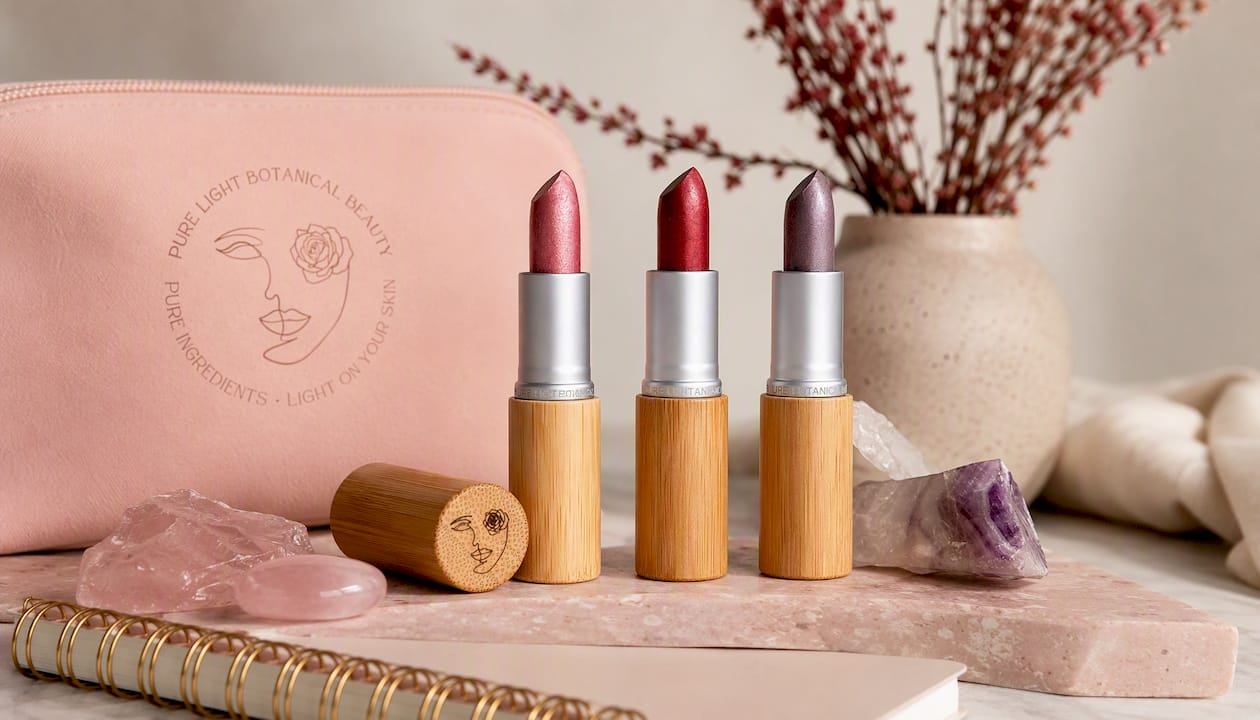
Each shade in the collection, Rose Quartz, Cherry Quartz, and Amethyst, is formulated with plant-based ingredients chosen for sensitive and reactive skin types, the same skin many people with celiac disease also manage alongside dietary restrictions. Rose Quartz leans into a soft, rosy neutral. Cherry Quartz brings a deeper, warmer red. Amethyst offers a muted plum for days you want something richer without the sting some conventional lipsticks cause on compromised lips.
If you want full ingredient disclosure or batch testing details before you buy, our customer service team will walk through the formulation with you directly, no vague reassurances, just the actual list. You can also browse our full plant-based lip balm collection if you want options beyond lipstick. Send us a message today to confirm any shade fits your specific sensitivities before it goes anywhere near your lips.
Sources and Further Reading
- National Celiac Association guidance on gluten-free skincare and body products explains the topical-versus-ingestion distinction in plain terms
- Beyond Celiac’s cosmetics and skin-care hygiene pages detail labeling gaps and specific INCI names to watch for
- Gluten Free Watchdog’s product testing reports show real-world examples of mainstream lip balms lacking gluten-free labeling
- Consumer roundups of gluten-free lip balm brands offer a discovery starting point, provided you verify each listing directly
Frequently Asked Questions
Is regular chapstick safe for people with celiac disease? It depends on the brand and formulation. Many mainstream lip balms carry no gluten-free claim at all, so checking the label or contacting the manufacturer directly is the only reliable way to know.
Can gluten in lip balm actually cause a reaction if I don’t swallow it? The main risk comes from indirect ingestion, licking your lips, eating after application, or drinking from a cup, rather than absorption through the skin itself.
Are eos, Burt’s Bees, or ChapStick gluten-free? Some products from these brands appear on consumer gluten-free roundups, but formulations change and vary by flavor. Confirm directly with the brand before relying on any older list.
What ingredient names should I search for besides “wheat”? Look for Triticum vulgare, Hordeum vulgare, Secale cereale, hydrolyzed wheat protein, malt extract, and dextrin or maltodextrin variants sourced from wheat.
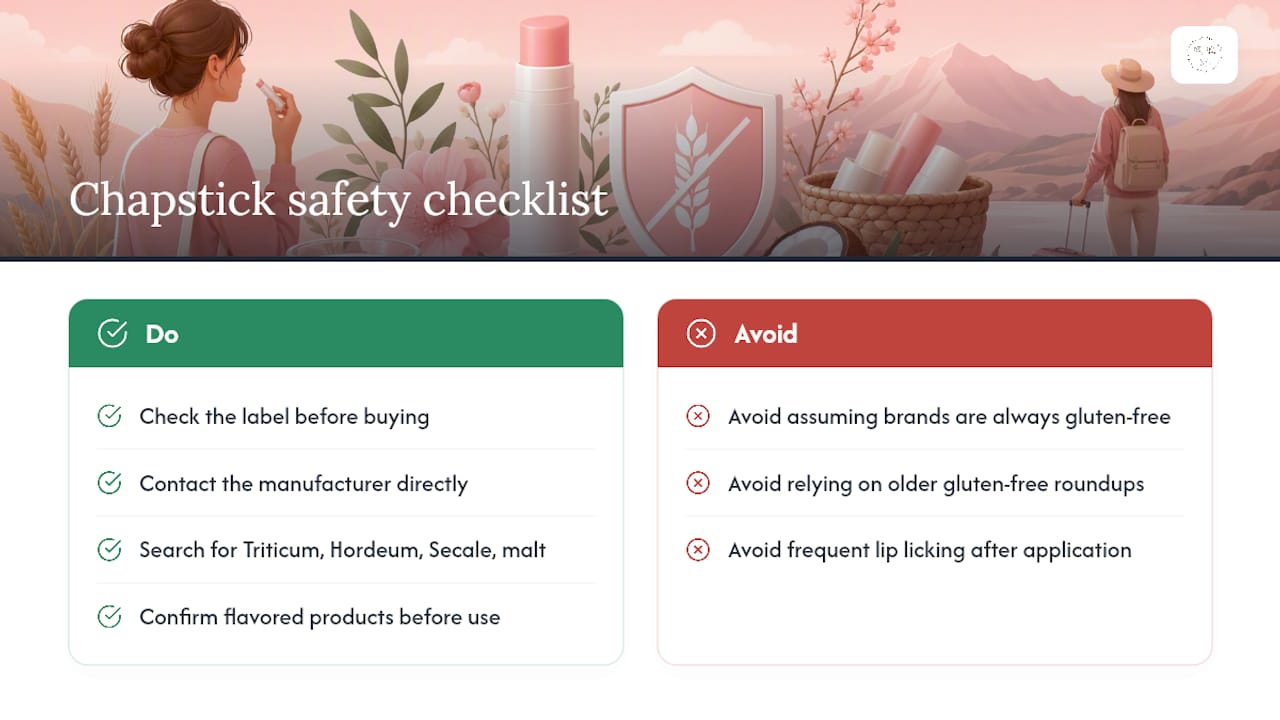
Should I avoid flavored lip balms entirely? Not necessarily, but flavored and candy-like products encourage more frequent licking, which raises ingestion risk if the formula isn’t confirmed gluten-free.
Recommended
- 7 Essential Tips for Choosing Gluten Free Makeup Safely – Pure Light Botanical Beauty
- Lip Care and Gloss Guide for Nourishing, Hydrated Lips – Pure Light Botanical Beauty
- Top 8 Best Hypoallergenic Lipsticks in 2026 for Sensitive Skin – Pure Light Botanical Beauty
- Top plant-based lip balm collection for sensitive skin 2026 – Pure Light Botanical Beauty