

TL;DR:
- Makeup allergies often stem from hidden allergens like fragrances and preservatives present even in “natural” products. Eyelid skin’s thinness makes it highly susceptible to allergen absorption, leading to delayed allergic contact dermatitis symptoms. Proper patch testing and ingredient awareness are essential for identifying triggers and preventing reactions effectively.
You apply the same foundation you’ve used for years, and two days later your eyelids are swollen, red, and unbearably itchy. Sound familiar? Understanding what causes makeup allergies, medically known as allergic contact dermatitis, is less straightforward than most people expect. The culprit is rarely the product you’d guess, and the reaction often surfaces long after the exposure. This guide breaks down the real causes of cosmetic reactions, how to read your symptoms accurately, and what you can do to stop the cycle.
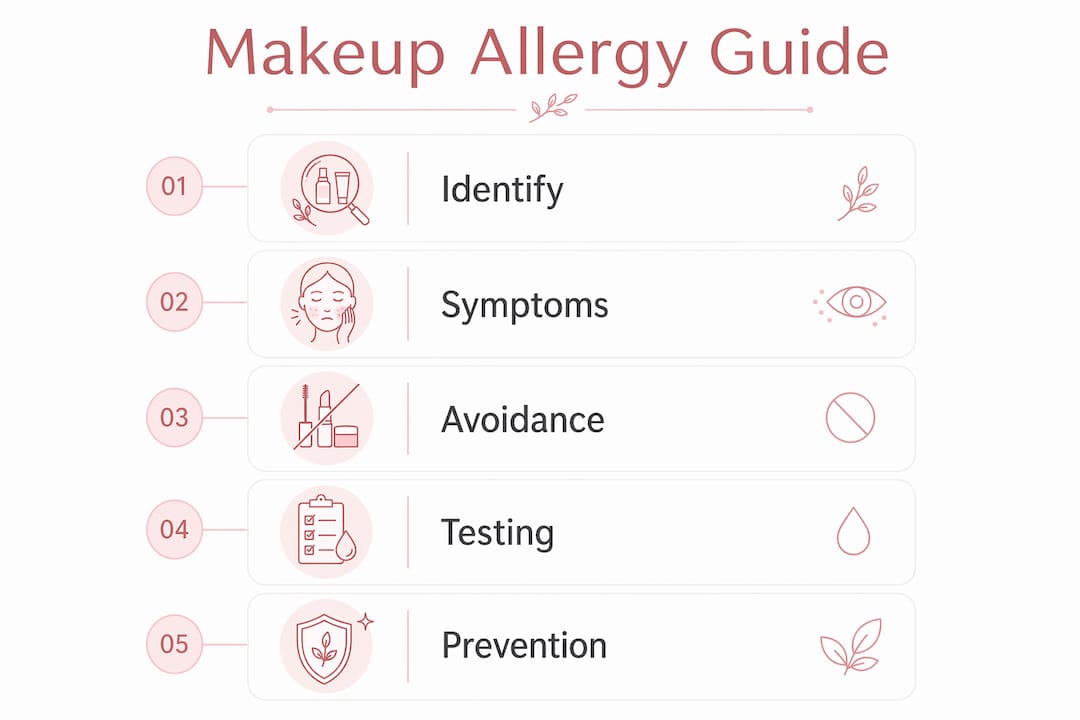
Key Takeaways
| Point | Details |
|---|---|
| Hidden allergens are common | Fragrances and preservatives lurk even in unscented or “natural” products, making label reading non-negotiable. |
| Eyelids react first | Eyelid skin is extremely thin, absorbing allergens at a far higher rate than other facial areas. |
| Reactions are delayed | Allergic contact dermatitis typically appears 24 to 96 hours after exposure, not immediately. |
| Patch testing identifies triggers | A dermatologist-supervised patch test is the most reliable way to pinpoint your specific allergens. |
| Cleaner formulas reduce risk | Choosing botanical, preservative-free makeup significantly lowers your exposure to common sensitizers. |
What causes makeup allergies: the main culprits
Allergic contact dermatitis from cosmetics happens when your immune system tags a specific ingredient as a threat. After repeated exposure, your body mounts a reaction. The tricky part is that cosmetic allergen groups include fragrances, formaldehyde releasers, nickel in pigments, shellac, and rubber accelerators. These are not always obvious on a label.
Fragrances
Fragrance is the single most reported allergen in cosmetics. What makes it especially deceptive is that “fragrance-free” and “unscented” are not the same thing. An unscented product may still contain masking fragrances designed to neutralize the smell of other ingredients. Those masking agents can still trigger a reaction.
Preservatives
Preservatives keep your makeup from growing bacteria, but some of the most effective ones are also significant sensitizers. Formaldehyde releasers like quaternium-15 are a major concern. Research shows formaldehyde contact allergy affects roughly 2.88% of dermatitis patients, with quaternium-15 showing the highest clinical relevance. Parabens, though less reactive, still cause problems for some people.
Nickel and pigment contaminants
Metallic eyeshadow shimmers and certain pigments can carry trace nickel, which is a well-known sensitizer. If you react to jewelry but not to matte products, nickel in pigments may be your trigger.
Here is a quick reference for the most common ingredients causing makeup allergies:
| Allergen | Common sources | Reaction type |
|---|---|---|
| Fragrance compounds | Foundation, blush, lip products | Allergic contact dermatitis |
| Quaternium-15 | Mascara, liquid liner, moisturizers | Formaldehyde-releasing sensitizer |
| Parabens | Most cosmetics as preservatives | Contact allergy, less common |
| Nickel | Metallic pigments, eyeshadow | Metal hypersensitivity |
| Tosylamide resin | Nail polish | Eyelid dermatitis via transfer |
| Rosin/shellac | Mascara, blush | Resin sensitizer |
Pro Tip: If you react to adhesive bandages, you may already be sensitized to rosin, a resin used in many mascaras and blushers. Cross-reactivity between these products is well-documented.
The allergen profile also shifts depending on the makeup type. Eye products tend to carry more preservatives due to hygiene concerns. Lip products concentrate flavoring agents. Face products like foundation are the most complex, often combining fragrances, preservatives, and pigments in one formula.
Symptoms and where they show up
Makeup allergy symptoms follow a recognizable pattern once you know what to look for. Redness, swelling, itching, and flaking appear most often on the eyelids, cheeks, lips, and neck. These are areas where skin is thinner and product contact is frequent.
The eyelids deserve particular attention. Eyelid dermatitis accounts for 15 to 25% of facial dermatitis cases, and eyelid skin is approximately 0.5 mm thick. That thinness means allergens absorb at rates five to ten times higher than on thicker skin elsewhere on the body. You do not need to apply eye makeup directly to trigger an eyelid reaction. Touching your face after applying a hand cream or nail polish can be enough.
Timing is also a key diagnostic clue:
- Immediate reactions (within minutes to an hour): More likely irritant contact dermatitis, not a true allergy. Often caused by harsh surfactants or high-alcohol products.
- Delayed reactions (24 to 72 hours after exposure): Classic pattern for allergic contact dermatitis. Your immune system needs time to mount its response.
- Crescendo reactions (peak at 48 to 96 hours): A hallmark of true allergic response. An irritant reaction fades over this window; an allergic reaction intensifies.
This timing distinction matters. If you apply a new foundation and break out two days later, you may assume it was something you ate or a stress flare. The foundation is the far more likely cause.
Repeated rubbing during a flare makes the condition significantly worse. Early allergen avoidance is consistently more effective than managing symptoms after the fact, which is why identifying your triggers accurately is so worth the effort.
How to identify your specific triggers
Knowing how to identify makeup allergies goes beyond eliminating one product at a time. That approach can take months and still leaves you guessing.
Patch testing is the gold standard. Here is how the process works:
- A dermatologist applies small amounts of suspected allergens to your upper back using adhesive patches.
- Patches stay in place for 48 hours. You avoid bathing and heavy sweating during this time.
- An initial reading happens at 48 hours when patches are removed.
- A second reading occurs at 72 to 96 hours after the initial application. This delayed reading is critical because many reactions only become visible at this stage.
- Results guide your dermatologist in identifying specific allergens to avoid.
One limitation worth knowing: patch test accuracy depends on the breadth of the allergen panel. Standard panels may miss certain cosmetic-specific allergens. Ask your dermatologist about adding a specialized cosmetic or personal product panel.
For home-based tracking, the Repeated Open Application Test (ROAT) is a practical tool. You apply a suspected product to the same small area of skin twice daily for two weeks and monitor for reactions. It is not a replacement for clinical patch testing, but it can help you narrow down suspects before your appointment.
Pro Tip: Keep a makeup reaction journal. Record the date, product, application area, and when symptoms appeared. Bring this log to your dermatology appointment. It gives your doctor the context needed to select the right allergen panel for your patch test.
Your clinical history matters as much as the test itself. Patterns across multiple reactions, the products involved, and your exposure timeline all inform a more accurate diagnosis. For additional support, the allergen-free beauty guide from Purelightbotanicalbeauty is a practical starting point for understanding which ingredients to watch for.
Preventing reactions and building safer habits
Preventing makeup allergies is not about giving up beauty. It is about making smarter choices with clearer information.
Start with an ingredient audit of your current collection. Pull every product and scan the labels for the allergens listed in the comparison table above. If you have already identified a specific sensitivity, search for it by its INCI (International Nomenclature of Cosmetic Ingredients) name, not just the common name.
Here is a practical framework for reducing your risk:
- Simplify your routine. The fewer ingredients you apply, the lower your exposure load. A 10-step routine with complex products multiplies your allergen contact.
- Patch test new products before full use. Apply to your inner arm for three to five days before using it on your face. This won’t catch every reaction, but it catches many.
- Avoid switching multiple products at once. If you introduce several new items simultaneously and react, you cannot identify which one caused it.
- Choose natural makeup for sensitive skin. Formulas with shorter ingredient lists and plant-based preservatives typically carry fewer synthetic sensitizers.
- Support your skin barrier. A compromised barrier absorbs allergens more readily. Gentle cleansing, consistent moisturizing, and avoiding harsh exfoliants all reduce your skin’s vulnerability.
- Reconsider your makeup remover. Some micellar waters and oil-based removers contain fragrances and preservatives that are just as allergenic as the products they’re removing.
Pro Tip: Look for products labeled “fragrance-free” rather than “unscented.” Unscented products can still contain masking fragrances. Fragrance-free means none were added at all.
See a dermatologist if your reactions are recurring, severe, or spreading. Self-management works well once you know your triggers, but getting to that point usually requires professional help. You can also explore the clean makeup checklist from Purelightbotanicalbeauty to build a safer routine from scratch.
Myths and overlooked causes
Several widespread misconceptions keep people stuck in a cycle of reactions and guesswork.
- “If it smells natural, it’s safe.” Many botanical essential oils are potent allergens. Tea tree, lavender, and citrus oils appear frequently in natural cosmetics and cause genuine contact allergy. The word “organic” on a label says nothing about allergenicity.
- “The product I react to is always the one I applied to the area.” Nail polish tosylamide resin accounts for 8 to 10% of eyelid dermatitis cases in patch-tested patients. The resin transfers from fingertips to eyelids during normal face-touching. The eye product is innocent.
- “Hypoallergenic means allergy-proof.” The term hypoallergenic has no legal definition. Brands use it freely. Always read the ingredient list rather than relying on marketing labels.
- “Once I stop using the product, the reaction stops.” Allergic contact dermatitis can persist for weeks after allergen removal, especially if the skin barrier is already damaged.
- “Hair products can’t cause face reactions.” Shampoo, conditioner, and styling products run down your face when you wash your hair. They leave residue on pillowcases. Both transfer significant allergen contact to your eyelids and cheeks.
Recognizing these overlooked sources is often the missing piece for people who have tested and eliminated obvious suspects without finding relief.
My honest take on the makeup allergy puzzle
I’ve watched so many people cycle through dozens of products, spending hundreds of dollars and months of frustration, because they skipped the one step that would have answered everything: a proper patch test. The truth is that self-diagnosis with makeup allergies is genuinely hard, not because people aren’t paying attention, but because the system makes it hard.
Ingredient labels are dense. Cross-reactivity is real and unpredictable. A fragrance molecule you react to in your foundation might also be present in your “sensitive skin” moisturizer under a completely different chemical name. Without knowing your specific triggers through clinical testing, you’re guessing.
What I’ve also found is that people underestimate how much lifestyle factors amplify skin reactivity. Stress, poor sleep, and a disrupted gut microbiome all affect your immune threshold. When your system is already taxed, ingredients you previously tolerated can suddenly become reactive. Allergen avoidance is necessary, but it works best alongside broader skin-supporting habits.
The good news is that once you identify your triggers, recovery is very possible. Avoiding the specific allergen usually resolves the reaction over a few weeks. Choosing clean, short-ingredient-list products maintains that recovery. Persistent, methodical attention pays off.
— Kaitlyn
Gentler beauty starts with what’s in the formula
If you’ve realized your current makeup is working against your skin, the next step is finding products designed with your sensitivity in mind.
Purelightbotanicalbeauty formulates every product around this exact problem. The brand uses plant-based, short-ingredient-list formulas that intentionally avoid the synthetic preservatives, synthetic fragrances, and chemical additives most commonly linked to skin reactions to makeup. Products like the Botanical Crème Blush and Nourishing Lipstick are crafted to let your skin breathe and heal, not just look good for a few hours. If you’ve been searching for botanical makeup for sensitive skin, this is where to start. You deserve makeup that feels like self-care, not something you have to recover from.
FAQ
What are the most common ingredients causing makeup allergies?
Fragrances, formaldehyde-releasing preservatives like quaternium-15, nickel in metallic pigments, and resin compounds like tosylamide are the most frequently identified allergens in cosmetics.
How long does it take for a makeup allergy to appear?
Allergic contact dermatitis typically appears 24 to 72 hours after exposure and may peak between 48 and 96 hours, unlike irritant reactions that appear more quickly.
How do I test for makeup allergies at home?
The Repeated Open Application Test (ROAT) involves applying a product to the same small skin area twice daily for two weeks and watching for a reaction. Clinical patch testing by a dermatologist is more accurate.
Can “natural” or “organic” makeup still cause allergic reactions?
Yes. Many plant-derived ingredients like essential oils are potent allergens. Natural or organic labeling does not guarantee a product is hypoallergenic or free from sensitizers.
Why are my eyelids reacting when I’m not wearing eye makeup?
Allergens transfer easily from hands, nail polish, and hair products to eyelid skin. Since eyelid skin is extremely thin, it absorbs these transferred allergens readily, causing reactions without any direct eye product application.
Recommended
- Skin-Friendly Makeup Tips: Complete Expert Guide – Pure Light Botanical Beauty
- What Is Eczema-Safe Makeup? True Comfort For Skin – Pure Light Botanical Beauty
- 7 Essential Tips for Choosing Gluten Free Makeup Safely – Pure Light Botanical Beauty
- What is mindful makeup: a natural guide for sensitive skin – Pure Light Botanical Beauty