

TL;DR:
- Ritualistic beauty practices transform grooming into meaningful acts rooted in culture, identity, and spirituality. These routines, like ancient Egyptian kohl rituals and South Korea’s 10-step skincare, emphasize intentionality and repetition for psychological and communal benefits. Engaging fully in these practices reconnects individuals with ancient traditions, fostering self-connection and cultural reverence.
Ritualistic beauty is defined as intentional, culturally rooted practice that transforms grooming into an act of meaning, identity, and spiritual connection. These are not habits performed on autopilot. The most compelling examples of ritualistic beauty span ancient Egypt’s kohl ceremonies, Myanmar’s thanaka paste tradition, South Korea’s 10-step skincare sequence, and Ghana’s Krobo Dipo beadwork. Each practice reveals the same truth: beauty has always been about more than appearance. It is about who you are, where you come from, and how you choose to show up in the world.
1. Ancient Egyptian kohl rituals: the original examples of ritualistic beauty
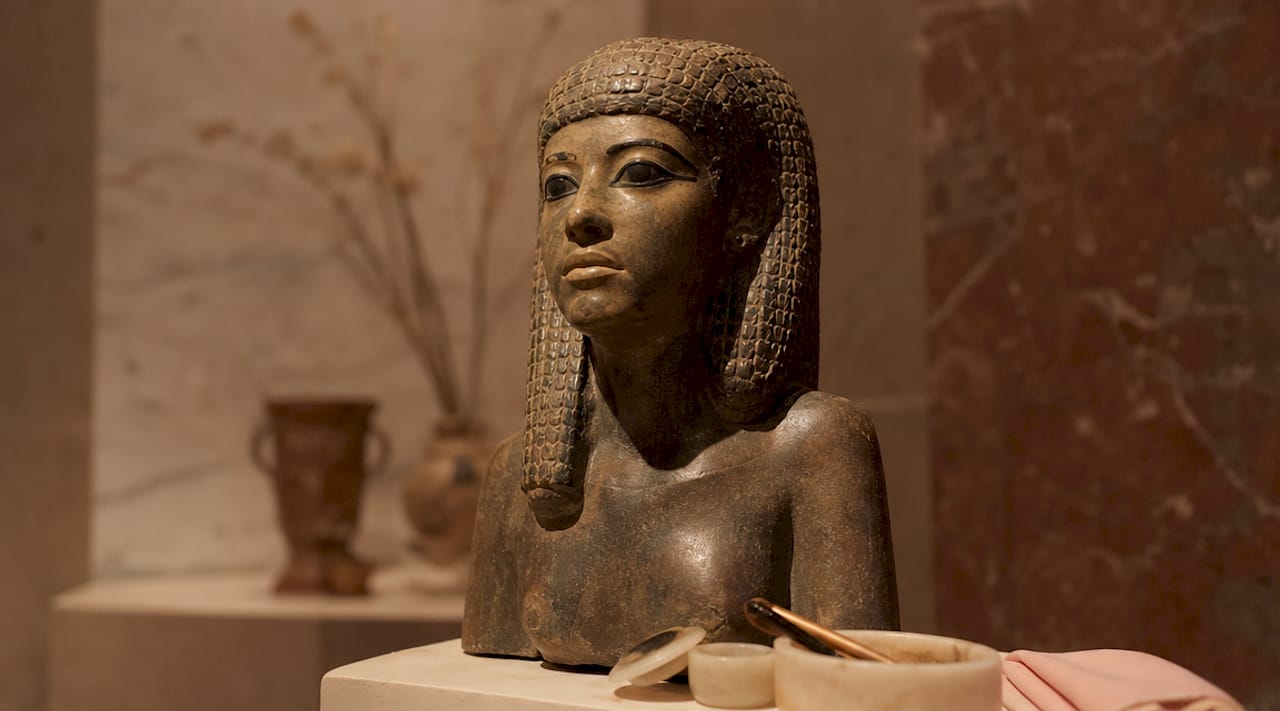
Ancient Egyptian cosmetics were sacred tools of worship, used in devotion to Hathor, the goddess of beauty and love. Kohl was not applied for vanity. It was applied for protection, divine communion, and identity. The dark pigment drawn around the eyes was believed to guard against the Evil Eye and signal alignment with sacred forces.
The objects used in this practice carried their own ritual weight:
- Bronze mirrors were considered portals to the divine, not just reflective surfaces
- Carved kohl applicators made from ivory, wood, or faience were treated as sacred instruments
- Pigment palettes shaped like animals or fish held cosmetic materials used in temple offerings
“Applying kohl involves enforced intimacy, such as steadying another’s face, transforming grooming into a shared protective ritual that regulates anxiety and creates communal bonds.”
This communal dimension is what separates ritual from routine. When one person steadies another’s face to apply kohl, the act becomes a gesture of care, trust, and mutual protection. The cosmetic becomes secondary to the connection.
Pro Tip: Recreate this intentionality in your own practice by treating your makeup tools as objects worthy of care. Clean your brushes with intention, store them with respect, and notice how that shift changes the energy of your morning routine.
2. Myanmar’s thanaka paste: 2,000 years of grounding ritual
Thanaka paste is a 2,000-year-old daily ritual applied by millions across Myanmar for sun protection, acne treatment, and skin cooling. What makes it ritualistic is not just the paste itself but the preparation. Each morning, bark from the thanaka tree is ground on a flat stone called a kyauk pyin using a circular motion with water. That grinding is the ritual.
The preparation technique has remained unchanged over millennia. Grinding bark on stone each morning transforms application into mindfulness, marking a conscious transition from sleep to waking life. The repetition grounds the practitioner before the day begins. No app, no alarm, no notification can replicate that kind of presence.
Here is how the thanaka ritual unfolds in practice:
- Select fresh thanaka bark or a pre-formed cylinder
- Add a few drops of water to the kyauk pyin stone
- Grind the bark in slow, circular motions until a pale yellow paste forms
- Apply to cheeks, forehead, or nose in circular patterns or leaf designs
- Allow to dry for a cooling, protective finish
| Application pattern | Meaning |
|---|---|
| Circular cheek discs | Everyday wear, sun protection |
| Leaf or floral designs | Ceremonial occasions or festivals |
| Full face coverage | Traditional ethnic group identity |
| Minimal nose stripe | Modern urban adaptation |
Pro Tip: You do not need thanaka bark to borrow this ritual’s spirit. Try grinding a small amount of a natural ingredient, like oat flour or clay, by hand before applying it. The physical preparation shifts your mindset from task to ceremony.
3. K-beauty 10-step routines as modern ceremonial practice
South Korea’s 10-step skincare routine is one of the most widely recognized contemporary examples of ritualistic beauty practices. The sequence requires precise ordering: oil cleanser, water-based cleanser, exfoliant, toner, essence, serum, sheet mask, eye cream, moisturizer, and SPF. Skipping steps or reversing the order breaks the ritual effect, much like omitting a step in a ceremony changes its outcome.
The goal of this sequence is “glass skin,” a term describing skin so hydrated and clear it appears translucent. Achieving it requires patience, repetition, and belief in the process. Those three qualities are the same ones that define any sacred practice.
The psychological dimension is equally significant:
- Each step creates a micro-pause that forces presence
- The repetition builds identity: “I am someone who cares for myself this way”
- The sequence becomes a form of self-investment that compounds over time
| Conventional skincare | K-beauty ritual approach |
|---|---|
| Cleanse and moisturize | 10 ordered steps with specific timing |
| Product-focused | Process and sequence-focused |
| Efficiency goal | Transformation goal |
| Minimal time investment | 20 to 45 minutes of intentional care |
The psychological benefits of ritual repetition are well documented. When you perform the same sequence with full attention, you build a mental boundary between who you were before the ritual and who you are after it. K-beauty practitioners understand this intuitively.
4. Krobo Dipo beadwork: adornment as communal identity in Ghana
The Krobo Dipo ceremony in Ghana is one of the most visually striking cultural beauty ceremonies in the world. Young women wear heavy, layered handmade glass bead sets as a visible sign of communal investment and rite of passage. The bead sets can weigh up to 25 kilograms, and the ceremony occurs annually between April and May.
This is not decorative excess. Each bead carries meaning. The weight itself is part of the message: you are held by your community, adorned by your ancestors, and seen by your people.
- Glass beads are handcrafted by Krobo artisans using powdered glass pressed into molds and fired in kilns
- Layering reflects the depth of family investment and social standing
- Color combinations communicate specific messages about the wearer’s identity and status
- The ceremony itself marks the transition from girlhood to womanhood, witnessed by the entire community
The Dipo ceremony makes visible what most cultures leave invisible: the community’s role in shaping individual identity. Beauty here is not a private act. It is a public declaration of belonging, continuity, and shared history. The adornment functions as embodied history worn on the body.
5. Glamour conjure: spiritual beauty practices in Black American traditions
Glamour conjure is the practice of intentional aesthetic labor linked to ancestry, spiritual alignment, and self-empowerment in Black American traditions. It treats adornment not as vanity but as sovereign devotional practice. Repeated acts of beautification serve as knowledge production and spiritual technology within a historical context where visibility and self-presentation carried profound stakes.
“Ritualistic beauty transcends surface enhancement, functioning as knowledge production and self-inscription connecting individuals to ancestral lineages.”
In practice, glamour conjure includes mirror affirmations spoken while applying makeup, charm work woven into the selection of colors and adornments, and ancestral alignment through scent, color, and intention. Each choice is deliberate. The mirror is not just a reflective surface. It is a site of self-recognition and power.
Stylist Emman describes beauty as psychological armor, a deliberate act that empowers individuals before they face judgmental environments. This framing resonates deeply with glamour conjure’s core premise: that how you adorn yourself shapes not just how others see you but how you move through the world.
Pro Tip: Before applying your makeup or skincare, take 30 seconds to set an intention. Say aloud what you want to carry with you today. This single act transforms a routine into a spiritual beauty practice with real psychological weight.
Key takeaways
Ritualistic beauty practices are most powerful when they combine intentionality, cultural grounding, and repetition to transform daily grooming into acts of identity and self-investment.
| Point | Details |
|---|---|
| Intentionality defines ritual | Practices like kohl application and glamour conjure derive power from conscious, purposeful action. |
| Preparation is part of the ritual | Myanmar’s thanaka grinding shows that how you prepare is as meaningful as what you apply. |
| Community amplifies meaning | Krobo Dipo beadwork proves that beauty rituals gain depth when witnessed and shared. |
| Repetition builds identity | K-beauty’s 10-step sequence demonstrates that consistent ritual creates lasting psychological transformation. |
| Ritual is culturally universal | From ancient Egypt to modern Seoul, every culture has developed sacred beauty traditions that serve identity and spirit. |
Why I think beauty rituals deserve more credit than we give them
I used to think of my morning routine as something to get through, not something to experience. That changed when I started paying attention to what I was actually doing and why. The moment I slowed down and treated my skincare as a sequence with intention rather than a checklist, everything shifted. Not just my skin. My whole relationship with the day ahead.
What strikes me most about the examples in this article is that none of them are complicated. Grinding bark on stone. Layering beads. Drawing a line around your eyes. The power is never in the complexity. It is in the presence. You can build a holistic beauty ritual from almost nothing if you bring your full attention to it.
The cultures that have preserved these practices for centuries understood something we are only beginning to reclaim: that beauty is not separate from healing, identity, or spirit. It is woven through all of them. When you treat your beauty routine as a ritual, you are not being indulgent. You are doing something ancient and deeply human.
— Kaitlyn
Bring ritual into your beauty routine with Purelightbotanicalbeauty
Purelightbotanicalbeauty was built on the belief that beauty and healing come from the same source. Every product in the line, from the Petal Perfect Lip Oil to the Botanical Crème Blush and Nourishing Lipstick, is formulated with clean, plant-based ingredients designed to nourish your skin while you wear them. These are products made for women who want their beauty routine to feel like something more than a task. Explore the full collection at Purelightbotanicalbeauty and find the products that will anchor your own daily ritual. Your practice deserves ingredients as intentional as the care you bring to it.
FAQ
What are examples of ritualistic beauty practices?
Examples of ritualistic beauty include ancient Egyptian kohl application, Myanmar’s thanaka paste preparation, South Korea’s 10-step skincare routine, Ghana’s Krobo Dipo beadwork ceremony, and glamour conjure in Black American traditions. Each practice combines intentionality, cultural meaning, and repetition to transform grooming into a sacred act.
How do beauty rituals differ from regular beauty routines?
A beauty ritual is defined by intention, sequence, and meaning, while a regular routine is defined by habit and efficiency. Ritualistic beauty practices like K-beauty’s 10-step sequence or kohl application involve conscious presence and a belief that the process itself carries transformative power.
What are the psychological benefits of beauty rituals?
Beauty rituals create mental boundaries and build confidence before social exposure. Stylist Emman describes this as psychological armor, noting that deliberate adornment empowers individuals in environments where judgment is present.
How can I create my own ritualistic beauty practice?
Start by choosing one step in your existing routine and performing it with full attention. Set an intention before you begin, use tools you care for deliberately, and repeat the same sequence daily. Consistency and presence are the two ingredients every nourishing daily ritual requires.
Are beauty rituals connected to spirituality?
Many traditional beauty rituals are directly connected to spiritual practice. Ancient Egyptian cosmetics were acts of divine communion with Hathor, glamour conjure aligns adornment with ancestral power, and thanaka application carries meditative and grounding dimensions that extend well beyond skincare.
Recommended
- Glow from within: spiritual beauty rituals for radiant skin – Pure Light Botanical Beauty
- How to create a holistic beauty ritual for sensitive skin – Pure Light Botanical Beauty
- How to Build Skin-Nourishing Rituals for Sensitive Skin – Pure Light Botanical Beauty
- Self-Expression in Beauty: Pathway to Healing and Confidence – Pure Light Botanical Beauty