

A simple, twice-daily skin cleansing regime keeps your skin balanced, clear, and ready to absorb the treatments you layer on top. The American Academy of Dermatology recommends cleansing gently in the morning and again at night, removing all makeup and sunscreen before bed, moisturizing after every cleanse, and applying broad-spectrum SPF each morning. That four-part principle, backed by the Cleveland Clinic’s practical face-washing guidance, is the foundation of every effective cleansing skincare routine, whether your skin is oily, dry, sensitive, or somewhere in between.
The most important thing to understand from the start: consistency outperforms complexity. A simple routine you follow every day will always deliver better long-term results than an elaborate one you abandon by Thursday. Purelightbotanicalbeauty is built on exactly this belief, that gentle, plant-based formulations designed to protect the skin barrier are the most meritorious foundation you can give your skin.
Your AM checklist:
- Rinse or gently cleanse with a mild, pH-balanced cleanser
- Apply any water-based serum (optional)
- Moisturize
- Apply broad-spectrum SPF 30 or higher
Your PM checklist:
- Remove makeup and sunscreen (oil-based cleanser or micellar water first, if needed)
- Follow with a gentle water-based cleanse
- Apply targeted treatments (retinoids or acids at night only)
- Moisturize
Table of Contents
- What does your AM vs PM cleansing routine look like?
- How to cleanse your skin properly, step by step
- Which cleanser should you use for your skin type?
- Why does product order matter in your skincare routine?
- How often should you exfoliate, and when do actives fit in?
- What cleansing mistakes are quietly damaging your skin?
- How do you adapt your cleansing routine for sensitive or eczema-prone skin?
- How long does a cleansing routine take, and what does it cost?
- Key Takeaways
- The quiet power of a ritual you actually keep
- Useful sources and further reading
What does your AM vs PM cleansing routine look like?
Your morning and evening routines serve different purposes, and keeping that distinction clear makes both more effective.
Morning:
- Gentle cleanser (or a simple lukewarm water rinse for very dry skin) → water-based serum if used → moisturizer → broad-spectrum SPF
Evening:
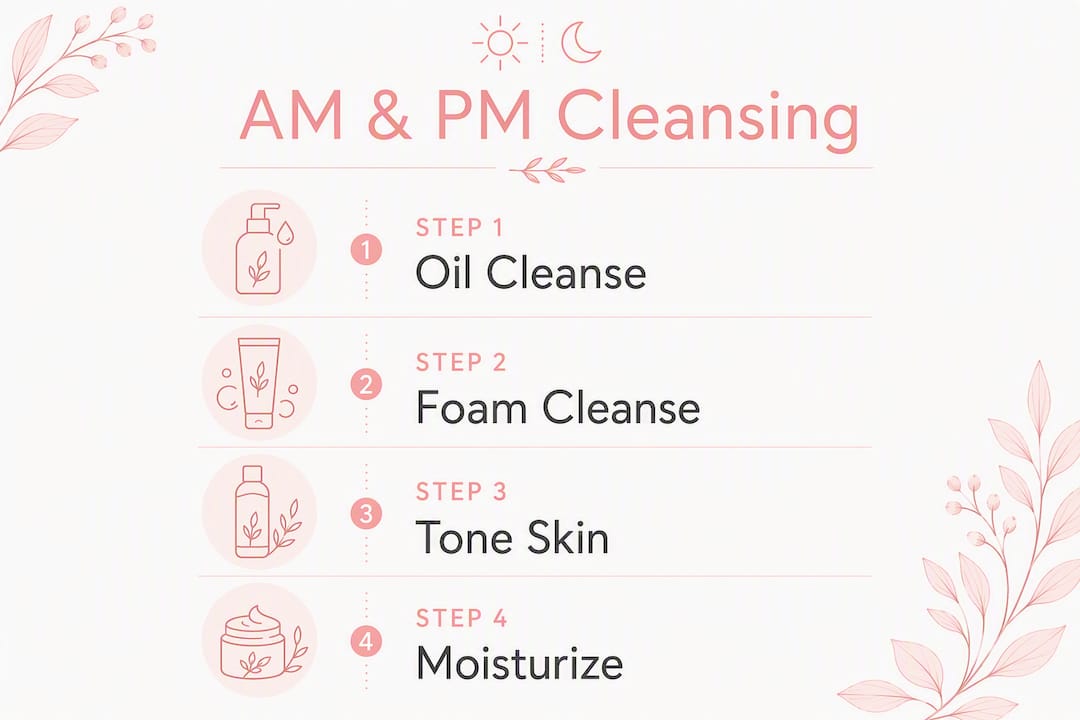
- Oil-based cleanser or micellar water to dissolve makeup and sunscreen → water-based cleanser → treatment serums (vitamin C in the evening works for some; retinoids and AHAs belong at night) → moisturizer
When to double cleanse: If you wore makeup, sunscreen, or spent time in a heavily polluted environment, double cleansing is the right call. A single gentle cleanse is perfectly sufficient on bare-skin days or when you’ve only applied a light moisturizer and SPF.
The logic is straightforward. Water alone cannot dissolve oil-based molecules like sunscreen and long-wear foundation. An oil-based first step, whether a cleansing balm, cleansing oil, or micellar water, breaks those bonds before your water-based cleanser clears everything away.

How to cleanse your skin properly, step by step
Getting the technique right matters as much as choosing the right product. Here is the exact sequence, drawn from Cleveland Clinic guidance on face-washing best practices.
- Wet your face with lukewarm water. Hot water strips the skin’s natural lipids and accelerates barrier damage. Lukewarm is the standard, every time.
- Dispense a small amount of cleanser onto your fingertips. You rarely need more than a dime-to-quarter-sized amount. Fingers are gentler than washcloths or silicone scrubbers for daily use.
- Massage in gentle circular motions for 30–60 seconds. If you’re using a medicated cleanser containing salicylic acid or benzoyl peroxide, some formulations benefit from a 1–2 minute contact time before rinsing; check the product directions.
- If double cleansing, emulsify the oil cleanser first. Add a small amount of water to your hands while the oil cleanser is still on your face and work it into a milky emulsion. This step is what allows the oil phase to rinse cleanly. Skipping it leaves an oily residue that can clog pores.
- Rinse the oil cleanser thoroughly, then apply your water-based cleanser. The second cleanse removes any remaining residue and refreshes the skin’s surface.
- Rinse completely with lukewarm water. Leftover cleanser residue, even from gentle formulas, can cause irritation or dullness over time.
- Pat dry with a clean face towel. Never rub. Rubbing creates friction that irritates freshly cleansed skin. Use a dedicated face towel, separate from your body towel, and launder it every few days. A damp towel left on a bathroom rack reintroduces bacteria to skin you just cleaned.
- Apply your next product immediately. Slightly damp skin absorbs serums and moisturizers more readily than fully dry skin.
Troubleshooting: If your skin feels tight or dry after cleansing, that sensation signals barrier disruption, not cleanliness. Switch to a gentler, pH-balanced formula and skip any hot water.
Pro Tip: Keep a small stack of clean face cloths folded near your sink so swapping to a fresh one each day requires zero extra effort.
Which cleanser should you use for your skin type?
Choosing the right cleanser texture and active ingredients is where a daily skin cleansing routine becomes genuinely personal. The table below gives you a quick reference, followed by the reasoning behind each recommendation.

| Skin Type | Recommended Texture | Key Ingredients to Look For | Ingredients to Avoid |
|---|---|---|---|
| Oily | Gel or foaming | Salicylic acid, niacinamide | Heavy oils, comedogenic emollients |
| Dry | Cream, lotion, or oil-based | Ceramides, hyaluronic acid, glycerin | Sulfates, high-fragrance formulas |
| Combination | Gentle gel or micellar water | Niacinamide, mild surfactants | Alcohol-heavy toners used as cleansers |
| Acne-prone | Gel or medicated wash | Salicylic acid, benzoyl peroxide | Abrasive scrubs, comedogenic oils |
| Sensitive / Eczema-prone | Cream or micellar | Ceramides, colloidal oatmeal, minimal ingredients | Fragrance, dyes, essential oils |
| Mature / Dull | Gentle cream or low-lather gel | AHAs (low concentration), hyaluronic acid | Harsh sulfates, physical scrubs |
Reading labels with confidence:
- Non-comedogenic means the formula was tested to avoid blocking pores, though testing standards vary by brand.
- Fragrance-free is more protective than unscented; unscented products can still contain masking fragrances.
- “Gentle” is an unregulated marketing term. Look past it to the actual ingredient list. A fragrance-free, liquid formulation with a mildly acidic pH is a more reliable signal than the word “gentle” on the front of the package.
- Avoid bar soaps on your face. Their pH tends to be too alkaline for facial skin, which disrupts the acid mantle and leaves the barrier vulnerable.
For acne-prone skin, salicylic acid works by penetrating the pore lining and dissolving the debris that causes congestion. Benzoyl peroxide kills acne-causing bacteria directly. AHAs like glycolic acid offer mild chemical exfoliation that can improve radiance and texture, particularly for people in their 30s and 40s, but they belong in a separate treatment step rather than a daily cleanser for most skin types.
Why does product order matter in your skincare routine?
Cleansing is the first active step in any routine because it clears the surface so everything applied afterward can actually reach the skin. Think of it as preparing a canvas: treatments applied to skin still coated in sunscreen, sebum, or pollution residue simply cannot penetrate as intended.
Once the skin is clean, the guiding principle is thin to thick. Apply products from the lightest, most water-based consistency to the heaviest, most occlusive one. This sequence optimizes absorption because lighter molecules need an unobstructed path to the skin’s surface, while thicker creams and oils seal everything in.
A practical AM sequence:
- Cleanser → toner (optional, hydrating) → vitamin C serum → moisturizer → SPF
A practical PM sequence:
- Oil-based makeup remover → water-based cleanser → exfoliant or retinoid (not both on the same night) → moisturizer
Sunscreen always comes last in the morning, after moisturizer. Applying it underneath other products defeats its protective function. At night, retinoids and acids go on after cleansing and before moisturizer, because the moisturizer layer can dilute their activity if applied first.
Pro Tip: Patch test any new active ingredient on the inner forearm for 24–48 hours before applying it to your full face. Cleansed, bare skin gives you the clearest read on how your skin responds.
A skincare ritual that transforms your skin is less about the number of products you own and more about the order and intention you bring to each step.
How often should you exfoliate, and when do actives fit in?
Exfoliation is where many people either under-deliver or overdo it, and the difference shows up quickly on the skin.
Physical vs. chemical exfoliation:
- Physical exfoliation uses friction, whether a scrub, brush, or textured cloth, to manually remove dead skin cells. It works, but it’s easy to overdo, especially on sensitive or acne-prone skin where micro-tears can worsen inflammation.
- Chemical exfoliation uses AHAs (glycolic acid, lactic acid) or BHAs (salicylic acid) to dissolve the bonds holding dead cells to the surface. It tends to be more even and controllable.
Frequency by skin type:
- Oily or resilient skin: up to 2–3 times per week with a BHA or mild AHA
- Normal or combination skin: 1–2 times per week
- Dry, sensitive, or eczema-prone skin: once per week at most, or skip chemical exfoliants entirely and rely on gentle cleansing
Start once per week and build from there. Your skin will tell you when it’s ready for more frequency: no redness, no tightness, no increased sensitivity.
Toners: They’re optional. Hydrating, alcohol-free toners can remove any remaining cleanser residue after washing and add a layer of comfort, particularly for oily skin types that benefit from lightweight hydration without heaviness. Alcohol-based toners, on the other hand, strip the skin’s natural oils and can trigger the very oiliness they’re meant to control. If a toner doesn’t serve a clear purpose in your routine, you don’t need it.
Pro Tip: Never layer a retinoid and an AHA on the same night without clinician guidance. Both increase cell turnover; combining them without building tolerance first often leads to significant irritation and barrier compromise.
For a glowing skin routine that actually holds, exfoliation frequency matters far less than consistency and the gentleness of your base cleanser.
What cleansing mistakes are quietly damaging your skin?
Some of the most common cleansing habits feel harmless, or even thorough, but they work against the skin’s natural resilience.
- Washing more than twice daily. Excessive cleansing disrupts the skin microbiome and strips the lipids that keep the barrier intact. Once in the morning and once at night is the dermatologist-recommended standard. A midday rinse with water is fine; a third full cleanse usually isn’t.
- Using hot water. It feels satisfying, but hot water accelerates the breakdown of the skin’s protective lipid layer. Lukewarm is the upper limit.
- Trusting “gentle” on the label without reading further. The word is unregulated. Check for fragrance-free status and a mildly acidic pH instead.
- Using bar soap on your face. Bar soaps are typically too alkaline for facial skin and can disrupt the acid mantle, leading to dryness, tightness, and increased sensitivity.
- Skipping makeup and sunscreen removal. Sleeping in sunscreen or foundation prevents the skin from its natural overnight repair cycle and can contribute to congestion.
- Failing to emulsify oil cleansers. If you skip the emulsification step, the oil phase doesn’t rinse away cleanly, leaving a pore-clogging film on the skin’s surface.
- Reusing damp face towels. A towel that sits wet on a rack for days harbors bacteria. Swap to a fresh one every few days.
- Rubbing the skin dry. Friction on freshly cleansed skin causes irritation. Pat gently.
- Over-exfoliating or stacking actives without rest days. Skin needs recovery time. Layering multiple acids or using exfoliants daily without building tolerance leads to redness, peeling, and a compromised barrier.
Pro Tip: If your skin feels tight immediately after cleansing, that’s a signal to reassess your cleanser, not to add more products on top. A pH-balanced, fragrance-free formula should leave skin feeling comfortable, not stripped.
How do you adapt your cleansing routine for sensitive or eczema-prone skin?
Sensitive and eczema-prone skin requires a more deliberate, protective approach to cleansing. The goal shifts from thorough removal to barrier preservation, and every product choice reflects that priority.
Favor fragrance-free cleansers with minimal ingredient lists. Ceramide-rich or micellar formulations are particularly well-suited because they cleanse without disrupting the lipid matrix that eczema-prone skin already struggles to maintain. Avoid AHAs, physical scrubs, and any product with essential oils or synthetic fragrance, unless a dermatologist has specifically cleared them for your condition.
Shorter contact times help. Apply the cleanser, massage briefly, and rinse promptly rather than letting it sit. If your skin is very dry or actively flaring, once-daily cleansing in the evening may be sufficient; a simple lukewarm water rinse in the morning preserves more of the skin’s natural oils.
Patch testing is non-negotiable when introducing anything new. Apply a small amount to the inner forearm or along the jawline and wait 24–48 hours before using it on your full face. Introduce one new product at a time, spaced 1–2 weeks apart, so you can identify the source if a reaction occurs.
When to seek professional care: Persistent redness that doesn’t resolve within a few days, weeping or crusting skin, intense burning after product use, or a significant flare following a new cleanser all warrant a visit to a board-certified dermatologist. These are signals that the skin barrier needs more support than an over-the-counter routine can provide.
Pro Tip: An emollient-rich cleanser that doubles as a gentle makeup remover can reduce the number of steps for sensitive skin, lowering the total product exposure and the risk of cumulative irritation.
A soulful skincare routine for sensitive skin starts with the cleanser you choose and the patience you bring to building tolerance slowly.
How long does a cleansing routine take, and what does it cost?
One of the most underestimated barriers to a consistent routine is the belief that it has to be time-consuming. It doesn’t.
Realistic time expectations:
- AM routine (cleanse, moisturize, SPF): a few minutes
- PM routine with makeup removal: five to ten minutes
- Double cleansing adds a small additional time to either routine
Five to ten minutes in the evening is a meaningful investment in your skin’s long-term health. Most people already spend that time scrolling before bed.
Rough cost expectations by tier:
- Drugstore gentle cleansers (gel, cream, or micellar): typically $6–$15 per bottle, lasting 1–3 months with daily use
- Dermatologist-recommended medicated washes (salicylic acid, benzoyl peroxide): typically $10–$20, sometimes available as generics
- Mid-range botanical or hydrating cleansers with ceramides, hyaluronic acid, or plant-based actives: typically $18–$40
A consistent routine with one well-chosen cleanser delivers better results than a rotating collection of specialty products. Spending more doesn’t guarantee better outcomes; spending wisely on a formula matched to your skin type does.
The most practical budgeting advice: buy one cleanser that genuinely suits your skin type and use it consistently for at least four weeks before evaluating whether it’s working. Switching products too frequently prevents you from ever knowing what’s actually helping.
Key Takeaways
A twice-daily skin cleansing regime, matched to your skin type and followed consistently, is the single most effective foundation for healthy, balanced skin.
| Point | Details |
|---|---|
| Cleanse twice daily | Morning and evening cleansing, as recommended by the AAD, keeps skin balanced without over-stripping. |
| Remove makeup and sunscreen at night | Water alone cannot dissolve oil-based residues; use an oil-based cleanser or micellar water first. |
| Match cleanser to skin type | Gel or foaming for oily skin; ceramide-rich cream for dry or sensitive skin; medicated wash for acne-prone skin. |
| Apply products thin to thick | Cleanse first, then layer from lightest serum to heaviest moisturizer, with SPF always last in the morning. |
| Consistency beats complexity | A simple, repeatable routine outperforms an elaborate one you don’t maintain. |
The quiet power of a ritual you actually keep
There’s a perspective I find myself returning to whenever the conversation turns to skincare: the most transformative routines are rarely the most complicated ones. The dermatology community has said this clearly for years, and yet the beauty industry continues to push complexity as a proxy for care.
What I believe, and what the evidence supports, is that a skin cleansing regime works not because of the number of products involved, but because of the meticulous attention you bring to the basics. Lukewarm water. A cleanser matched to your skin’s actual needs. A clean towel. Moisturizer. SPF. That sequence, repeated with intention twice a day, does more for skin health than any elaborate ten-step stack applied inconsistently.
The botanical approach that Purelightbotanicalbeauty champions, plant-based, minimal-ingredient formulations designed to protect rather than overwhelm the skin barrier, aligns precisely with what dermatologists recommend for sensitive and reactive skin. Fragrance-free. pH-balanced. Gentle enough to use every day without disrupting the microbiome. These aren’t compromises; they’re the most sophisticated choices you can make.
There’s also something worth naming about the ritual itself. The two to five minutes you spend cleansing your face in the morning and evening are not just functional. They’re a moment of deliberate self-care in a day that often offers very few of those. Beauty habits that transform skin and mental health are rarely dramatic. They’re the quiet, repeated acts of showing up for yourself, morning after morning, with a gentle cleanser and the intention to begin again.
What I’d caution against is the instinct to add more when results feel slow. Tight skin after cleansing isn’t a sign that you need a stronger product; it’s a signal to simplify. Breakouts after introducing a new active aren’t always a “purge”; they’re often irritation. The skin communicates clearly when you learn to listen, and the clearest message it sends is this: less, done consistently, is almost always more.
Useful sources and further reading
The guidance in this article draws on clinician-backed and expert-reviewed resources. For deeper reading and verification, these are the strongest references to consult:
- Cleveland Clinic — practical face-washing technique, towel hygiene, and double-cleansing mechanics
- American Academy of Dermatology (AAD) — foundational guidance on twice-daily cleansing, sunscreen use, and barrier-safe habits
- Medical News Today — overview of daily routines for glowing skin, including the cleanse-moisturize-protect framework
- Healthline — product layering order and the thin-to-thick application principle
- The INKEY List blog — evidence-based case for simplicity and consistency over complex product stacks
- Purelightbotanicalbeauty.com — best practices for healthy skin and minimalist routine guidance rooted in botanical formulation philosophy
Recommended
- Glowing Skin Steps for a Radiant Complexion Routine – Pure Light Botanical Beauty
- Clean Beauty Routine Steps for Sensitive, Radiant Skin – Pure Light Botanical Beauty
- Nourishing daily beauty rituals for sensitive skin – Pure Light Botanical Beauty
- Skincare Rituals for Wellness: Your Mindful Beauty Guide – Pure Light Botanical Beauty