

TL;DR:
- True inclusivity in beauty involves accessible products with suitable ingredients for diverse needs.
- Researchers measure inclusivity through binary and continuous assessments of product performance and access.
- Genuine inclusion builds trust, supports wellness, and requires ongoing listening and community engagement.
Most people assume an inclusive beauty brand simply hires a more diverse lineup of models for its ads. It’s a reasonable assumption, but it misses the deeper reality by a wide margin. True inclusivity reshapes how products are made, what ingredients are chosen, and who can actually benefit from using them. This guide walks you through what real inclusivity looks like in the beauty world, how it’s measured by researchers, and why it matters deeply for your skin health and self-care practice. You’ll walk away knowing exactly how to spot a brand that genuinely serves you, not just one that performs inclusion for the camera.
Table of Contents
- Defining an inclusive beauty brand: Beyond marketing
- How are inclusive offerings measured?
- Why inclusivity matters: Wellness, trust, and growth
- Pitfalls and practical tips for spotting real inclusivity
- Why real inclusivity requires listening, not just labels
- Discover truly inclusive beauty that honors your wellness
- Frequently asked questions
Key Takeaways
| Point | Details |
|---|---|
| True inclusivity | An inclusive brand ensures all identities can access and benefit from its products, not just see themselves in ads. |
| Measured, not claimed | Experts use data and specific criteria to assess a brand’s true inclusivity in offerings and formulations. |
| Wellness impact | Inclusive choices empower wellness and self-care, especially for those with sensitive skin or unique needs. |
| Spot real efforts | Look beyond marketing; verify ingredient transparency, product variety, and genuine brand accountability. |
Defining an inclusive beauty brand: Beyond marketing
Now that you know inclusivity goes deeper than visuals, let’s break down what truly defines an inclusive beauty brand.
The word “inclusive” gets stretched thin in the beauty industry. Campaigns featuring a wider range of skin tones or body types feel like progress, and sometimes they are. But representation in advertising is only the surface. Real inclusion starts in the lab, in the formulation room, and in the decisions brands make about who their products are actually built for.
At its core, an inclusive beauty brand “creates products and messaging so people with different identities and needs can access suitable beauty options.” That definition is broader than most people expect. It touches on skin tone, age, gender identity, skin sensitivity, physical ability, and even cultural beauty norms. Each of those dimensions requires intentional product development, not just a thoughtful campaign brief.
Here’s where many brands fall short. A company can launch a foundation range with 40 shades and still fail someone with a latex allergy or a fragrance sensitivity. Diversity of color is meaningful, but it’s only one layer. Inclusivity also means:
- Formulating without common allergens and irritants
- Offering fragrance-free and hypoallergenic options
- Designing packaging accessible to people with limited dexterity
- Providing clear, transparent ingredient lists
- Communicating in ways that are accessible to people with visual impairments
Marketing alone cannot create this kind of access. A glossy campaign might inspire someone, but if the product they reach for triggers a flare-up or simply doesn’t exist in a shade that suits them, the promise breaks down. Real inclusivity requires operational commitment, not just creative intention.
“Inclusivity in beauty is not a visual exercise. It is an access exercise. When a person cannot find a product that works safely for their skin, they have been excluded, regardless of who appears in the brand’s imagery.”
Researchers have started treating inclusivity as something that can be formally evaluated, which is explored further when measuring inclusivity using frameworks applied to real product lines. For brands that prioritize this, like those offering genuinely clean beauty options, inclusivity becomes woven into every product decision. It’s also something you can verify by looking at a brand’s mission and standards directly, rather than just their ads.
How are inclusive offerings measured?
Understanding what makes a brand inclusive begs a practical question: how can you recognize and measure true inclusivity?
Researchers have worked hard to answer this with real precision. Rather than relying on gut feeling or marketing language, formal frameworks now exist to evaluate whether a brand’s offerings are genuinely accessible. Formal definitions and measures of inclusive offerings have been proposed and tested against real foundation lines, giving us a much sharper picture of what inclusion actually looks like in practice.
Two key approaches emerge from this research:
Binary inclusivity asks a yes-or-no question: does a product exist for this person at all? For example, does this concealer come in a deep enough shade for deeper skin tones? Binary measurement is a starting point, but it can mask important gaps.
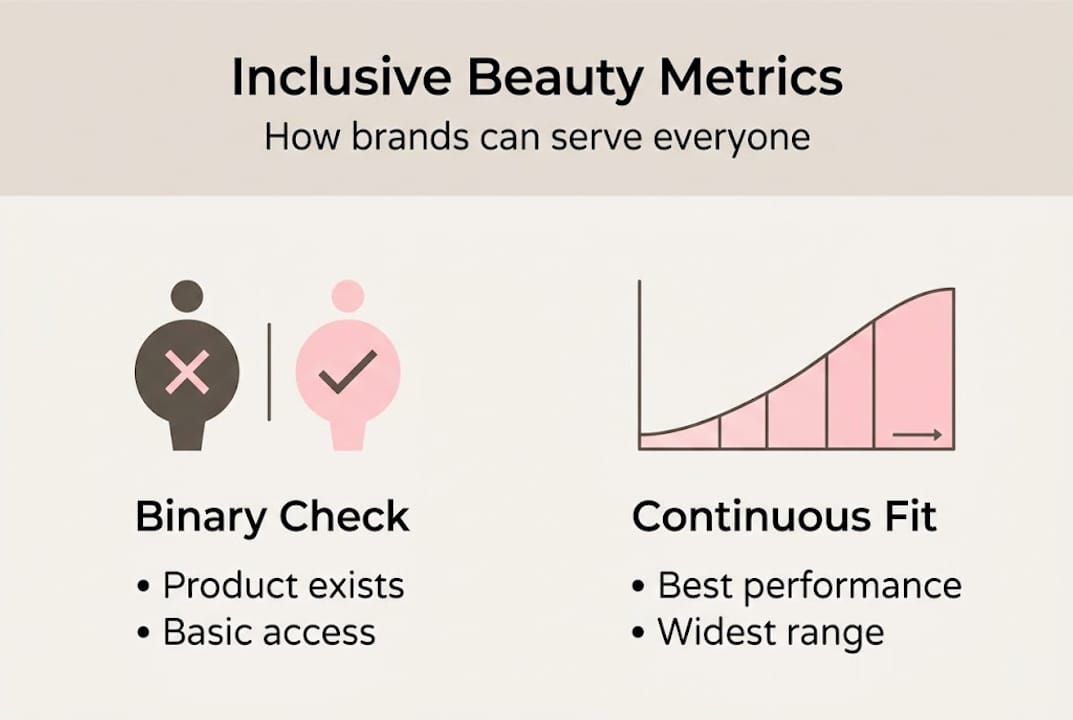
Continuous inclusivity goes further, measuring how well a product performs across the full spectrum of users. A brand might offer 50 foundation shades, but if the lightest 10 and darkest 10 shades have a noticeably different finish quality or formula stability, those edge users are still underserved. Continuous measurement catches this.
Here is a simplified view of how these measurement types apply:
| Metric | Binary measure | Continuous measure |
|---|---|---|
| Shade range | Does it exist for my tone? | How evenly distributed are the shades? |
| Allergy suitability | Is there a fragrance-free option? | How many products meet allergy criteria? |
| Skin type suitability | Does it work for dry skin? | Does it perform equally across all skin types? |
| Ingredient transparency | Is an ingredient list provided? | Are ingredients clearly explained and accessible? |
These frameworks matter because they expose performance gaps that a simple shade count never would. A brand might look inclusive on the surface while quietly failing users with sensitive skin or specific health needs. Looking at a brand’s inclusive operational strategies tells you far more than their advertising ever will.
Pro Tip: When evaluating a brand, look beyond the number of shades or products. Ask whether the brand publishes transparent data about formulation, ingredient sourcing, and suitability for sensitive or reactive skin. Brands that share this information openly are demonstrating real commitment, not performance.
Why inclusivity matters: Wellness, trust, and growth
With measurement in mind, you might wonder: does it really matter if a brand is inclusive? The answer reveals deep links to wellness and values.
When you have sensitive skin, finding a product that works without causing a reaction is not a luxury. It’s a requirement for basic self-care. Inclusive beauty acknowledges this reality. It means that the ritual of applying makeup can be a moment of nourishment rather than a gamble. That shift matters enormously for emotional wellness, not just skin health.
Ingredient transparency is central here. When a brand lists every ingredient clearly and explains what each one does, you can make informed choices without anxiety. For people managing eczema, rosacea, or contact allergies, that transparency is the difference between a product they can trust and one they have to fear. Building inclusive beauty rituals that actually feel safe transforms beauty from a source of stress into a source of joy.

31% of U.S. shoppers would not buy from a brand not committed to DEI. That statistic reflects a real shift in values. Consumers are connecting their purchasing power to their principles, and brands that ignore this lose trust fast.
The business case is compelling, but the wellness case is even stronger. Here’s what truly inclusive brands tend to deliver:
- Ingredient lists that are complete, honest, and easy to read
- Formulas developed with sensitive and reactive skin in mind
- Product ranges that cover diverse skin tones with equal quality
- Clear communication about allergens and potential irritants
- A community culture that welcomes feedback and adapts
When you explore holistic product options rooted in these values, you start to see beauty as something that supports your whole self. That is what genuine inclusivity looks like from the inside out.
Pitfalls and practical tips for spotting real inclusivity
Knowing why inclusivity matters, it’s essential to distinguish genuine efforts from surface-level gestures.
Brands that practice performative inclusivity can add representation to their imagery without fixing the access issues buried in their product formulation. Performative inclusivity adds diversity to visuals but doesn’t guarantee that products are actually safer, more suitable, or more accessible for underserved users. Knowing the difference protects your skin and your values.
Here’s a side-by-side comparison of what real versus performative inclusivity often looks like:
| Area | Performative brand | Genuinely inclusive brand |
|---|---|---|
| Marketing | Diverse models in campaigns | Diverse models AND product testers |
| Formulation | Standard fragrance-heavy formula | Fragrance-free and hypoallergenic options |
| Ingredient list | Vague or partial | Full, clearly explained, allergy-flagged |
| Shade range | Wide range but uneven quality | Wide range with consistent performance |
| Feedback | PR responses to criticism | Active community input into R&D |
You can verify a brand’s real commitment by checking whether their formal inclusivity criteria hold up under scrutiny, not just whether their Instagram grid looks diverse.
Here is a practical numbered checklist you can use before buying:
- Read the full ingredient list. If it’s hard to find or incomplete, that’s a red flag.
- Check for fragrance-free or allergen-safe options in their core line.
- Look for independent reviews from people with sensitive or reactive skin.
- Research how the brand has responded to criticism or calls for improvement.
- Compare their marketing claims directly against their actual product range.
Pro Tip: Comparing self-care product options side by side using this checklist helps you move past brand story and into actual product reality. You can also explore clean beauty brand comparisons to see how ingredient transparency stacks up across different lines.
Why real inclusivity requires listening, not just labels
Having explored how to evaluate brands, here’s an honest perspective on what matters most in building real inclusion.
In our experience building Pure Light Botanical Beauty, we’ve learned that no checklist captures everything. Inclusivity isn’t a certification you earn once. It’s a practice you return to again and again, shaped by the real people using your products. People who have eczema, who have tried dozens of foundations that burned, who have given up on lip color because every formula dried them out.
The brands that actually serve these women are the ones that listen. Not just through surveys but through genuine community dialogue. They change formulas based on feedback. They add options that nobody requested in a focus group but that users needed deeply. Real inclusion comes from staying humble and curious, not from announcing how inclusive you are.
We believe the future of beauty is flexible and user-led. That’s why following someone like our founder’s journey reveals something more honest than any brand manifesto. It shows you a process of learning, adapting, and letting real skin needs lead the way.
Discover truly inclusive beauty that honors your wellness
Ready to move from knowing to doing?
At Pure Light Botanical Beauty, we build every product around the belief that clean, plant-based formulas should work beautifully for sensitive skin without compromise. Our commitment to ingredient transparency, botanical nourishment, and real accessibility isn’t a marketing choice. It’s the foundation of everything we create.
Whether you’re searching for a nourishing lipstick that hydrates as it colors, or exploring what inclusive beauty standards look like when they’re actually lived out, you’ll find products here that were thoughtfully made for you. Your skin, your wellness, your ritual. Explore the full collection and feel the difference that genuine care makes.
Frequently asked questions
How can I tell if a beauty brand is truly inclusive?
Look for full ingredient transparency, a product range suitable for all skin types including sensitive skin, and DEI commitments that show up in product formulation and access, not just in advertising images.
Why does inclusivity matter for sensitive skin and wellness?
It ensures that everyone, especially those with unique sensitivities or conditions, can find products that are safe and effective for all skin types rather than being left without suitable options.
What is performative inclusivity in beauty brands?
It’s when a brand focuses on diverse visuals or campaigns but doesn’t back it up with products that are genuinely accessible. Performative inclusivity adds representation without fixing the real access or formulation gaps.
Are there ways to measure if a brand is inclusive?
Yes. Researchers use both binary and continuous metrics across product lines, and formal inclusivity measures have been tested against real makeup brands to evaluate them objectively beyond marketing claims.
Recommended
- Certified Clean Beauty—Why Ingredient Transparency Matters – Pure Light Botanical Beauty
- Clean Beauty Certification: What It Really Means – Pure Light Botanical Beauty
- Transparency in Beauty – Why It Matters for Sensitive Skin – Pure Light Botanical Beauty
- What Is Mindful Beauty and Why It Matters – Pure Light Botanical Beauty